
Middlesbrough Financial Results 2024/25
- Matchday Finance

- Mar 5
- 12 min read
The 2024/25 season was Middlesbrough’s 149th season in its history and their eighth consecutive season in the Championship.

Middlesbrough have competed in the Championship in 15 of the last 16 seasons, with only the 2016/17 campaign in the Premier League breaking this run. Aside from their promotion season, the club has reached the play-offs just three times during this period, progressing to the final on only one occasion.
In the 2024/25 season, Middlesbrough remained in contention for the play-off places for much of the campaign. However, with just one win in their final five matches, they ultimately finished 10th, only four points outside the play-off spots.
Middlesbrough have enjoyed one of their strongest seasons for several years under new manager Kim Hellberg, who replaced Rob Edwards after his controversial move to Wolves in November. The club currently sits second in the table behind leaders Coventry, but only three points ahead of third-placed Ipswich, setting up what promises to be an exciting—and no doubt stressful—run-in to the end of the season.
Since 1994, the club has been wholly owned by The Gibson O’Neill Company Limited, which is majority owned by local businessman Steve Gibson alongside minority shareholder Mike O’Neill. The company is a diversified group with interests in global transportation, a hotel and golf complex, as well as the football club.

During their time as owners, The Gibson O’Neill Company has invested more than £200 million into the club, primarily to cover operating losses as Middlesbrough have consistently spent in pursuit of a return to the Premier League. This includes the conversion of £148 million of shareholder loans into equity in 2023/24, effectively writing off the debt. Even by the standards of the Championship—where many clubs operate at significant losses—this represents a substantial level of owner support.
In more recent seasons, however, annual losses have reduced to levels more typical of the division. A key driver has been the club’s strong player trading performance, generating more than £60 million in profits over the last three seasons. The club also operates a Category One academy and has produced several notable players, including Djed Spence (Tottenham Hotspur), Marcus Tavernier (Bournemouth), and Middlesbrough midfielder Hayden Hackney.

Middlesbrough Financial Results 2024/25
Turnover increased marginally to £32.5 million in 2024/25, although staff costs rose sharply by 18%. However, the club once again benefited from profitable player trading, generating more than £26 million in profit on player sales. This helped reduce overall losses to £11.4 million.

Financial highlights:
Revenue: Total revenue reached £32.5 million, up £0.3 million from the previous year, driven primarily by higher EFL broadcast distributions under the new Sky Sports deal, offsetting drops in matchday and commercial revenue.
Staff costs: Following several player acquisitions, wages and salaries rose by £5 million to £36.3 million. Player amortisation also increased, from £9.2 million to £11.4 million in 2024/25. Total staff costs reached £47 million, the second highest reported so far and represents 147% of turnover.
Player sales: The club generated £26.3 million from player sales, primarily from the departures of Latte Lath and Jones.
Profit/loss: Middlesbrough reported a loss of £11.4 million, compared with a £12.4 million loss in the previous season. Strong profit from player sales have reduced losses in the last three season.
Net assets: Net assets fell to £2 million from £10 million. The clubs positive assets position is due to the £148 million owner loan converted to equity in 2023/24.
Player trading: Middlesbrough spent £22.6 million on new players, with Whittaker, Conway, Hamilton, Morris, Burgzorg and Borges joining the squad.
Loans and debt: The club has £16 million in related party loans and a bank loan of £11.5 million. These are one the lower debt levels in the division.
Cash Flow: The club recorded an estimated negative operating cash flow of £12 million. It spent £17 million on player signings and £0.4 million on facilities, while receiving £26.4 million from player sales. The resulting net outflow was funded by an additional £4 million in loans.
Financial Outlook
Middlesbrough’s financial outlook will be heavily influenced by whether they achieve promotion to the Premier League this season. If successful, the club would transition to a completely different financial model, with over £120 million in additional revenue effectively guaranteed. However, promotion would also require significant investment in the squad.
Without promotion, the status quo is likely to continue. The club will continue to spend more than it earns from core revenue streams and will remain reliant on player sales to reduce losses. As with most Championship clubs striving for promotion, further owner funding will be required. Steve Gibson has not shown any reluctance to invest, but without promotion, the key question is for how long this support will continue.
Regardless of the promotion outcome, we expect this season’s financial results to be broadly in line with 2024/25. Revenue growth is likely to be marginal, costs are unlikely to fall, but player trading should again generate healthy profits. As a result, a loss in the region of £10–15 million would be expected, with the potential for higher costs in the event of promotion due to squad bonuses.
Turnover
Key revenue sources include matchday income (ticket sales), central broadcasting distributions from the EFL, Premier League solidarity payments, and commercial income such as sponsorships, merchandising, and other business activities.
Revenue has grown steadily over the past five seasons, a trend that continued in 2024/25, driven primarily by higher broadcasting income.

Middlesbrough are one of larger clubs in the division and are likely to rank in the top half for revenue. Eleven clubs have published results so far; the chart below compares these figures with estimated revenues for the remaining clubs, placing Middlesbrough 10th overall.

Matchday Revenue
Matchday revenue is influenced by factors such as the number of home games, average attendance, ticket prices, and the club's ability to generate income from hospitality events and corporate boxes. The only exception to this is domestic cup matches, where revenue is shared between the clubs and the FA.
Middlesbrough have played at the Riverside Stadium since leaving their former home, Ayresome Park, in 1995.

The Riverside Stadium has a capacity of 33,746, making it the fourth-largest in the division, and is owned outright by the club. In the 2024/25 season, Middlesbrough averaged 25,416 supporters per league match, representing 73% of total capacity—slightly below the previous season’s attendance levels.

Middlesbrough's average attendance was the eighth highest in the league.

The club participated in five fewer domestic cup matches than the previous year, when they reached the semi-final of the Carabao Cup. Combined with a slight decline in average league attendance, the total number of paying fans fell by 14%.
Average revenue per fan also dipped slightly to £15.27, likely reflecting the absence of high-value cup fixtures the prior season, and remaining close to the Championship average.
Taken together, these factors saw matchday revenue decline from £10.9 million to £9.4 million in 2024/25.

Middlesbrough’s matchday revenue is likely to rank around seventh in the league,

There are no plans to expand the Riverside, and with stadium utilisation around 75%, the focus is likely to remain on increasing revenue per fan through enhanced hospitality and an improved matchday experience.
Broadcast Revenue
The new EFL domestic broadcasting agreement with Sky has increased central distributions to Championship clubs. The structure comprises a basic award of approximately £4.5–£5.0 million per club, facility fees for televised matches and merit payments linked to final league position. In aggregate, central distributions now total approximately £5.5–£6.5 million per club, compared with roughly £4.0 million in the prior year.
In addition, Championship clubs receive Premier League solidarity payments of approximately £5 million, alongside any prize money generated through domestic cup competitions. As a result, Middlesbrough’s total broadcast revenue increased to £12.2 million for the year, up from £9.7 million in 2023/24.

Revenue distribution within the Championship remains heavily distorted by the Premier League’s parachute payment system. Clubs relegated from the Premier League receive 55% of the Premier League equal-share distribution in year one, 45% in year two, and — if they had been in the Premier League for more than one season — 20% in year three.
Due to the recent “yo-yo” effect between the two divisions, only four clubs received parachute payments in 2024/25. The three clubs relegated from the Premier League each received approximately £50 million in year-one payments, while Leeds United, in their second Championship season, received approximately £45 million.

Commercial Revenue
Commercial revenue includes sponsorships, retail merchandising, and other commercial activities. In the 2024/25 season, the club’s principal front-of-shirt sponsor was Scandinavian betting company Unibet, with holiday letting company Host & Stay on the back of the shirt, and online homeware company BOXT sponsoring the sleeve.
Total commercial revenue fell from £11.7 million to £10.9 million in 2024/25. The decline is likely attributable to fewer matches compared with the previous season, which featured the club’s strong Carabao Cup run.

Middlesbrough’s commercial revenue is likely to be above average for the division, estimated to rank eighth.

Staff Costs
Staff costs encompass salaries and wages for all employees, the amortisation of player transfer fees (spreading a player’s acquisition cost over the length of their contract), and any impairments, recognised when a player’s estimated market value falls below their book value.
Salaries and wages increased sharply from £31.4 million to £36.4 million, a rise of around 16%, largely reflecting new player recruitment.
With over £22 million invested in player acquisitions, the squad’s book value increased, leading to amortisation rising from £9.2 million to £11.5 million in 2024/25.


Compared with other clubs that have published results, Middlesbrough’s total staff costs of £47.8 million are the second-highest, behind only Norwich City. It should be noted that none of the clubs receiving parachute payments have released their results yet; these are expected to be significantly higher. Based on estimates, Middlesbrough’s staff costs are likely to rank eighth in the division.
With the club finishing 10th, their on-field performance relative to wage expenditure remains broadly on par, as it was the previous season.

Middlesbrough’s staff costs are equivalent to 147% of turnover, creating clear profitability challenges unless the club can generate profits from player sales—a feat they have achieved in each of the last three seasons.
While Middlesbrough’s ratio is high, it ranks only fourth among the eleven clubs that have published accounts, with Hull topping the list at a remarkable 182%. Like Boro, Hull also benefited from significant player sales.
As illustrated below, this highlights a structural challenge across the Championship, as only one club so far—relegated Plymouth—has staff costs below turnover.

Profit on Player Sales
As mentioned, Middlesbrough have been very successful in generating profits from player sales in recent seasons, both through the output of their Category One academy and shrewd player acquisitions. The most notable departure last season was Emmanuel Latte Lath, who joined Atlanta United in the US for around £18 million, having been purchased from Italian club Atalanta for just £5 million only 18 months earlier. Academy graduate Isaiah Jones also contributed to the total £26.3 million in player trading profits.

Of the eleven Championship clubs that have published their results, Middlesbrough recorded the second-highest player sales profits, behind only Hull.
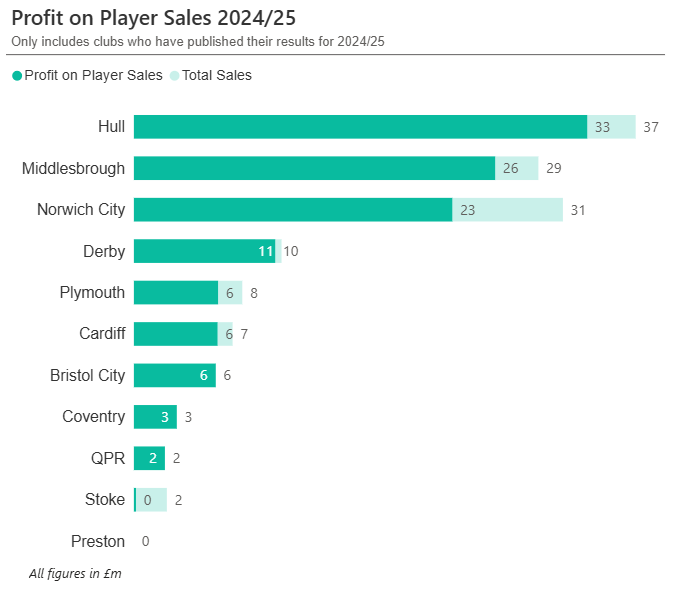
The club will once again generate strong profits this season, with the sales of Finn Azaz, Rav van den Berg, and Josh Coburn expected to bring in an estimated £20 million.
It is a delicate balancing act for Championship clubs—selling key players profitably to help fund higher wages. Based on the club’s performance this season, Middlesbrough appear to be managing this balance well.
Profit and Loss
Since Premier League parachute payments ended in 2019/20, the club has consistently operated with staff costs exceeding turnover. As a result, significant losses are inevitable unless players are sold. In the immediate years following 2019/20, Middlesbrough generated limited profits from player sales and faced constrained revenue due to COVID-19, leading to cumulative losses of £85 million over three seasons. Since then, losses have been reduced through a highly effective player trading model, leveraging both home-grown talent and smart acquisitions.
Unless there is a major change, such as promotion to the Premier League—which the club is currently well placed to achieve—Middlesbrough will continue to rely on player sales to mitigate losses.
Ultimately, all losses must be funded, most likely by the owner, who to date has supported the club to the tune of around £200 million.

In 2024/25, total revenue of £32.5 million increased by £0.2 million year-on-year, while salaries and wage costs rose by £5 million and other operating expenses by £0.2 million. As a result, EBITDA (earnings before interest, tax, depreciation, and amortisation) declined by £4.9 million to a negative £22 million.
After accounting for £14.7 million in player amortisation and depreciation, the club reported an operating loss of £36.7 million. This is a substantial figure, surpassed so far this season only by Norwich and Hull. Very few Championship clubs have recorded operating profits in recent seasons (none in 2023/24), highlighting the division’s heavy reliance on player trading to mitigate losses.
For Middlesbrough, player sales generated £26.3 million in profits in 2024/25—their highest in recent seasons—reducing overall losses to £11.4 million, a slight improvement on the previous season’s £12.4 million deficit.
Most Championship clubs also operate at a loss. In 2023/24, only four clubs reported a profit, all driven by player sales, with the average loss per club around £13 million. Early results for 2024/25 show a similar pattern, with only Plymouth avoiding a real loss.
Stoke City reported a £60 million profit; however, this was due to a £90 million loan write-off (following a £120 million write-off three seasons earlier), which had no impact on cash or operating profits. Excluding this adjustment, the club would have recorded a £30 million loss.
Relegated Cardiff City posted the largest loss, totalling £35 million.

Unless the club earns promotion, opportunities to grow revenue significantly are limited, and reducing staff wages could negatively impact on-field performance. As a result, player trading remains the primary lever available to help mitigate losses.
In the meantime, the club remains fully reliant on owner funding to cover these deficits,
Net Assets
Net assets represent the difference between total assets and total liabilities and correspond to the club’s net equity.
Assets include fixed assets—such as player registrations, facilities, and goodwill—as well as current assets like trade debtors, transfer fees receivable, and cash.
Liabilities comprise loans (from banks, shareholders, or group companies), transfer fees payable, trade creditors, deferred income (for example, advance season ticket sales), and other financial provisions.
Prior to 2023/24, the club was primarily funded through loans from their parent company and ultimate owner, Steve Gibson. Outstanding loans amounted to £150 million, leaving the club with a substantial net liability position. In 2023/24, £148 million of debt was converted to equity, significantly strengthening the balance sheet.
In 2024/25, Middlesbrough reported net assets of £2 million, down from £10 million the previous year. The club’s assets are primarily its squad, with a net book value of £26 million, and its facilities, including the Riverside Stadium, recorded at £52 million. These are offset by £28 million in loans, £25 million in outstanding transfer commitments, and other liabilities and provisions.


It is not unusual for Championship clubs to report net liabilities, as Middlesbrough did prior to 2022/23, since many rely on owner funding to operate. Based on the latest available accounts, 13 Championship clubs reported net liabilities.

In practice, shareholder loans are rarely repaid in cash and are typically converted into equity over time.
Player Trading
Middlesbrough have invested heavily in their squad over the past three seasons, while also recouping much of this expenditure through player sales.
In 2024/25, the club spent £22.6 million on new signings, including Morgan Whittaker from Plymouth, Tommy Conway from Bristol City, Micah Hamilton from Manchester City’s U21 team, Aidan Morris from Columbus Crew, Delano Burgzorg from Mainz, and Neto Borges from Clermont Foot.
The club again recovered all of this outlay, with the sales of Emmanuel Latte Lath to Atlanta United and Isaiah Jones to Luton accounting for the bulk of £29.5 million in player trading profits.
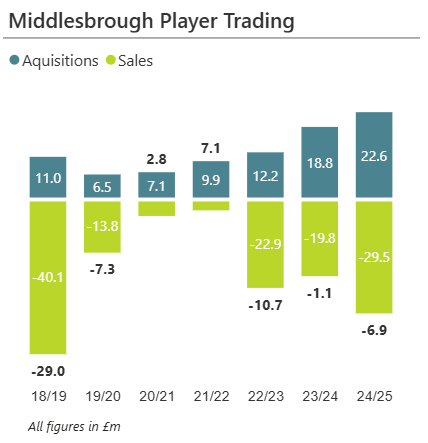
The club’s £22.6 million in spending is the third-highest reported so far this season. In terms of net trading (acquisitions minus sales), Middlesbrough have the largest trading net gain, totalling £6.9 million.

Squad Net Book Value
The squad’s Net Book Value (NBV) represents the total acquisition cost of players less accumulated amortisation, with transfer fees expensed over the length of each player’s contract. Following the season’s investment, Middlesbrough's Net Book Value increased to £25.5 million, up from £17.5 million in the previous year. This is likely to be in the top 10 squad book values reported this season.

Football Net Debt
Football net debt reflects the total amount a club owes to external parties. This includes bank loans (after deducting cash holdings), funding from owners, loans from related entities such as a parent company, and outstanding transfer fees owed to other clubs, minus any transfer fees the club is due to receive.
As mentioned, in 2023/24 £148 million in loans owed to the parent company were converted to equity, effectively writing off the amount.
At the end of the 2024/25 season, Middlesbrough reported £16 million in outstanding loans to related parties, in addition to a bank loan of £11.5 million.
Owner Steve Gibson also lent the club £15 million during the season to support working capital, which has since been repaid.
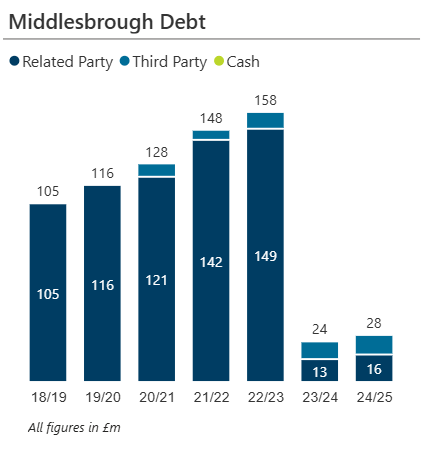
Based on the clubs that have published 2024/25 figures to date, Middlesbrough’s debt is among the lowest reported. It should be noted that Stoke City reported no debt, following a £90 million loan write-off as part of an ownership change.

Following Middlesbrough’s investment in new players in recent seasons, the club currently has £22.8 million in outstanding transfer fees. This is partly offset by £14.7 million owed to them from player sales. It is standard practice for clubs to structure transfer payments over multiple years.

Cash Flow
Cash Flows are reported in three categories:
Cash Flows from Operations refer to cash generated from the club’s core activities—revenue minus day-to-day costs such as salaries, rent, and utilities.
Cash Flows from Investments include cash spent on player acquisitions and facility improvements, net of player or asset sales.
Cash Flows from Financing cover new loans or equity raised, less repayments or buybacks. If operational cash flow cannot fund investments, the shortfall is usually met through financing.
Middlesbrough’s cash position reflects a combination of operating outflows—since day-to-day costs significantly exceed revenue—substantial investment in the squad, and strong player sales, with the remaining gap funded by the parent company.
The club does not publish a separate cash flow statement for the football operations. Based on our estimates over the last five years, operating cash outflows total approximately £62 million. During this period, the club spent £56 million on players, very little on facilities, and recovered £67 million from player sales. The resulting gap of around £50 million has been covered by additional loans, while £148 million has been converted to equity.

Reporting Entity
This analysis is based on Middlesbrough Football & Athletic Company (1986) Limited. This entity is owned by The Gibson O'Neill Company Limited of which is 75% owned by Steve Gibson.


Comments