
Millwall Financial Results 2024/25

Millwall’s 2024/25 season marked the club’s 140th year in existence and their eighth consecutive campaign in the Championship.

The season itself was one of two halves. Following a poor run of results, Neil Harris left the club after just 11 months in charge in his second spell at the club. Alex Neil took over in January and oversaw a strong run of form that ultimately saw Millwall finish eighth, narrowly missing out on the play-off places.
This season under Neil, Millwall are enjoying their best campaigns in many years. They currently sit third in the table, just outside the automatic promotion places and 14 points clear of seventh, meaning a play-off place at minimum now looks highly likely. If maintained, this would represent the club’s highest league finish in more than 30 years and could offer the opportunity to return to the top flight for the first time since 1990.
The club is majority owned by James Berylson through the investment vehicle Chestnut Hill Ventures, which controls around 94% of Millwall Holdings Limited. James’ father, British-born US businessman John Berylson, first invested in the club in 2006 when Millwall was facing financial difficulty and became the majority owner in 2007. Following John’s death in 2023, James assumed the role of chairman and controlling owner.

Since acquiring the club, the Berylson family has invested in the region of £120 million. While this is a substantial sum, it is far from unusual in the Championship, where owner funding is often required to sustain competitiveness. Clubs such as Stoke City, Bristol City, Preston North End, Middlesbrough and Birmingham City have all injected even larger amounts over similar periods.
Investment has increased in recent years, with more than £70 million provided over the past five seasons. Whilst Millwall are another example of a Championship club reliant on shareholder funding, the club is generally seen as well run, with the owners popular among the fan base. For a club of this size, losses are inevitable if it wants to compete in the Championship.
Funding continued in 2024/25, although the club effectively broke even thanks to profits from player sales, most notably academy graduate Romaine Esse and Zian Fleming. As a result, Millwall are only the second club (of the 12 Championship clubs to have published accounts so far) to avoid reporting a loss. Stoke City reported a profit of around £60 million, although this was largely the result of a £90 million shareholder loan write-off.

Millwall Financial Results 2024/25
Turnover increased marginally to £23.9 million in 2024/25, although staff costs rose sharply by 18%. However, the club benefited from profitable player trading, generating more than £21 million in profit on player sales. This helped reduce losses to just £0.3 million.

Financial highlights:
Revenue: Total revenue reached £23.9 million, up £2.4 million from the previous year, driven primarily by higher EFL broadcast distributions under the new Sky Sports deal, plus an increase in commercial revenue.
Staff costs: Following several player acquisitions, wages and salaries rose by £3.1 million to £28.6 million. Player amortisation also increased, from £3.4 million to £5.4 million in 2024/25. Total staff costs reached £34.2 million, the eighth highest reported so far and represents 143% of turnover.
Player sales: The club generated £21.6 million from player sales, primarily from the departures of Esse and Flemmings.
Profit/loss: Millwall reported a loss of £0.3 million, a big improvement from the £19.1 million loss the previous season. This turnaround is primarily due to profit from player sales.
Net assets: Net assets increased to £18 million from £2 million. The clubs' positive assets position is mainly due to their owner funding being provided as equity as appose to debt.
Player trading: Millwall spent £14.5 million on new players, with Neghli, Ivanovic, Cundle, and the late season signing of Josh Coburn joining the club.
Loans and debt: The club has £10 million in related party loans. This is one the lower debt levels in the division.
Cash Flow: The club recorded a negative operating cash flow of £15.8 million. It spent £14.5 million on player signings and £7.4 million on facilities, while receiving £21.7 million from player sales. The resulting net outflow was funded by an additional £15.7 million in equity.
Financial Outlook
Millwall’s financial outlook will be shaped largely by whether they secure promotion to the Premier League this season. Promotion would move the club into a completely different financial environment, with more than £120 million in additional revenue effectively guaranteed through broadcasting distributions and other central payments. However, reaching the Premier League would also require significant investment in the playing squad.
If promotion is not achieved, the current financial model is likely to continue. The club will remain reliant on owner support and player trading, as operating costs continue to exceed core revenues, which is typical of Championship clubs.
Regardless of the outcome on the pitch, the club’s financial results for this season are likely to show to a loss. Revenue growth is expected to be modest and there is little indication that operating costs will decline, although player sales will again generate some profits. Overall, a loss in the region of £10–15 million would be a reasonable expectation, with the possibility of higher costs should promotion be achieved due to promotion-related bonuses.
Turnover
Key revenue sources include matchday income (ticket sales), central broadcasting distributions from the EFL, Premier League solidarity payments, and commercial income such as sponsorships, merchandising, and other business activities.
Revenue has grown steadily over the past five seasons, a trend that continued in 2024/25, largely driven by increased broadcasting income.

To date, twelve clubs have published their financial results. The chart below compares Millwall’s reported figures with published results and our revenue estimates for the remaining teams. Millwall are one of the smaller clubs in the division and are likely to rank towards the bottom of the league, mainly due to their commercial revenue, which is among the lowest in the Championship.

Matchday Revenue
Matchday revenue is influenced by factors such as the number of home games, average attendance, ticket prices, and the club's ability to generate income from hospitality events and corporate boxes. The only exception to this is domestic cup matches, where revenue is shared between the clubs and the FA.
Millwall have played at the Den since leaving their former home, The Old Den, in 1994.

The Den, which is owned by the club, has a capacity of 20,146, making it the fifth-smallest stadium in the division. In the 2024/25 season, Millwall averaged 15,497 supporters per league match, representing 77% of total capacity. This was below the previous season’s average of 16,554, which the club says was due to lower season ticket sales (of which they have around 8,000), likely linked to performance after finishing 13th
in 2023/24.
Being based in London, competition for supporters is high, but even with the slight drop in 2024/25, these are the highest attendances the club has recorded for more than 70 years.

Millwall's average attendance was the third lowest in the league.

The club played three additional domestic cup matches compared with the previous season, where revenues are shared. This helped offset the drop in average league attendance, resulting in the total number of paying fans increasing slightly by 1%.
Being based in London, Millwall have one of the highest yields in the division. In 2024/25, their average revenue per fan dipped to £18.40, down from £19.30, but this remains well above the division average of around £15.50.
Taken together, these factors saw matchday revenue decline slightly from £7.5 million to £7.3 million in 2024/25.

Millwall’s matchday revenue is likely to rank around twelfth in the league,

Millwall made plans to redevelop The Den and the surrounding area, which were approved in 2022. The proposals include increasing the stadium’s capacity to 34,000 and constructing 3,500 homes on the land around the ground. The club was recently granted a 999-year lease on the surrounding land, giving them the rights to begin the development if they choose.
Broadcast Revenue
The new EFL domestic broadcasting agreement with Sky has increased central distributions to Championship clubs. The structure comprises a basic award of approximately £4.5–£5.0 million per club, facility fees for televised matches and merit payments linked to final league position. In aggregate, central distributions now total approximately £5.5–£6.5 million per club, compared with roughly £4.0 million in the prior year.
In addition, Championship clubs receive Premier League solidarity payments of approximately £5 million, alongside any prize money generated through domestic cup competitions. As a result, Millwall's total broadcast revenue increased to £12.6 million for the year, up from £11.0 million in 2023/24.

Revenue distribution within the Championship remains heavily distorted by the Premier League’s parachute payment system. Clubs relegated from the Premier League receive 55% of the Premier League equal-share distribution in year one, 45% in year two, and — if they had been in the Premier League for more than one season — 20% in year three.
Due to the recent “yo-yo” effect between the two divisions, only four clubs received parachute payments in 2024/25. The three clubs relegated from the Premier League each received approximately £50 million in year-one payments, while Leeds United, in their second Championship season, received approximately £45 million.

Commercial Revenue
Commercial revenue covers sponsorships, retail merchandising, and other commercial activities. In the 2024/25 season, the club’s main front-of-shirt sponsor was payments platform MyGuava, with property and construction company The Wigget Group featured on the back. The kit was supplied by Errea.
In 2023/24, Millwall had the smallest commercial revenue in the division at just £2.9 million. This improved in 2024/25, rising to £4 million, but still ranked among the lowest in the league. Part of the increase came from retail sales, which grew by 13%.

Millwall's commercial revenue is likely to be second lowest, ahead of only Preston North End.

Staff Costs
Staff costs encompass salaries and wages for all employees, the amortisation of player transfer fees (spreading a player’s acquisition cost over the length of their contract), and any impairments, recognised when a player’s estimated market value falls below their book value.
Salaries and wages rose sharply from £25.6 million to £28.6 million, an increase of around 12%, primarily reflecting new player signings and a change in management.
With over £14 million invested in player acquisitions, the squad’s book value increased, pushing amortisation up from £3.4 million to £5.6 million in 2024/25.


Compared with the eleven other clubs that have published results, Millwall’s total staff costs of £34.2 million rank as the eighth-highest. It should be noted that none of the clubs receiving parachute payments have released their results yet; these are expected to be significantly higher. Based on estimates, Millwall’s staff costs are likely to rank around 15th in the division once all results are published.
With the club finishing 8th, this suggests they outperformed their staff cost budget by a considerable margin—an efficiency that has likely continued into the current season.

Millwall’s staff costs are equivalent to 143% of turnover, creating clear profitability challenges unless the club can generate profits from player sales—something they achieved in 2024/25.
While Millwall’s ratio is high, it ranks only seventh among the twelve clubs that have published accounts, with Hull topping the list at an extraordinary 182%.
As illustrated below, this underscores the structural challenge across the Championship, as only one club so far—relegated Plymouth—has staff costs below turnover.

Profit on Player Sales
Prior to 2024/25, Millwall had generated very little income from player sales. However, two notable departures—Romaine Esse and Zian Flemmings—brought in £21.6 million in 2024/25. The sale of Esse was particularly significant, as he was an academy graduate who had been with the club since the age of nine.

Of the twelve Championship clubs that have published their results, Millwall recorded the fourth-highest player sales profits.

The club is set to generate further profits this year with the sale of Japhet Tanganga, who joined just one year ago on a free transfer and was sold to Sheffield United for £5 million.
Profit and Loss
Like almost all Championship clubs, Millwall have operated at a significant loss in recent seasons. Prior to 2024/25, losses over the preceding five years averaged £12 million per season. The club earned very little from player sales during that period, whereas in 2024/25 they generated £21 million, effectively bringing them close to a break-even position. This again highlights the importance of player sales in managing losses.
Ultimately, all losses must be funded—most likely by the owner. In Millwall’s case, the owner has contributed around £70 million over the past five years, which is roughly average for the division.

In 2024/25, total revenue of £23.9 million rose by £2.4 million year-on-year, while salaries and wages increased by £3.1 million and other operating expenses by £0.2 million. As a result, EBITDA (earnings before interest, tax, depreciation, and amortisation) fell by £0.4 million to a negative £13.9 million.
After accounting for £6.5 million in player amortisation and depreciation, the club reported an operating loss of £20.4 million—their highest in recent seasons. Very few Championship clubs have recorded operating profits in recent years (none in 2023/24), underscoring the division’s heavy reliance on player trading to offset losses.
For Millwall, player sales generated £21.6 million in profits in 2024/25, reducing overall losses to just £0.3 million—a significant improvement on the previous season’s £19.1 million deficit.
Most Championship clubs operate at a loss. In 2023/24, only four clubs reported a profit, all driven by player sales, with the average loss per club around £13 million. Early results for 2024/25 show a similar pattern, with only Plymouth, and now Millwall avoiding a substantial loss
Note, Stoke City reported a £60 million profit; however, this was due to a £90 million loan write-off (following a £120 million write-off three seasons earlier), which had no impact on cash or operating profits. Excluding this adjustment, the club would have recorded a £30 million loss.
Relegated Cardiff City posted the largest loss, totalling £35 million.

Unless Millwall earns promotion, opportunities to grow revenue significantly are limited, and reducing staff wages could negatively impact on-field performance. As a result, player trading remains the primary lever available to help mitigate losses.
In the meantime, the club remains fully reliant on owner funding to cover these deficits,
Net Assets
Net assets represent the difference between total assets and total liabilities and correspond to the club’s net equity.
Assets include fixed assets—such as player registrations, facilities, and goodwill—as well as current assets like trade debtors, transfer fees receivable, and cash.
Liabilities comprise loans (from banks, shareholders, or group companies), transfer fees payable, trade creditors, deferred income (for example, advance season ticket sales), and other financial provisions.
In 2024/25, Millwall reported net assets of £18 million, up from £2 million the previous year. The club’s main assets are its playing squad, with a net book value of £13 million (up from £9 million following player acquisitions), and its facilities, including The Den, which are recorded at £24 million (up £7 million after investment in infrastructure, primarily pitch renovations at the Calmont Road training ground).
These assets are offset by £12 million in loans and £21 million in other liabilities and provisions.


The club has been funded primarily through share issues, which avoids large debt liabilities sitting on the balance sheet and has helped maintain a positive net asset position. This is not the case for many Championship clubs, which often carry significant debt liabilities, usually owed to their owners, and therefore report a net liability position. Based on the latest available accounts, 13 Championship clubs reported net liabilities.
In practice, owner loans are rarely repaid in cash and are typically converted into equity over time.

Player Trading
Prior to 2023/24, Millwall’s squad had largely been built through free transfers, loan players and talent developed through the club’s academy. Over the previous five years, the club had one of the lowest levels of transfer spending in the Championship.
However, during the 2024/25 season the club became more active in the transfer market, investing £14.5 million in new players. Key signings included Camiel Neghli from Sparta Rotterdam, Mihailo Ivanovic from Serbian club Vojvodina, Luke Cundle from Wolves and Femi Azeez from Reading. They also signed Josh Coburn from Middlesbrough at the end of the season, following a loan spell, for a club-record fee of around £5 million.
The club also made two high-value player sales during the year, something not seen in recent seasons, generating £21.6 million in transfer income. Academy graduate Romain Esse was sold to Crystal Palace for a reported £12 million, while Zian Flemming moved to Burnley at the end of the season.

The club’s £14.5 million in transfer spending is the fifth-highest reported in the Championship so far this season. In terms of net player trading (acquisitions minus sales), Millwall recorded the largest net gain, totalling £7.2 million.

Squad Net Book Value
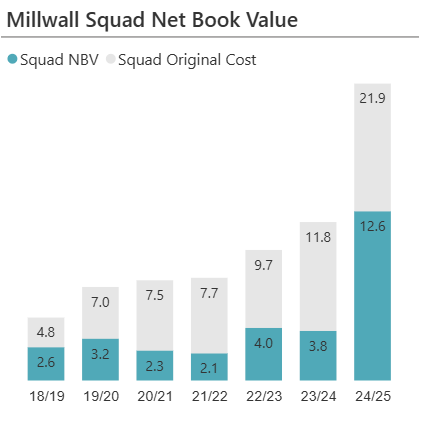
The squad’s Net Book Value (NBV) reflects the total cost of player acquisitions minus accumulated amortisation, with transfer fees spread over the length of each player’s contract. Following the season’s investment, Millwall’s NBV rose to £12.6 million, up from £3.8 million the previous year. Despite this increase, it remains likely one of the smallest squad book values in the Championship this season.
Football Net Debt
Football net debt reflects the total amount a club owes to external parties. This includes bank loans (after deducting cash holdings), funding from owners, loans from related entities such as a parent company, and outstanding transfer fees owed to other clubs, minus any transfer fees the club is due to receive.
While the club has relied on significant owner funding to cover operating losses, this support has primarily been provided as equity, keeping overall debt levels relatively low.
At the end of the 2024/25 season, Millwall reported £9 million in outstanding convertible loan notes owed to their parent company, Chestnut Hill Ventures.

Based on the clubs that have published 2024/25 figures so far, Millwall’s debt is among the lowest in the Championship. It should be noted, however, that Stoke City reported no debt following a £90 million loan write-off as part of an ownership change.

Cash Flow
Cash Flows are reported in three categories:
Cash Flows from Operations refer to cash generated from the club’s core activities—revenue minus day-to-day costs such as salaries, rent, and utilities.
Cash Flows from Investments include cash spent on player acquisitions and facility improvements, net of player or asset sales.
Cash Flows from Financing cover new loans or equity raised, less repayments or buybacks. If operational cash flow cannot fund investments, the shortfall is usually met through financing.
Millwall’s cash flow follows a pattern common among Championship clubs. Large operating cash outflows. Investments in players and assets, typically offset by player sales. This leaves a large cash shortfall with is funded through new owner investment.
Over the past five years, operating cash outflows totalled approximately £63 million. During this period, the club spent £25 million on player acquisitions and £12 million on facilities, while generating £26 million from player sales. The resulting shortfall of around £70 million was covered by £73 million raised through new share issues.

Reporting Entity
This analysis is based on Millwall Holdings Limited This entity is 94% owned by Chestnut Hill Ventures, which is controlled by James Berylson.


Comments