
Queens Park Rangers Financial Results 2024/25

The 2024/25 campaign was the 143rd season in Queens Park Rangers’ history and their tenth consecutive year in the Championship.

QPR have a proud footballing heritage, having been an established top-flight club throughout the 1980s and early 1990s. The club last competed in the Premier League in 2014/15 and have since played in the Championship, where they have largely occupied mid-table positions having not reached the play-offs during this ten-year period.
The 2024/25 season was a story of three parts. A very poor start — with just one win in the opening 15 matches — left the club bottom of the table. However, a strong post-Christmas run of eight wins in 12 games pushed QPR into 10th place and within reach of the play-off positions. This run of form proved unsustainable, and a subsequent downturn saw the club finish the season in 15th place.
This season, under new manager Julien Stéphan — who replaced Martí Cifuentes at the end of last season — the club has once again occupied a mid-table position. At the time of this report, QPR sit 13th in the Championship, but just four points outside the play-off places.
Off the pitch, the club has experienced a turbulent financial history. During QPR’s last spell in the Premier League, the club was owned by a consortium, including Malaysian businessman and AirAsia founder Tony Fernandes, who invested heavily in an effort to establish the club in the top tier. The strategy ultimately proved unsustainable. Relegation for a second time in 2015 followed three seasons in which the club accumulated losses in excess of £100 million and breached EFL Financial Fair Play regulations.
In 2018, QPR reached a settlement with the EFL, agreeing to pay a £42 million fine — one of the largest in history. The settlement was structured over multiple years and continues to impact the club’s cash flow, with approximately £6.2 million still payable to the league.
Since that period, Malaysian businessman Ruben Gnanalingam has increased his stake and now controls 79% of the club through Total Soccer Growth Holdings. The Mittal family retain a minority interest, alongside American investor Richard Reilly. Tony Fernandes exited fully in 2018.
Under the current ownership, QPR have stabilised operationally as a mid-table Championship club, generating mid-range divisional revenues while operating with a lower-half staff cost base. However, consistent with much of the division, the club remains structurally loss-making. Over the past five years, ownership has injected approximately £100 million in additional funding, around £30 million of which has been directed towards infrastructure investment. Last season alone, the club lost £20.1 million and required a further £18 million in new loans.
This highlights the structural challenge of the Championship model: even clubs operating with controlled wage structures and mid-tier revenues continue to generate material losses without significant player trading gains.

QPR Financial Results 2024/25

Financial highlights:
Revenue: Total revenue reached £28 million, up £2.2 million from the previous year, driven primarily by higher EFL broadcast distributions under the new Sky Sports deal.
Staff costs: Following several player acquisitions, wages and salaries rose by £4 million to £27.4 million. Player amortisation also increased, from £1.6 million to £2.4 million in 2024/25. Total staff costs reached £30 million, which remains one of the lower cost bases in the league.
Player sales: The club generated £2.2 million from player sales, primarily from the departures of Armstrong and Dykes.
Profit/loss: QPR reported a loss of £20.1 million, compared with a £13.5 million loss in the previous season. This is the second highest loss out of the seven clubs who have published 2024/25 results.
Net assets: Net assets fell to negative £71 million following a further net increase in shareholder loans. £13.5 million of loans were converted to equity during the year.
Player trading: QPR spent £10 million on new players—the highest investment in recent years—with Madsen, Celar, and Varane joining the squad.
Loans and debt: Convertible shareholder loans increased by a net £5 million, raising total debt to £107 million, one of the highest in the division.
Cash Flow: The club recorded negative operating cash flows of £12 million. It spent £6 million on player signings and £1.4 million on facilities, while receiving £1.8 million from player sales. The resulting net outflow was funded by an additional £18 million owner loan.
Financial Outlook
The structural challenges of competing in the Championship without the benefit of Premier League parachute payments are clearly evident in QPR’s financial results. Despite generating mid-tier revenues and operating with relatively modest wage levels, the club continues to incur annual losses in the region of £15–20 million. A key issue has been the limited contribution from player trading to offset these structural deficits.
The club has stated that it is “in the process of fine-tuning our player trading model, which forms the largest component of our financial planning strategy to adhere to the League’s financial regulations as well as advancing the core objectives of the Club, i.e. financial self-sustainability.”
At present, however, QPR remains some distance from achieving self-sustainability and is wholly reliant on continued owner funding. Part of the longer-term strategy centres on academy development, with the club expressing its intention to apply for Category One status (currently Category Two). Achieving Category One status would represent a significant step, enabling participation in the highest level of U21 competitions.
In the near-term, however, losses are likely to persist, meaning continued reliance on shareholder funding. There appears limited opportunity for revenue expansion and cutting staff wages risks undermining performance. Consequently, player sales may be necessary to maintain compliance with EFL rules.
Turnover
Key revenue sources include matchday income (ticket sales), central broadcasting distributions from the EFL, Premier League solidarity payments, and commercial income such as sponsorships, merchandising, and other business activities.
Revenue has grown steadily over the past five seasons, a trend that continued in 2024/25, driven mainly by increases broadcast income.

QPR remain one of the smaller clubs in the division and are likely to rank in the lower half for revenue. With only seven clubs having published results so far, the chart below compares these figures with estimated revenues for the remaining clubs, placing QPR 15th overall.

Matchday Revenue
Matchday revenue is influenced by factors such as the number of home games, average attendance, ticket prices, and the club's ability to generate income from hospitality events and corporate boxes. The only exception to this is domestic cup matches, where revenue is shared between the clubs and the FA.
Queens Park Rangers’ stadium, currently known as the MATRADE Loftus Road Stadium, has been the club’s home for over a century. The ground has a capacity of 18,439 and is owned outright by the club. In the 2024/25 season, QPR averaged 15,656 supporters per league match, equating to 86% of total capacity, slightly below the previous season’s attendance levels.

QPR have the fourth-smallest stadium in the Championship and recorded the fifth-lowest average attendance in the division.

Average revenue per fan remained flat at £17.60, representing one of the higher yields in the Championship, largely reflecting the club’s West London location. Although QPR hosted two additional cup fixtures during the season, the incremental attendance from these matches was offset by a decline in average league attendances. As a result, matchday revenue fell marginally from £6.9 million to £6.8 million.

QPR’s matchday revenue is likely to rank toward the lower end of the Championship. However, among the clubs that have reported to date, it remains ahead of both Plymouth and Preston.

Loftus Road retains a traditional, “old school” character but occupies a relatively small footprint in a densely populated residential area of West London, limiting expansion potential and non-matchday commercial development. The club has explored options for a new stadium site, though land availability is scarce. While several potential locations have been discussed publicly, no formal plans are currently in place.
The club has however continued to invest in infrastructure, with the first phase of redevelopment at the Heston Sports training ground now complete.
Broadcast Revenue
The new EFL domestic broadcasting agreement with Sky has increased central distributions to Championship clubs. The structure comprises a basic award of approximately £4.5–£5.0 million per club, facility fees for televised matches and merit payments linked to final league position. In aggregate, central distributions now total approximately £5.5–£6.5 million per club, compared with roughly £4.0 million in the prior year.
In addition, Championship clubs receive Premier League solidarity payments of approximately £5 million, alongside any prize money generated through domestic cup competitions. As a result, QPR’s total broadcast revenue increased to £11.8 million for the year, up from £9.3 million in 2023/24.

Revenue distribution within the Championship remains heavily distorted by the Premier League’s parachute payment system. Clubs relegated from the Premier League receive 55% of the Premier League equal-share distribution in year one, 45% in year two, and — if they had been in the Premier League for more than one season — 20% in year three.
Due to the recent “yo-yo” effect between the two divisions, only four clubs received parachute payments in 2024/25. The three clubs relegated from the Premier League each received approximately £50 million in year-one payments, while Leeds United, in their second Championship season, received approximately £45 million.

Commercial Revenue
Commercial revenue comprises sponsorships, retail merchandising, and other commercial activities. Sponsorship income increased slightly from £3.6 million to £3.9 million, reflecting, in part, the new two-year agreement with online betting company CopyBet, the club’s front-of-shirt sponsor. Merchandise sales remained steady at £4.6 million, but a decline in other commercial income meant that total commercial revenue fell marginally from £9.7 million to £9.4 million.

QPR’s commercial revenue is likely slightly below the Championship average. Among the clubs that have reported so far, it ranks as the third-lowest, ahead of Hull and Preston but below peers such as Derby and Plymouth.

Staff Costs
Staff costs encompass salaries and wages for all employees, the amortisation of player transfer fees (spreading a player’s acquisition cost over the length of their contract), and any impairments, recognised when a player’s estimated market value falls below their book value.
Salaries and wages increased sharply from £23.8 million to £27.5 million, a rise of around 16%, largely reflecting new player recruitment.
With over £10 million invested in player acquisitions, the squad’s book value increased slightly, with amortisation rising from £1.6 million to £2.5 million in 2024/25.


Compared with other clubs that have published results, QPR’s total staff costs of £29.9 million are the second-lowest, ahead only of relegated Plymouth, and roughly half the level of Norwich City. Based on our estimates, QPR’s staff costs would rank around 18th in the Championship, suggesting that their 15th-place finish represented slightly above-par performance relative to the wage budget. With the exception of the 2022/23 season, when the club finished 20th, QPR has generally outperformed its staff budget.

Despite QPR’s relatively modest staff costs by Championship standards, they still exceed turnover, with a staff-to-turnover ratio of 106%. This creates clear profitability challenges unless the club can generate profits from player sales.
QPR are not alone in this regard; in 2023/24, 16 Championship clubs recorded staff-to-revenue ratios above 100%.
Profit on Player Sales
Many Championship clubs rely on player trading to offset losses. Since the sale of Arsenal and England striker Eberechi Eze in 2021—a product of the QPR academy—the club has generated limited profit from player sales.
This combination of staff costs exceeding turnover and low player trading activity has contributed to significant operating losses. In 2024/25, however, the club sold Sinclair Armstrong to Bristol City and Lyndon Dykes to Birmingham, generating £2.3 million in profits.

Out of the seven Championship clubs that have published their results, only Preston recorded lower player sales profits than QPR.

Player trading activity has again been limited in 2025/26, with the only notable departure being Charlie Kelman’s transfer to Charlton, expected to generate around £3 million in profit this season.
The club has highlighted that player trading forms the largest component of its strategy for achieving financial self-sustainability. However, to date, there is little evidence of this.
Profit and Loss
With staff costs exceeding turnover and relatively limited profits from player sales, QPR face a clear profitability challenge. Over the past seven years, the club has reported cumulative losses of £109 million. Under EFL Profit and Sustainability Regulations, clubs are permitted an adjusted loss of £39 million over a rolling three-year period. Adjustments may include expenditure on infrastructure, youth development, community initiatives, and women’s football.
In the three years to 2024/25, QPR recorded pre-adjustment losses of £54 million, implying the need for approximately £15 million in allowable adjustments—around £5 million per year. While the club does not publish adjusted figures, we assume these thresholds were met, though likely only marginally.

In 2024/25, total revenue of £28 million increased by £2.1 million year-on-year, while wage costs rose by £3.7 million and other operating expenses by £2.0 million. As a result, EBITDA (earnings before interest, tax, depreciation, and amortisation) declined by £3.6 million to a negative £15 million.
After accounting for £5.8 million in player amortisation and depreciation, the club reported an operating loss of £20.8 million. This was partially offset by £2.3 million in profits from player sales, but interest costs of £1.5 million increased the overall loss to £20.1 million—well above the £13.5 million loss reported in the previous year.
Most Championship clubs operate at a loss. In 2023/24, only four clubs reported a profit, all driven by player sales, with the average loss per club around £13 million. Early results for 2024/25 show a similar pattern. Only Plymouth avoided a loss, while QPR recorded the second-highest deficit, exceeded only by Norwich.

It is difficult to see how the club will materially reduce these losses in the near term. While QPR has stated that its objective is financial self-sufficiency, the club remains a long way from achieving this. Opportunities to grow revenue significantly are limited, and reducing staff wages could negatively impact on-field performance. As a result, player trading remains the primary lever available to help mitigate losses.
In the meantime, the club remains fully reliant on owner funding to cover these deficits, as was again the case in 2024/25. The club has a deed with shareholders committing to provide these funds; however, the arrangement is not legally enforceable, so there is no guarantee it will continue.
Net Assets
Net assets represent the difference between total assets and total liabilities and correspond to the club’s net equity.
Assets include fixed assets—such as player registrations, facilities, and goodwill—as well as current assets like trade debtors, transfer fees receivable, and cash.
Liabilities comprise loans (from banks, shareholders, or group companies), transfer fees payable, trade creditors, deferred income (for example, advance season ticket sales), and other financial provisions.
The 2024/25 season saw a further increase in liabilities, rising by £12 million. During the year, £13.5 million of loans were converted into equity, while new debt of £19.5 million was issued, alongside an increase of £3.5 million in outstanding player transfer obligations..


The net effect is that QPR now report net liabilities of £71 million. In practical terms, this means that even if the club sold all assets at book value, it would not be sufficient to settle its debts. This situation is not unusual in the Championship; 13 clubs’ most recent accounts also report net liabilities.

In practice, shareholder loans are rarely repaid in cash and are typically converted into equity over time. QPR has followed this pattern: in 2024/25, £13.5 million of shareholder loans were converted to equity, with a further £3.7 million converted after the financial year-end.
Player Trading
QPR invested approximately £10 million in new signings during 2024/25, representing their highest transfer spend in recent years. Key arrivals included Nicolas Madsen from Belgian club KVC Westerlo, Žan Celar from FC Lugano, and Jonathan Varane from Sporting Gijón.
The club recouped £2.3 million in transfer income, primarily through the sales of Sinclair Armstrong to Bristol City and Lyndon Dykes to Birmingham City.

The club’s £10 million the fifth highest reported so far.

Squad Net Book Value
The squad’s Net Book Value (NBV) represents the total acquisition cost of players less accumulated amortisation, with transfer fees expensed over the length of each player’s contract. Following the season’s investment, QPR’s Net Book Value increased to £8.4 million, up from £1.1 million in the previous year.
Despite this rise, the figure remains low relative to most Championship peers, reflecting the club’s historically limited activity in the transfer market.

Football Net Debt
Football net debt reflects the total amount a club owes to external parties. This includes bank loans (after deducting cash holdings), funding from owners, loans from related entities such as a parent company, and outstanding transfer fees owed to other clubs, minus any transfer fees the club is due to receive.
At the end of the 2024/25 season, QPR reported £107 million in outstanding loans, the majority of which is owed to shareholders in the form of convertible shareholder loans. These loans are unsecured, interest-free, and repayable on demand.
Outstanding borrowings have increased year-on-year, reflecting the need to fund operating losses as well as capital investment, primarily in the training ground.
During 2024/25, £13.5 million of shareholder loans were converted into equity, bringing the total converted over the past five years to £60 million.

Subsequent to the 2024/25 reporting date, the club issued a £10 million bond to one of its shareholders, and a further £3.5 million of shareholder loans were converted into equity.
Across the Championship, total debt reached £1.4 billion in 2023/24, equating to an average of approximately £58 million per club. More than £1.1 billion of this total comprises loans from owners or owner-related entities. In practice, such loans are rarely repaid in cash outside of a club sale and are typically rolled over or converted into equity.
Based on the clubs that have published 2024/25 figures to date, QPR’s debt is the highest reported and is likely to rank among the highest in the division overall.

Following QPR’s £10 million investment in new players, the club has £4 million in outstanding transfer fees. It is standard practice for clubs to structure transfer payments over multiple years.
Additionally, QPR has £6.5 million payable to the FA, representing the remaining balance of a Financial Fair Play (FFP) penalty, of which £1.7 million is due in the current year.
Cash Flow
Cash Flows are reported in three categories:
Cash Flows from Operations refer to cash generated from the club’s core activities—revenue minus day-to-day costs such as salaries, rent, and utilities.
Cash Flows from Investments include cash spent on player acquisitions and facility improvements, net of player or asset sales.
Cash Flows from Financing cover new loans or equity raised, less repayments or buybacks. If operational cash flow cannot fund investments, the shortfall is usually met through financing.
The chart below illustrates the cash impact of QPR’s ongoing losses. Over the past five years, operational losses have consumed approximately £79 million. In addition, the club invested £19 million in players and £33 million in facilities—primarily the training ground—partially offset by £27 million in proceeds from player sales.
The resulting funding gap of over £100 million has been covered by shareholder loans, around £60 million of which have subsequently been converted into equity.
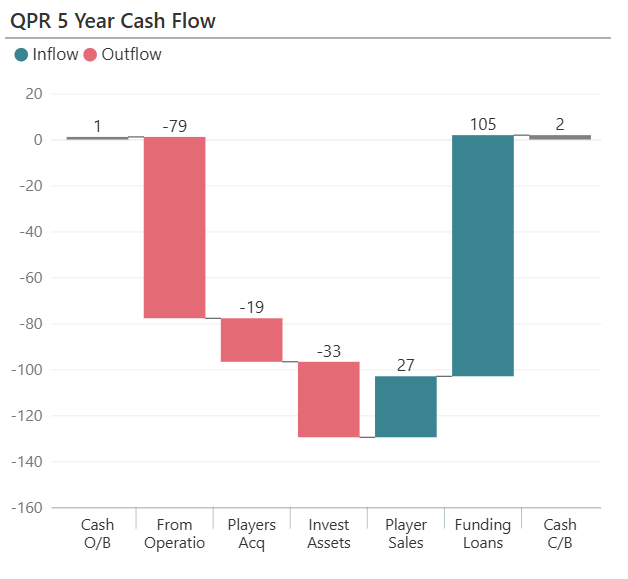
Over the past ten years, the club has consumed approximately £180 million, a substantial level of investment for a mid-table Championship club.
Reporting Entity
This analysis is based on QPR Holdings Limited which is currently owned 79% by Total Soccer Growth Holdings Ltd (Ruben Gnanalingam), 11% by Sea Dream Ltd (Mittal family), and 10% by QPR Newco LLC (Richard Reilly). QPR Holdings, in turn, owns 100% of Queens Park Rangers Football & Athletic Club Limited.


Comments