
West Ham United Financial Results 2024/25

The 2024/25 campaign marked the 130th season in West Ham United’s history and their thirteenth consecutive year in the Premier League, the longest top-flight run in the club’s history.

West Ham have enjoyed a period of on-field success in recent years. Over the past five seasons, they recorded their highest league finish in 25 years by placing sixth in 2020, qualified for European competition in three consecutive seasons, and secured their first major trophy in 45 years.
After the departure of David Moyes, season 2024/25 began under a new manager, Julen Lopetegui, alongside several new signings. However, performances fell below expectations during the first half of the campaign. With the club sitting 16th in January, Lopetegui was dismissed after just eight months and replaced by Graham Potter. Results improved only marginally under Potter, and West Ham ultimately finished 14th with 42 points.
After three consecutive seasons of European competition, 2024/25 was a quiet year in the cups, with the club exiting in the third round of both domestic competitions. As a result, West Ham played 12 fewer matches than in 2023/24, a reduction that clearly impacted commercial performance over the season.
The club has been under the control of British businessman David Sullivan since 2010, when he acquired West Ham United alongside David Gold. Since then, Czech billionaire Daniel Křetínský has invested in the club, purchasing a 27% stake. Sullivan now holds 38.8% of the shares, while Gold’s widow, Vanessa Gold, owns 25%, with the remainder held by smaller shareholders.
Sullivan has faced sustained criticism from sections of the West Ham support, who question the club’s ambition and point to several poor investment decisions. When compared with peers such as Newcastle United and Aston Villa, West Ham’s level of investment over the past decade has been relatively limited. In addition, the London Stadium remains a major source of supporter dissatisfaction, with concerns over atmosphere and a perceived loss of the club’s Upton Park identity. The sight of empty white seats at matches has also become a reputational issue for the club.
The current season’s poor on-pitch performance, with the team sitting in 18th place and undergoing another managerial change, has further intensified these frustrations.

West Ham Financial Results 2024/25
Prior to 2024/25, the club had operated on a relatively conservative basis, generating a small cumulative profit over the previous eight years, a feat few clubs can claim. Debt levels were also low, and notably the club repaid remaining debts in 2023/24 — a rare occurrence in the Premier League.
However, significant recent investment in the playing squad has driven a sharp increase in costs. At the same time, revenues have declined due to lower league finishes and the absence of European competition. The combination of rising expenses and falling income resulted in a record pre-tax loss of £104 million.
While the club is not the first to exceed the £100 million loss threshold, the figure highlights a structural issue: declining on-field performance has reduced revenue at the same time as the cost base has expanded.

Financial highlights:
Revenue: Total revenue was £228 million, down £42 million from the previous year. All major revenue streams declined, with a lower league finish and no European participation being the main drivers.
Staff costs: Following significant investment in the squad, salaries and wages rose by £15 million to £176 million. Player acquisitions also drove a £16 million increase in amortisation. Total staff costs reached £275 million, likely the ninth-highest in the league, and represented 120% of revenue.
Player sales: The club generated £20 million from player sales, primarily from Downes, Benrahma, and Kehrer.
Profit/loss: West Ham reported a £104 million loss, compared with a £57 million profit in the previous season. The reversal was driven by lower revenues, higher staff costs, and reduced profits from player sales.
Net assets: The club reported net liabilities of £4 million after bringing forward transfer fee receivables and using cash reserves to cover outgoings.
Player trading: West Ham spent £133 million on new signings, including Kilman. Summerville, Füllkrug, Guilherme and Wan-Bissaka This was partly offset by £44 million in player-sale income.
Loans and debt: The club utilised £19 million of a £40 million overdraft facilities. Net transfer-related debt increased by £65 million to £192 million after £60 million of transfer fees receivable were brought forward.
Cash Flow: West Ham generated only £1 million in operating cash flow, while recording a net investment outflow of £51 million. The resulting cash shortfall was funded by the overdraft and existing cash reserves.
Financial Outlook
The club’s financial outlook is challenging, to say the least. Following the £104 million loss in 2024/25 and the current on-pitch performance, West Ham may face significant financial pressures.
Revenue growth this season is unlikely, given their league position. While the club is expected to generate around £50 million in profit from player sales, the £200 million spent on new signings will substantially increase amortisation and may put upward pressure on wages. As a result, further losses are anticipated, although the club should remain within the Profit and Sustainability limits, as the 2023/24 season — when they recorded a £57 million profit — still counts.
Cash flow is likely the greatest concern. At the end of 2024/25, £195 million in transfer fees remained outstanding, with £100 million due this season. In addition, the club has spent a further £200 million on players, some of which will also fall due this year. While around £120 million in player sales will bring in cash, a significant funding gap will remain.
As operating cash flows are minimal, this shortfall will need to be covered through additional debt or equity injections from the owners.
Another challenge is identifying sources of profit from player sales. With Kudos and Paquetá leaving this year, the club’s pool of high-value assets is limited.
These challenges will be magnified further if the worst-case scenario happens and the club is relegated this season.
Turnover
Revenue is generated from three primary streams: matchday income (ticket sales), broadcasting distributions (from the Premier League and, where applicable, UEFA competitions), and commercial activities, including sponsorship, merchandising, and other business operations.
The absence of European football, combined with a lower league finish and early exits from domestic cup competitions, significantly reduced both broadcasting and matchday income.

To date, seven clubs have published their financial results: Arsenal, Brentford, Brighton, Liverpool, West Ham, and the two Manchester clubs. The chart below compares these reported figures with our revenue estimates for the remaining Premier League teams.
Liverpool generated the highest revenue in 2024/25. West Ham ranked ninth overall, although there is a significant gap of more than £100 million to eighth-placed Newcastle.

Matchday Revenue
Matchday revenue is driven by several factors, including the number of home fixtures, average attendance, ticket pricing, and a club’s ability to optimise hospitality and premium seating. Domestic cup competitions are an exception, as gate receipts are shared between the participating clubs and the FA.
West Ham have played at the London Stadium since 2016. The ground has a capacity of 62,500 and is owned by E20 Stadium LLP, a joint venture between the Greater London Authority and the UK Government. The club operates under a long-term lease and pays relatively modest annual rent, estimated at approximately £2.5 million.
During the 2024/25 season, the club reported an average league attendance of 62,464, the second-highest in the Premier League behind Manchester United. In effect, the stadium is sold out for most matches. However, actual turnstile attendance is typically lower than the official figure — a common occurrence across the Premier League, though particularly visible at the London Stadium.
The absence of European competition reduced the number of home fixtures by five matches, while participation in two fewer domestic cup ties (where revenue is shared) further limited matchday income. Overall, the number of paying spectators fell by approximately 12%. In addition, revenue per attendee declined by 5% to £31.40, likely reflecting the absence of higher-value European and late-stage cup fixtures. While revenue per fan remains significantly below that of the larger London clubs, it is broadly comparable to Brentford and Fulham.
The combined impact of fewer fixtures and lower revenue per supporter resulted in matchday income declining by £5.3 million to £39.3 million.


While the table below includes revenue estimates for clubs yet to publish their accounts, West Ham’s matchday income is likely the eighth highest in the Premier League.

There are currently no plans to expand the London Stadium.
Broadcast Revenue
Broadcast revenue is generated primarily through central Premier League distributions, UEFA payments from European competitions and the club’s own media activities.
The 2024/25 season marked the third and final year of the Premier League’s current broadcast cycle, with total distributions broadly consistent with 2023/24 levels. Approximately 67% of broadcast income is shared equally among clubs, with the remainder allocated through merit payments based on league position and facility fees linked to the number of live televised matches.
West Ham's fourteenth-place finish earned them £131 million, £16 million lower than the previous season.

The chart below shows the club by club distributions published by the Premier League.

After three consecutive seasons of European football, the Hammers failed to qualify in 2023/24. This had a clear impact across all revenue streams, with no UEFA distributions, fewer high-value fixtures, and reduced commercial opportunities.

For reference the chart below shows combined broadcast revenue, including Premier League distributions, UEFA payments, and income from the recently expanded FIFA Club World Cup, which was contested only by Chelsea and Manchester City.

Commercial Revenue
West Ham’s commercial revenue has historically been among the highest outside the so-called Big Six. After a club-record £58 million in 2023/24, commercial income fell to £56 million in 2024/25. This decline was primarily driven by the absence of European fixtures — which reduced hospitality opportunities and retail sales — as well as a general downturn in on-field performance.

West Ham, like ten other Premier League clubs, have partnered with the betting industry. Betway remained the club’s front-of-shirt sponsor in 2024/25, with an estimated value of £10 million. For 2025/26, Betway was replaced by another betting company, BoyleSports. However, with the new ban on displaying betting company names on shirts, the club will need to secure a partner from a different industry next season.
Other major partnerships include kit supplier Umbro, estimated at £7 million per year, and sleeve sponsor Intuit QuickBooks, estimated at £2 million per year.
As the chart below illustrates, the “Big Six” continue to generate significantly higher commercial revenue. West Ham currently rank ninth in the Premier League for commercial income but have lost ground to Newcastle United and Aston Villa, who have benefited from recent Champions League participation and corresponding revenue growth.

Staff Costs
Staff costs include salaries and wages for all employees, the amortisation of transfer fees (spreading a player’s acquisition cost over the length of their contract), and impairment charges. Impairments occur when a player’s estimated recoverable value falls below their carrying value on the balance sheet.
Following substantial investment in the squad — approximately £440 million over three seasons — and an increase in overall headcount, salaries and wages have risen significantly, reaching £176 million in 2024/25, a 28% increase over two years. The impact of player acquisitions is also reflected in amortisation costs, which climbed to £99 million in 2024/25, a 50% increase over the same period.


Collectively, these factors have pushed the club’s staff costs to £275 million, up £31 million from the previous year and £73 million higher than two years ago.
With revenues down — in part due to the absence of European competition — staff costs now represent 120% of turnover, creating a clear profitability challenge. Recovery would require significant player sales, as occurred in 2023/24 with the sale of Declan Rice, but this did not materialise in 2024/25. West Ham’s staff-to-turnover ratio is likely among the highest in the division.
Based on estimates for clubs yet to publish accounts, West Ham’s staff costs are expected to rank ninth in the Premier League. Combined with a 14th-place finish, this represents a notable underperformance in 2024/25.

Profit on Player Sales
In 2023/24, West Ham generated close to £100 million from the sale of Declan Rice to Arsenal, providing a major financial boost and contributing to a reported £57 million profit. In 2024/25, player sales totalled only £20 million, from the departures of Flynn Downes, Saïd Benrahma, and Thilo Kehrer. This significant drop in income from player trading was a key factor in the shift from profit to substantial losses.

Among the six clubs that have published full financial results to date, West Ham reported the lowest profit from player sales.

This season, the club has offloaded further players, with the sales of Kudos and Paquetá expected to generate approximately £50 million in profits.
Squad Cost Ratio
The Premier League will introduce a new set of financial rules from the 2026/27 season, replacing the existing Profitability and Sustainability Rules (PSR). A key metric under the new framework is the Squad Cost Ratio (SCR), which limits clubs’ on-pitch spending to 85% of football-related revenue, including net profit or loss from player sales.
This metric is broadly aligned with UEFA’s SCR, which applies a stricter 70% threshold. Consequently, clubs not participating in European competitions can invest at relatively higher levels than those who are already active in Europe.
The ratio considers only player and coaching staff costs, while incorporating a three-year average of profits from player sales into revenue. Although clubs rarely report “football-only” staff costs, we estimate West Ham’s SCR at approximately 85% (assuming 75% of total staff costs relate to football), placing them right at the limit of the so-called SCR Green Zone. Clubs may exceed this level, but only temporarily.
Profit and Loss
West Ham’s £104 million loss for 2024/25 was the largest in the club’s history. While the club has historically fluctuated between profitable and unprofitable seasons, performance has generally averaged around break-even. This record loss reflects substantial investment in the squad at a time when revenues were declining. The club’s cost structure relies on some level of European participation, yet on-pitch performance has moved them far from achieving this.
The worst-case scenario for the club is relegation, which remains a significant risk. Even without relegation, continued cost management will be required to avoid repeating losses of this magnitude.
These losses have created short-term cash flow pressures. The club has brought forward receipts from previous player sales, accessed short-term overdrafts, and, following these results, drawn on a new £124 million term loan. Beyond this, West Ham have indicated they may need to sell players and may rely on shareholder support to provide additional funding.

In 2024/25, total revenue fell to £228 million, a decline of £42 million from the previous year. Wage costs increased by £15 million, while other operating expenses fell by £4 million. As a result, EBITDA (earnings before interest, tax, depreciation, and amortisation) dropped £57 million to -£3 million.
After accounting for £99 million in player amortisation (up £16 million) and £3 million in depreciation, the club recorded an operating loss of £105 million. While significant, operating losses remain common across the Premier League, and it is unlikely that any club reported an operating profit in 2024/25.
The operating deficit was partially offset by £20 million of profit from player sales, but interest payments of £19 million contributed to an overall net loss of £104 million — a £161 million reversal from the prior year.
Six other clubs have published their financial results to date. Of these, only Liverpool reported a profit, and even that was modest. West Ham’s deficit of £104 million is the largest by a significant margin, followed by Brighton with a £56 million loss.

Net Assets
Net assets represent the difference between total assets and total liabilities and correspond to the club’s net equity.
Assets include fixed assets—such as player registrations, facilities, and goodwill—as well as current assets like trade debtors, transfer fees receivable, and cash.
Liabilities comprise loans (from banks, shareholders, or group companies), transfer fees payable, trade creditors, deferred income (for example, advance season ticket sales), and other financial provisions.
The 2024/25 season saw West Ham move into a net liability position. Total assets declined as outstanding transfer receivables were settled, while operating losses depleted cash reserves. At the same time, liabilities increased as the club drew on its bank overdraft.


Overall, West Ham reported net liabilities of £4 million for 2024/25.
The table below shows the most recent net asset positions for Premier League clubs, with West Ham one of four clubs reporting net liabilities. It is important to note that a club’s net asset position is heavily influenced by its funding structure. For example, Aston Villa and Newcastle have benefited from substantial equity injections, supporting their positive net asset positions, whereas Brighton has been primarily funded through owner debt from Tony Bloom.

There are several balance sheet–related measures within the Premier League’s new financial regulations, which come into effect next year. These fall under the Sustainability and Systemic Resilience (SSR) framework and include:
Working Capital Test
This assesses a club’s immediately available cash headroom over the course of a season. Clubs must maintain at least £12.5 million in short-term liquid assets.
Liquidity Test
This examines medium-term resilience and a club’s ability to withstand financial shocks, such as relegation. A club must demonstrate that its liquid assets, less liquid liabilities, plus 40% of squad market value, exceed £85 million. In practical terms, this reflects whether a club could cover short-term obligations by selling part of its squad if required.
Positive Equity Test
This measures long-term financial health. It includes the full squad market value (or net book value, if higher) as an adjusted asset. Total liabilities must not exceed 90% of adjusted assets, tightening to 80% by 2028/29.
As West Ham report net liabilities, the club will need to monitor its position carefully against these measures. For example, our estimate for the Positive Equity test is around 75%, although this is highly dependent on the assessed market value of the squad (see calculation below).
The club reports total assets of £297 million. Based on Transfermarkt estimates, the squad’s market value of £330 million is £107 million higher than its squad book value, resulting in adjusted assets of approximately £404 million. With total liabilities of £302 million, this equates to 75% of adjusted assets — still within Premier League limits.
Player Trading
The club continued its strong investment in the squad in 2024/25, although this did not translate into success on the pitch.
During the season, West Ham spent £133 million on new signings, including Maximilian Kilman from Wolves, Crysencio Summerville from Leeds, Niclas Füllkrug from Borussia Dortmund, Luis Guilherme from Sociedade Esportiva Palmeiras, and Aaron Wan-Bissaka from Manchester United.
Player sales generated £44 million, largely driven by the departures of Flynn Downes to Southampton, Saïd Benrahma to Olympique Lyon, and Thilo Kehrer to AS Monaco.

West Ham’s investment in the squad was the seventh highest in the league, with net spend — acquisitions minus player sales — of £89 million also ranking seventh.

The club’s investment in the squad has been even higher this season, with approximately £200 million spent on players including Fernandes, Todibo, Castellanos, Pablo, Diouf, and Harmession. This will be partially offset by around £130 million expected from the sales of Kudos, Paquetá, Aguerd, and Guilherme.
This trading is expected to provide some relief through player sales profits, estimated at around £50 million, but will also significantly increase the club’s amortisation charges, estimated at an additional £30–40 million.
Squad Market Value
Clubs report the net book value (NBV) of their squads in published accounts, which represents the original acquisition cost (including associated fees) amortised over the length of a player’s contract. For example, a player purchased for £50 million on a five-year contract would have an NBV that decreases by £10 million each year.
NBV does not reflect a squad’s current market value. According to Transfermarkt.com, West Ham’s squad was estimated at approximately £330 million at the end of the season. The difference between market value and NBV provides an indication of potential profit from player sales and a rough measure of how well a squad is maintaining its value relative to its accounting value.
At season end, West Ham had one of the smallest differences between market value and NBV, estimated at just over £100 million. Furthermore, two of the higher-valued players, Kudos and Paquetá, have since been sold, likely reducing this difference further. As a result, the club currently has a limited pool of players from which to generate further profitable sales.

Football Net Debt
West Ham have historically operated with minimal debt relative to other Premier League clubs and in 2023/24, they repaid their remaining £50 million debt. The substantial losses in 2024/25 were partially managed by bringing forward transfer fee receipts, assumed to be from the Declan Rice sale, and the club held £32 million in cash reserves. Despite this, a shortfall remained, leading the club to utilise £19 million of its £40 million overdraft facility with Barclays Bank.

As spending on players continued into 2025/26, the club reported that, following these accounts, it had drawn down £89 million of a new £124 million loan facility with Rights and Media Funding Limited, a company that provides funding to several football clubs.
Premier League clubs’ total debt reached £3.6 billion in 2023/24, comprising £2.4 billion owed to third parties and £1.2 billion to related parties. Everton recorded the highest overall debt, although much of its related-party borrowing has since been converted into equity. West Ham had one of the lowest debt levels in the league.
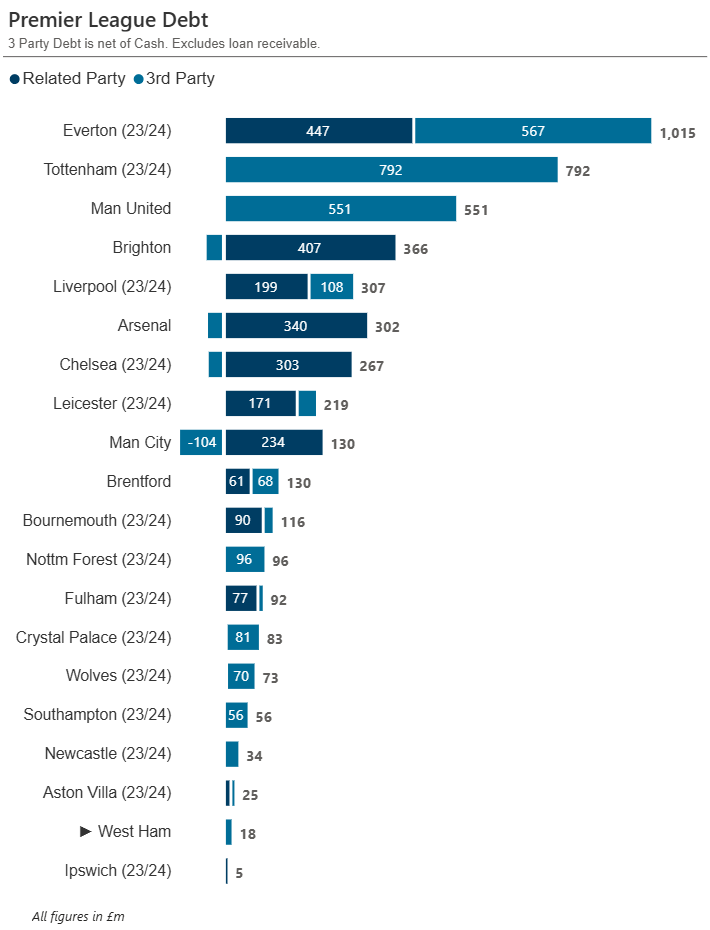
Following West Ham's continued spending on players, their transfer-related debt remained high. Note it is standard practice for clubs to structure transfer payments over multiple years.
As noted, the settlement of transfer fee receivables — primarily from the Declan Rice sale — was brought forward, reducing the outstanding balance from £64 million to just £4 million.

Cash Flow
Cash Flows are reported in three categories:
Cash Flows from Operations refer to cash generated from the club’s core activities—revenue minus day-to-day costs such as salaries, rent, and utilities.
Cash Flows from Investments include cash spent on player acquisitions and facility improvements, net of player or asset sales.
Cash Flows from Financing cover new loans or equity raised, less repayments or buybacks. If operational cash flow cannot fund investments, the shortfall is usually met through financing.
Due to high operating costs relative to revenue, West Ham generated only £1 million in operating cash flow. During the season, they spent £145 million on players, £9 million on other assets, and received £103 million from player sales, primarily reflecting the brought-forward debt from the Declan Rice transfer.
The resulting funding gap was covered using an £18 million overdraft facility and £33 million in cash reserves.

This does not provide the full picture, as the club still has £196 million in transfer fees payable, of which £110 million is due this season, while no transfer receivables remain.
Following these accounts, the club has already drawn £89 million of a new £124 million loan facility.
In recent seasons, the club has not relied on owner funding, with no outstanding shareholder loans and no equity raised since 2022. However, it is likely that additional funding from the owners will be required in 2025/26 and beyond.
Reporting Entity
This analysis is based on WH Holdings Limited. whose shares are owned by David Sullivan (38.8%), Daniel Kretinsky (27%), Estate of David Gold (25.1%), J Albert Smith (8%) and others (1%). No single party has ultimate control over the Group. WH Holdings controls several subsidiaries, including West Ham United Football Club Limited and West Ham United Women Football Club Limited.


Comments