
Nottingham Forest Financial Results 2024/25

Updated: Mar 31
The 2024/25 campaign marked Nottingham Forest’s 159th season and their third consecutive year in the Premier League.

Forest have a proud history, most notably winning back-to-back European Cups under Brian Clough in the late 1970s. More recently the club endured a sharp decline, including a drop to League One in the early 2000s. However, after 14 years in the Championship, they finally returned to the Premier League in 2022/23.
Following two seasons battling in the lower half, 2024/25 represented a major breakthrough. Forest spent much of the campaign in the Champions League places, before a late dip in form saw them finish seventh. Still, this was a remarkable achievement, securing European qualification for the first time in 30 years via the Europa Conference League. This was later upgraded to a Europa League place following Crystal Palace’s demotion due to multi-club ownership issues involving John Textor.
Forest have struggled to replicate that domestic form this season. It has been a chaotic campaign off the pitch. Nuno Espírito Santo, widely credited for last season’s success, departed in September and was replaced by former Tottenham manager Ange Postecoglou. His tenure lasted just eight matches without a win. Sean Dyche followed, delivering a relatively improved run of six wins in 18 games, but he too was dismissed. The fourth manager, Vítor Pereira, remains in charge, though Forest are still in relegation danger, currently sitting 16th and just three points above the drop zone. Their European campaign has been more positive, with the club reaching the quarter-finals and set to face Porto in mid-April.
Majority owner Evangelos Marinakis has overseen the club’s resurgence since acquiring Forest in 2017. The Greek businessman has invested over £280 million, largely directed towards squad development following promotion. However, this aggressive approach led to a breach of the Premier League’s Profit and Sustainability Rules (PSR) in 2023/24, resulting in a four-point deduction.

Marinakis also owns Greek side Olympiacos, placing Forest within a broader multi-club ownership model, now common across the Premier League.
Following the PSR breach, Forest moved to reduce losses and, through several strategic player sales, recorded a profit in 2023/24. However, in 2024/25, a lack of significant player trading meant that, despite increased revenues driven by their higher league finish, the club returned to a loss of £79 million.

Nottingham Forest Financial Results 2024/25
Forest’s seventh-place finish drove revenues to a club-record £222 million. However, with staff costs at 109% of revenue and only £7 million generated from player sales, the club reported a £79 million loss, the second largest recorded so far.

Financial highlights:
Revenue: Total revenue reached a club-record £222 million, up £32 million year-on-year, driven primarily by an improved league finish and higher matchday income.
Staff costs: Wages increased by £1 million to £166 million, likely the 11th highest in the league. Total staff costs rose to £241 million, equivalent to 109% of revenue, broadly in line with other non–Big Six clubs.
Player sales: The club generated £7 million from player sales, mainly from Omobamidele and Worrall.
Profit/loss: Forest reported a £79 million loss, the second highest among the nine clubs to have published results so far.
Net assets: Net liabilities decreased to £5 million following the conversion of £89 million of shareholder loans into equity, alongside proceeds from prior-year player sales.
Player trading: Forest spent £73 million on new players—among the lower totals in the league—including Milenković, Sosa, Carmo, Morato, Silva, Stamenic and Miguel. This was partially offset by £16 million in player sales.
Loans and debt: External borrowings stood at £99 million at the end of 2024/25, with net transfer fee liabilities of £73 million.
Cash Flow: The club recorded operating cash outflows of £2 million and net investment outflows of £77 million. This was funded by £89 million in shareholder loans (subsequently converted to equity) and a £15 million increase in external borrowing.
Financial Outlook
Forest are in a precarious position, hovering just above the relegation places. While a run in the Europa League has provided some relief for fans, it will be a nervy end to the season.
The financial consequences of relegation would be severe. Although parachute payments of around £50 million offer some protection, revenues could fall by over £100 million. The club will have contingency plans in place, but it is a scenario they will be desperate to avoid.
The fans (and clubs) anxiety is also mixed with the not unrealistic possibility of winning the Europa League and, with it, securing qualification for next season’s Champions league—even if the club is playing in the Championship.
Assuming they retain their Premier League status (and don't win the Europa League), Forest should be in a relatively stable financial position by top-flight standards. Revenues should be broadly in line with 2024/25, with a lower league finish offset by income from their Europa League run. In addition, the club has already generated around £45 million in profit from player sales. They are still expected to post a significant loss, but it should be lower than the £79 million reported in 2024/25.
With this being the final year of the current Profit and Sustainability Rules, the club is unlikely to have much headroom. As a result, further player sales at the end of the season may be required to help manage losses.
Turnover
Revenue is generated from three primary streams: matchday income (ticket sales), broadcasting distributions (from the Premier League and, where applicable, UEFA competitions), and commercial activities, including sponsorships, merchandising, and other business operations.
The 2024/25 season was a record year for Forest, with a higher league finish and increased ticket prices helping to lift total revenue to £222 million, up £32 million on the previous season.

To date, ten clubs have published their financial results. The chart below compares reported figures for these clubs with our revenue estimates for the remaining Premier League teams. Forest's revenue will likely rank 11th in the league.

Matchday Revenue
Matchday revenue is driven by several factors, including the number of home fixtures, average attendance, ticket pricing, and a club’s ability to optimise hospitality and premium seating. Domestic cup competitions are an exception, as gate receipts are shared between the participating clubs and the FA.
Nottingham Forest’s home ground is the City Ground, where they have played since 1898, making it one of the longest continuously used home stadiums in English football. Its current capacity is 31,042, ranking it as the 15th largest in the Premier League.
The club has discussed expanding the ground for several years and announced earlier this year that plans have been submitted to increase capacity to over 50,000. It is an ambitious project that will require significant investment from the owner.

In 2024/25, Forest averaged 30,076 fans per league match, a slight increase on the previous season. Of these, 18,240 were season ticket holders, marginally down year-on-year. Although the club hosted one fewer domestic cup game, where revenue is shared, an FA Cup run to the semi-finals, combined with larger crowds, lifted total attendance by 4% to 648,000.
The club has historically maintained relatively low ticket prices. However, it implemented a significant 24% increase for the 2024/25 season, which prompted a backlash from supporters due to a lack of consultation. As a result, average revenue per fan rose to £31.30, up from £23.20 the previous season. This now sits broadly in line with other non–Big Six clubs, comparable to West Ham, Aston Villa and local rivals Leicester.
The price increases, alongside the modest rise in total attendance, drove matchday revenue from £14.4 million to a club-record £20.3 million.


While the table below includes revenue estimates for clubs yet to publish their accounts, Forest is expected to rank 14th in matchday revenue.

For the current season, their run to the Europa League quarter-finals will significantly boost attendances and revenue, with at least seven additional European home matches likely to increase total fan numbers by 20% or more.
Broadcast Revenue
Broadcast revenue is generated primarily through central Premier League distributions, UEFA payments from European competitions and the club’s own media activities.
The 2024/25 season marked the third and final year of the Premier League’s current broadcast cycle, with total distributions broadly consistent with 2023/24 levels. Approximately 67% of broadcast income is shared equally among clubs, with the remainder allocated through merit payments based on league position and facility fees linked to the number of live televised matches.
Forests' seventh-place finish earned them £153 million in central distributions, the highest payment in the club’s history.

The chart below shows club-by-club distributions published by the Premier League, with each league position worth close to £3 million in merit payments.

Forest are participating in the Europa League this season, which could generate up to £30 million in revenue. There is also the scenario that, should they win the competition, they would qualify for the Champions League next season—even if they were competing in the Championship.
For reference, the chart below shows combined broadcast revenue, including Premier League distributions, UEFA payments, and income from the recently expanded FIFA Club World Cup, which was contested only by Chelsea and Manchester City.

Commercial Revenue
Forest’s commercial revenue has grown significantly year-on-year since their return to the Premier League, reaching £39 million in 2024/25—more than double the level recorded in their first season back in the top flight (2022/23). Like many Premier League clubs, Forest partnered with the betting industry, with Asian betting company Kaiyun Sports serving as front-of-shirt sponsor in a deal reportedly worth £7 million per year. This was structured as a two-year agreement, ahead of the ban on gambling sponsorship on club kits from the 2026/27 season.
The club’s “other” commercial revenue declined from £15 million to £4 million, likely reflecting reduced loan income, as Forest had as many as 18 players out on loan in 2022/23.

As the chart below illustrates, the “Big Six” remain on a distinctly higher scale for commercial revenue, although Newcastle United and Aston Villa have experienced significant growth following recent Champions League participation. Forests commercial revenue is expected to rank 13th in the league.

Staff Costs
Staff costs comprise salaries and wages for all employees, the amortisation of transfer fees (the allocation of a player’s acquisition cost over the length of their contract), and impairment charges. Impairments arise when a player’s estimated recoverable value falls below their carrying value on the balance sheet.
There was significant player movement again in the 2024/25 season, with numerous players sent out on loan. As a result, salaries and wages increased only slightly, rising by £2 million to £167 million.
Amortisation continued to climb following a further £70 million invested in players. It is now 80% higher than in 2022/23, reflecting more than £380 million spent on player acquisitions over that period.


Forest’s total staff costs are likely to rank 11th highest in the league, broadly in line with clubs such as Bournemouth and Fulham, and still less than half those of the division’s biggest sides. With a seventh-place finish, the club therefore outperformed relative to its staff cost base.

Forest’s total staff costs of £228 million equate to 109% of revenue, broadly in line with clubs outside the Big Six. This level creates clear profitability challenges unless supported by profits from player sales, and highlights the structural pressures faced by clubs without the substantial commercial and matchday income enjoyed by the league’s largest sides.
Profit on Player Sales
IIn 2023/24, following their PSR breach, the club sold several key players including Johnson, Niakhaté, Mangala and Vlachodimos, generating £90 million in profits. This provided the club with some PSR headroom, reducing the need for further sales in 2024/25. As a result, the club reported only £7 million in profits from player sales, primarily from the transfers of Andrew Omobamidele to Strasbourg and Joe Worrall to Burnley.

Among the ten clubs that have published full financial results to date, Forests profit from player sales is one of the lowest.
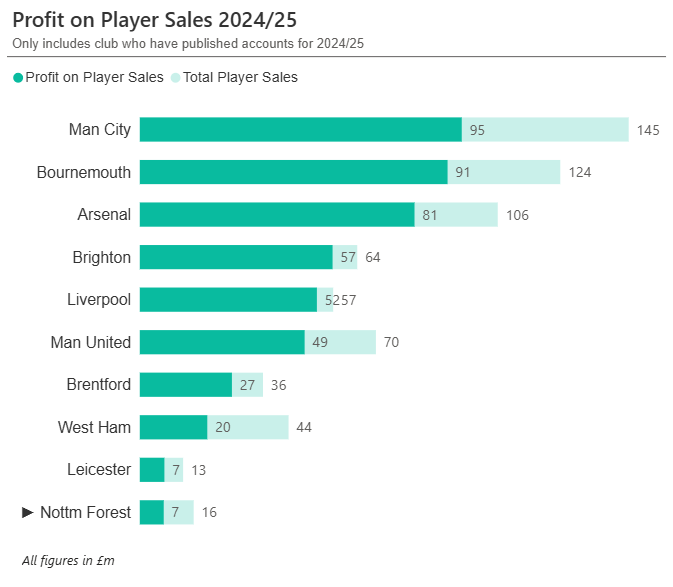
Based on sales to date, the club is expected to generate profits of around £45 million this season, with Anthony Elanga’s transfer to Newcastle proving particularly lucrative.
Squad Cost Ratio
The Premier League will implement a new set of financial rules from the 2026/27 season, replacing the existing Profitability and Sustainability Rules (PSR). A central metric under the new framework is the Squad Cost Ratio, which caps clubs’ on-pitch spending at 85% of football-related revenue, including net profit or loss from player sales (based on the average over the last three seasons).
This metric is broadly aligned with UEFA’s Squad Cost Ratio, which is set at a stricter 70%. As a result, clubs not competing in European competitions can invest at relatively higher levels than those, like Liverpool, already active in Europe.
The ratio considers only player and coaching staff costs while incorporating profits from player sales into revenue. Note that profit from player sales is based on the average over the last three years.
Based on our estimates, Forest’s squad cost ratio is around 75% (assuming that “football-only” wages account for 75% of total salaries and wages). This is well below the Premier League threshold, but above UEFA's, which will apply this season with their participation in the Europa League.
Profit and Loss
As mentioned, the club has not been without financial challenges, receiving a four-point penalty for a PSR breach relating to the 2022/23 reporting period. This covered losses made between the 2020/21 and 2022/23 seasons, which totalled £128 million before adjustments which exceeded the allowable losses over this period of £83 million (£35 million per year for Premier League seasons and £13 million for the Championship season).
This prompted strategic player sales in 2023/24, resulting in a £12 million profit. PSR remains in effect for 2024/25, with three-year losses totalling £134 million before adjustments. We would expect allowable adjustments of around £40 million, which should bring the club back within the £105 million PSR limit.
Like many mid-sized Premier League clubs, limiting losses remains a significant challenge. With staff costs exceeding 100% of revenue, the clubs will lose significant amounts without substantial player trading profits. In 2024/25, despite strong revenue growth, limited player sales led to a reported £71 million loss.
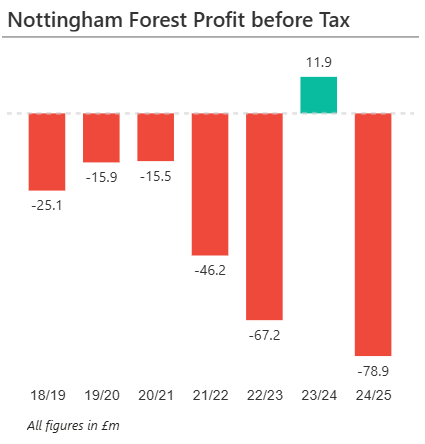
In 2024/25, Forests' total revenue reached a club record of £222 million, up £32 million year-on-year. Wage costs rose by £1 million and other operating expenses increased by £9 million. As a result, EBITDA (earnings before interest, tax, depreciation, and amortisation) grew by £22 million to £11 million.
After accounting for £74 million in player amortisation and impairment plus £2 million in depreciation, the club recorded an operating loss of £65 million. While this figure appears high, very few Premier League clubs report an operating profit, and Forests' loss is broadly in line with the league average.
The operating deficit was offset by £7 million in profit from player sales. Interest payments rose to £21 million, leaving an overall net loss of £79 million—a significant drop from the £12 million profit reported in 2023/24.
To date, nine other clubs have published their financial results. Bournemouth and Liverpool are the only clubs to report a profit, with both recording £15 million. West Ham posted the largest deficit at £104 million, followed by Forest's £79 million loss.

Net Assets
Net assets represent the difference between total assets and total liabilities and correspond to the club’s net equity.
Assets include fixed assets—such as player registrations, facilities, and goodwill—as well as current assets like trade debtors, transfer fees receivable, and cash.
Liabilities comprise loans (from banks, shareholders, or group companies), transfer fees payable, trade creditors, deferred income (for example, advance season ticket sales), and other financial provisions.
The club has been in a net liability position for several years, largely due to a relatively low asset base. Marinakis’ preferred method of financing; funding through loans via his company, NF Football Investments then subsequently converted into equity, keeps the debt levels relatively low.
The recent reduction in net liabilities has been driven mainly by transfer activity in 2023/24, which generated £136 million in player sales, as well as the continued conversion of debt into equity.


The table below shows the latest available net asset positions of Premier League clubs, with Forest net liabilities of £5 million likely one of the lowest in the division. It is important to note that a club’s net asset position is heavily influenced by its funding structure, particularly among challenger clubs. For instance, Aston Villa and Newcastle have benefited from significant equity injections, supporting their positive net asset positions, whereas Brighton has been primarily funded through owner debt from Tony Bloom.

There are several balance sheet–related measures within the Premier League’s new financial regulations, which come into effect next year. These fall under the Sustainability and Systemic Resilience (SSR) framework and include:
Working Capital Test
This assesses a club’s immediately available cash headroom over the course of a season. Clubs must maintain at least £12.5 million in short-term liquid assets.
Liquidity Test
This examines medium-term resilience and a club’s ability to withstand financial shocks, such as relegation. A club must demonstrate that its liquid assets, less liquid liabilities, plus 40% of squad market value, exceed £85 million. In practical terms, this reflects whether a club could cover short-term obligations by selling part of its squad if required.
Positive Equity Test
This measures long-term financial health. It includes the full squad market value (or net book value, if higher) as an adjusted asset. Total liabilities must not exceed 90% of adjusted assets, tightening to 80% by 2028/29.
Forest appear well positioned under these tests following the conversion of shareholder loans to equity, which has reduced their debt. For example, their estimated Positive Equity Test ratio stands at around 59% (see calculation below).
The club reports total assets of £301 million. Based on Transfermarkt estimates, the squad’s market value of £401 million is £221 million higher than its book value, resulting in adjusted assets of approximately £523 million. With total liabilities of £306 million, this equates to 59% of adjusted assets — comfortably within Premier League limits.
Player Trading
Over the past three seasons since promotion, Forest have invested more than £380 million in player acquisitions. While this represents a significant outlay requiring substantial owner funding, it is broadly in line with the league average over the same period.
In 2024/25 alone, the club spent £73 million, including Nikola Milenković from ACF Fiorentina, Ramón Sosa from CA Talleres, David Carmo from FC Porto, Morato from SL Benfica, Jota Silva from Vitória Guimarães SC, Marko Stamenic from Red Star Belgrade, and Carlos Miguel from Sport Club Corinthians Paulista.
As noted, player sales were relatively limited, with Andrew Omobamidele’s move to Strasbourg and Joe Worrall’s transfer to Burnley generating £16 million in total.

In 2024/25, Forest player spending of £64 million is likely to rank one of the lowest in the league. However, in terms of net spend—acquisitions minus sales—Forest $58 million is around the 10th highest in the league.

The club had a very busy summer window this season, with around £200 million spent on players offset by close to £100 million in player sales. Omari Hutchinson and Dan Ndoye were among the major signings, while Anthony Elanga was the most notable departure.
Squad Cost and Net Book Value
Squad costs represent the total acquisition cost of all squad members, including transfer fees and associated costs such as agent fees. A squad’s Net Book Value (NBV) represents this acquisition cost less accumulated amortisation, with transfer fees expensed over the length of each player’s contract. For example, a player purchased for £50 million on a five-year contract would have an NBV that decreases by £10 million each year.
Forest’s net book value dropped slightly to £179 million, after lower player acquisitions than previous years.

Forest's net book value of £179 million ranks 14th highest in the division.

Squad Market Value
The squad's net book value (NBV) is part of the club balance sheet, recorded as Intangible Player Assets. The NBV does not however reflect a squad’s current market value.
According to Transfermarkt.com, at the end of the 2024/25 season, Forest’s squad had an estimated market value of around £400 million. To put this into perspective, the club has spent £383 million on player acquisitions and recouped £149 million in player sales, a difference of £234 million. This suggests the club has recruited and sold effectively, with several players significantly increasing in value. The squad’s market value was also £221 million higher than its net book value.
Among the most highly valued players at the end of the 2024/25 season were Murillo at £46 million (signed for £10 million), Gibbs-White at £43 million (signed for £24 million), Milenković at £30 million (signed for £10 million) and Hudson-Odoi at £20 million (signed for £2 million).
For context, Chelsea is currently the only club whose squad market value is lower than its net book value, partly due to the club’s tendency to offer long-term contracts—though this alone does not fully explain the discrepancy, suggesting that some recently acquired players have not maintained their value.
Squad market value also forms part of the Premier League’s Sustainability and Systemic Resilience (SSR) framework, although the league has yet to specify exactly how market value will be measured.

Football Net Debt
Since acquiring the club, £276 million has been provided via loans, all of which have subsequently been converted into equity, leaving no outstanding related-party loans at the end of 2024/25. This includes £89 million which was loaned to the club during the 2024/25 season and then converted to equity.
The club does, however, owe £99 million to third-party lenders, including £80 million to a Luxembourg-based institution at an interest rate of 8.75%.

Premier League clubs’ total debt reached £3.6 billion in 2023/24, comprising £2.4 billion owed to third parties and £1.2 billion to related parties. Everton recorded the highest overall debt, although much of its related-party borrowing has since been converted into equity. Forest's debt, net of cash, ranks as the 12th highest in the league.

Following Forests' activity in the transfer market, both in buying and selling players, the club had amounts owed and owing to other clubs at the end of 2024/25. Outstanding transfer fees payable stood at £113 million, of which £60 million is due this year, while outstanding transfer fees receivable were £40 million, with £25 million expected this year.
As a result, net transfer debt increased slightly to £73 million, up from £70 million the previous year.

Cash Flow
Cash Flows are reported in three categories:
Cash Flows from Operations refer to cash generated from the club’s core activities—revenue minus day-to-day costs such as salaries, rent, and utilities.
Cash Flows from Investments include cash spent on player acquisitions and facility improvements, net of player or asset sales.
Cash Flows from Financing cover new loans or equity raised, less repayments or buybacks. If operational cash flow cannot fund investments, the shortfall is usually met through financing.
Since the acquisition, Marinakis, through his company NF Football Investments, has invested approximately £276 million in the club, of which £182 million has been provided since promotion to the Premier League.
Examining the club’s overall cash flow during their time in the top flight, Forest recorded £39 million of cash outflows from operations, driven by high staff costs relative to revenue. The club also spent £211 million on player acquisitions and £38 million on facilities, while generating £40 million from player sales. This resulted in a total funding gap of £263 million.
To cover this, £182 million was provided as owner loans (subsequently converted into equity), alongside a further £86 million in third-party borrowing.


Since the end of the 2024/25 financial year, the owners have provided a further £63 million, also converted to equity.
Managing cash flow for a mid-sized Premier League club like Forest is no small task, with large sums involved and a constant balancing act between investing in the squad and controlling losses through player trading.
Outside the Big Six, this pattern of low or negative operating cash flows, combined with significant net investment in players funded by substantial owner contributions, is common across many Premier League clubs (and most Championship clubs). There are a few exceptions, with Brentford and Sunderland (prior to promotion) often cited as standouts. For most others, there remains a heavy reliance on supportive ownership.
Reporting Entity
This analysis is based on the entity Nottingham Forest Football Club Limited for the period 1st July 2024 to 30th June 2025. The company is wholly owned by NF Football Investments Ltd which is controlled by Mr E Marinakis.


Comments