
Crystal Palace Financial Results 2024/25

The 2024/25 campaign marked Crystal Palace’s 119th season and their twelfth consecutive year in the Premier League.

Their time in the top flight has been defined by remarkable consistency. Since promotion from the Championship, Palace have finished every season between 10th (2023/24) and 15th (2015/16), firmly establishing themselves as a stable mid-table club.
However, 2024/25 was a season that Palace supporters will never forget. The club secured their first major domestic trophy, lifting the FA Cup after defeating Manchester City. They also recorded their highest-ever Premier League points total (53), finishing 12th, and reached the quarter-finals of the Carabao Cup. It was a standout campaign, made all the more impressive by one of the league’s lowest wage bills — a testament to the impact of manager Oliver Glasner.
At the close of the 2024/25 financial year, US entrepreneur John Textor held a 45% stake in the club, acquired in 2021 through Eagle Football Holdings, which also owns Botafogo, Lyon and RWD Molenbeek. Although Textor had ambitions to take full control, the club remained under a consortium structure, with Chairman Steve Parish (~10%), Josh Harris (~18%), David Blitzer (~18%), Stephen Bowett (~3%) and Jeremy Hoskins (~3%) retaining minority stakes.
Victory in the FA Cup secured qualification for the 2025/26 Europa League. However, Textor’s involvement with Lyon — who also qualified — created a breach of UEFA’s multi-club ownership rules. As Lyon finished higher in their domestic league, Palace were demoted to the Conference League, with Nottingham Forest taking their Europa League place. It was a frustrating conclusion to what had otherwise been the most successful season in the club’s history.
In 2025/26, Crystal Palace have again occupied a mid-table position domestically while enjoying a strong European campaign, reaching the Conference League final where they will face Spanish side Rayo Vallecano. Victory would secure qualification for the Europa League for the following season.
Notably, John Textor sold his stake in July 2025 to American businessman Woody Johnson, removing previous concerns around multi-club ownership.
Financially, Palace demonstrate one of the more controlled models in the Premier League. While they are one of the smaller clubs in terms of matchday and commercial revenue, they have consistently reported positive EBITDA and generated positive operating cash flow. Wage inflation has remained limited and recruitment has generally been effective.
That said, the club has still recorded losses. In the five years prior to 2024/25, cumulative losses totalled £191 million (an average of £38 million per year) — significant, but within Profitability and Sustainability Rules (PSR) limits. These losses have largely been funded through £160 million of shareholder investment.
The club did, however, report a rare profit in 2024/25. Despite an operating loss of £45 million — higher than the previous year — Palace recorded £66 million in profit from player sales, driven by the departures of Michael Olise and Joachim Andersen. Notably, they were one of only four Premier League clubs to post a profit without relying on one-off asset sales.

Crystal Palace Financial Results 2024/25
Crystal Palace’s FA Cup victory in 2024/25 boosted all revenue streams through prize money, additional fixtures, and enhanced commercial activity, although this was partly offset by a lower league finish. As a result, total revenue increased by £6 million to a club-record £197 million.
Costs also rose, driven by FA Cup-related bonuses and higher operating expenses associated with the extended cup run. However, profits from player sales of £66 million helped offset these increases, enabling the club to report a rare £8 million profit for the year.

Financial highlights:
Revenue: Total revenue reached a club-record £197 million, up £6 million year-on-year, primarily driven by FA Cup success, including prize money and additional matchday income from extra fixtures.
Staff costs: Wages increased by £15 million to £148 million, largely due to FA Cup-winning bonuses. Total staff costs rose to £202 million, equivalent to 103% of revenue, although still the fourth-lowest in the Premier League.
Player sales: The club generated £66 million from player sales, primarily from the transfer of Olise, Anderson and Johnston.
Profit/loss: Crystal Palace reported an £8 million profit, their first in six seasons and one of only four Premier League clubs to record a genuine profit without relying on one-off asset disposals.
Net assets: Net liabilities stood at £36 million, representing one of the lowest asset bases in the league.
Player trading: The club spent £83 million on new signings (fifth lowest in the Premier League), offset by £81 million in player sales, resulting in a net spend of just £2 million, ranked 17th in the division.
Loans and debt: Third-party debt increased 14 million to £95 million, whilst £50 million of owner funding was converted to equity, reducing related party loans to £26 million. Transfer fee payables of £79 million were partially offset by £13 million in receivables.
Cash Flow: The club generated £11 million in operating cash inflows and recorded £20 million in net investment outflows, including £14 million on facilities. The resulting funding gap was covered by a £13 million increase in loans.
Financial Outlook
This season, Crystal Palace may finish at the lower end of their usual league position range. At the time of writing, they sit 15th and are not yet mathematically safe from relegation, although a couple of wins would likely lift them a few places.
However, the club has also reached the final of the UEFA Conference League (a competition they did not initially expect to be in), where they will face Spanish side Rayo Vallecano. Winning a second major trophy in two years would represent an exceptional achievement and a fitting conclusion to Oliver Glasner’s tenure, as he will leave this summer.
The UEFA campaign will also provide a financial boost, with around £10 million earned from UEFA distributions, in addition to incremental income from additional matchdays and associated commercial activity.
On the cost side, while the club generally maintains disciplined spending, increased player investment and the demands of a European campaign will place upward pressure on operating expenses. Nevertheless, Palace are also expected to generate significant profits from player trading, with the departures of Eze and Guehi likely to deliver combined profits of £45–50 million. Overall, the club is expected to record a small loss for the season.
On the 24th July 2025, John Textor sold his stake in the club to to New York Jets owner Woody Johnson for a reported £190 million, implying an overall club valuation in excess of £400 million.
Turnover
Revenue is generated from three primary streams: matchday income (ticket sales), broadcasting distributions (from the Premier League and, where applicable, UEFA competitions), and commercial activities, including sponsorships, merchandising, and other business operations.
Crystal Palace’s revenue grew to a record £197 million in 2024/25. Their FA Cup success led to more matches, additional prize money and increased commercial opportunities. This was partly offset by a lower league finish (12th vs 10th), which reduced Premier League distributions.

Crystal Palace’s revenue ranks thirteenth in the Premier League and remains less than a third of that generated by the league’s biggest clubs.

Matchday Revenue
Matchday revenue is driven by several factors, including the number of home fixtures, average attendance, ticket pricing, hospitality and premium seating. Domestic cup competitions are an exception, as gate receipts are shared between the participating clubs and the FA.
Crystal Palace play at Selhurst Park, a traditional football ground that has been their home since 1924. The stadium has a capacity of 25,194, making it the fourth smallest in the Premier League. The club has around 18,000 season ticket holders and a reported waiting list of one to two years, which continues to grow.
The club is planning a major redevelopment of the Main Stand, which would increase capacity by around 8,000 seats and include upgraded hospitality facilities and approximately 6,000 premium seats. The aim is to keep the stadium operational throughout construction. The project has faced significant delays, but is now in the final stages of planning.

During 2024/25, the club averaged 25,116 fans per league match. Their cup runs, however, meant they played six additional domestic cup matches (where revenue is shared), lifting total attendance by 12% to a total of 605,000.
The club froze ticket prices for 2024/25, meaning average revenue per fan remained broadly flat at £25.8 (£25.6 in the prior year). Their yield is the lowest among London clubs and the fourth lowest in the Premier League.
As a result of the cup runs, total matchday revenue rose from £13.8 million to £15.6 million.


Crystal Palace’s matchday revenue ranks fourth lowest in the Premier League, ahead of only Brentford, Ipswich, and Bournemouth.

Matchday revenue is expected to increase slightly this season due to price increases and additional fixtures from their Europa Conference League run.
Broadcast Revenue
Broadcast revenue is generated primarily through central Premier League distributions, UEFA payments from European competitions and the club’s own media activities.
The 2024/25 season marked the third and final year of the Premier League’s current broadcast cycle, with total distributions broadly consistent with 2023/24 levels. Approximately 67% of broadcast income is shared equally among clubs, with the remainder allocated through merit payments based on league position and facility fees linked to the number of live televised matches.
Crystal Palace’s 12th-place finish earned them £136 million in central distributions, down £4 million from the previous season. This was driven by the lower league position (and associated merit payments), partially offset by three additional televised matches (18 compared to 15).

The chart below shows club-by-club distributions published by the Premier League, with each league position worth close to £3 million in merit payments.

This season Palace are playing in Europe’s third-tier competition, the Europa Conference League, following their controversial demotion from the Europa League. Potential earnings are significantly lower in the Conference League; however, their progression to the final should generate close to £10 million.
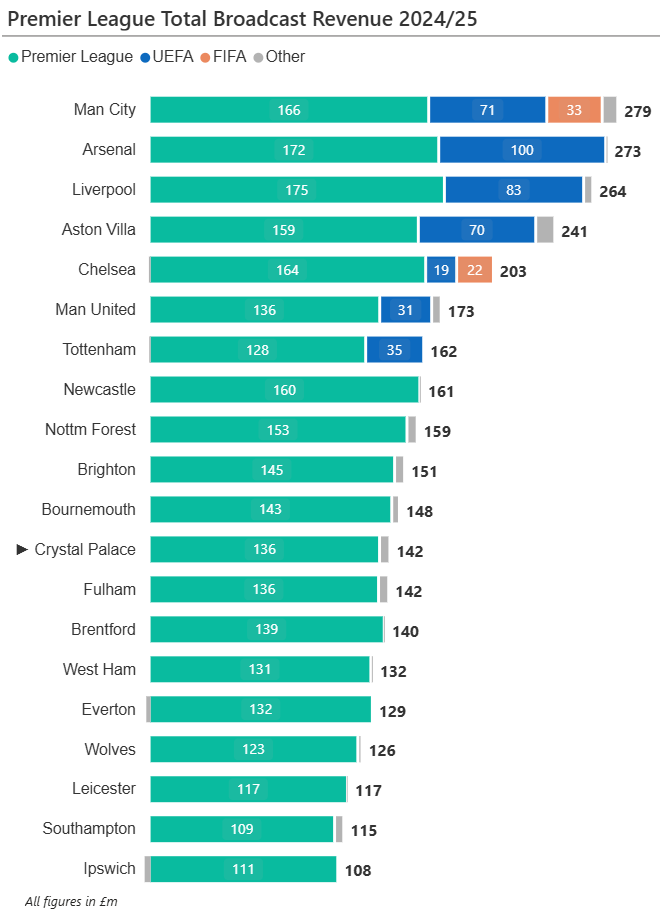
For reference, the chart below shows combined broadcast revenue for 2024/25, including Premier League distributions, UEFA payments, and income from the recently expanded FIFA Club World Cup, which was contested only by Chelsea and Manchester City. Palace ranked 12th overall.
Commercial Revenue
Palace’s successful season has been reflected in strong growth in commercial revenue, which reached £39 million in 2024/25, up from £31 million the previous year.
Sponsorship income increased by £3 million to £19 million, largely driven by a new front-of-shirt sponsorship with Vietnamese online gaming company NET88, which replaced Cinch after two years in the role. The deal was reportedly worth around £10 million per year and runs until the end of the current season, ahead of the planned ban on betting companies as shirt sponsors next season.
Other key partners include kit supplier Macron and sleeve sponsor Kaiyun Sports, another gaming company.
Main Commercial Partners.
Partner | Category | Est. Value (£/yr) | Deal Status | Sector |
NET88 | Shirt sponsorship | £10m/yr | 2-year deal (2024-25 + 2025-26) | Online Gaming |
Macron | Kit manufacturing | £3-5m/yr (est.) | Multi-year 2022→ (extended) | Sportswear |
Kaiyun Sports | Sleeve sponsorship | £3-5m/yr (est.) | Continued from 2023-24 (2nd consecutive season) | Online Gaming / Betting |
Pinnacle (PinnacleSports) | Performance / training partner | £500k-1m/yr (est.) | Multi-year | Sports Betting / Bookmaker |
MyGuava | Affinity card | ~£300-600k/yr (est.) | From June 2024 | Financial Services |
Merchandising and retail revenue also rose by £1 million to £11 million, while other commercial revenue, which includes FA Cup prize money, increased by £3 million to £8 million.

As the chart below illustrates, the “Big Six” remain on a distinctly higher scale in terms of commercial revenue. Newcastle and Villa have closed the gap on Chelsea in recent years., but Chelsea were without a front-of-shirt sponsor in 2024/25, which brought their number down.
Crystal Palaces commercial revenue was the 14th highest.

Staff Costs
Staff costs comprise salaries and wages for all employees, the amortisation of transfer fees (the allocation of a player’s acquisition cost over the length of their contract), and impairment charges. Impairments arise when a player’s estimated recoverable value falls below their carrying value on the balance sheet.
While salary and wage inflation across the Premier League has been running at around 8% in recent years, Palace have maintained a relatively stable cost base. Total costs in 2024/25 increased by £12 million to £148 million, although this was partly inflated by FA Cup winning bonuses.
Palace are one of the few Premier League clubs to report player wages separately, and at £110 million in 2024/25 this figure was effectively unchanged from the £110 million reported in 2019/20. This highlights the club’s underlying cost-control model.
Amortisation tells a similar story. While increased player trading activity has driven a 12% rise in amortisation across the Premier League in 2024/25, Palace’s charge—although rising in recent years—remains only slightly higher than in 2018/19. This reflects relatively modest net investment in player acquisitions over the period.


Crystal Palace’s total staff costs rank fourth lowest in the league, highlighting the achievement of their FA Cup win and 12th-place finish. In fact, the club has outperformed its staff cost ranking (finishing higher in the league than its cost position) in each of the last four seasons. They are one of only three clubs to achieve this, alongside Brentford and Brighton.

While staff costs have been controlled, they still equate to over 100% of revenue. This is common across the Premier League, with 14 clubs reporting ratios above 100%, and Wolves the highest at 146%.
Next season, the league will introduce a Squad Cost Ratio (SCR) as its primary financial control, similar to UEFA’s model. The Premier League’s threshold is more generous at 85%, compared with UEFA’s stricter 70% limit.
Palace will need to comply with UEFA’s limit this season and again next season if they qualify for Europe via the Conference League.
The measure includes all football-related staff costs and factors in profit on player sales (based on a three-year average) in the calculation. Based on 2024/25 figures, our estimate for Palace’s SCR is 78%—above UEFA’s limit but below the Premier League’s 85% threshold for next season. UEFA, however, calculates this on a calendar-year basis, so the figure can vary.
Profit on Player Sales
In the five seasons prior to 2024/25, Crystal Palace made only one notable player sale, Alexander Sørloth’s move to RB Leipzig. This is somewhat unusual by Premier League standards, where most clubs rely on player trading to help offset losses and remain compliant with PSR requirements.
The club has generally followed a clear strategy of careful recruitment, youth development, and promotion from the academy. This approach has enabled them to maintain a relatively stable squad over several seasons. However, this changed in 2024/25 with the departures of Michael Olise to Bayern Munich, Joachim Andersen to Fulham and Sam Johnstone to Wolves.
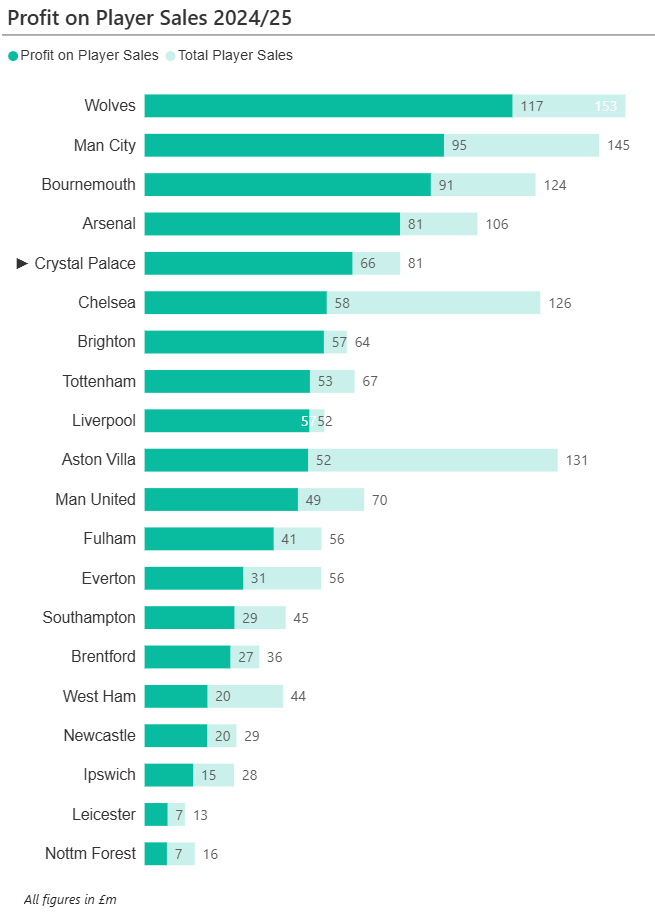
Collectively, these transactions generated around £80 million in transfer fees, of which approximately £66 million was recognised as accounting profit (being the difference between sale proceeds and the players’ net book value). Olise was the standout departure, having originally joined from Reading for £8 million in 2021.

Palaces profits from player sales ranked fifth highest in the league, and were the main factor in the club reporting a profit.
This season, two more key players have left the club, with Eberechi Eze joining Arsenal for £60 million and Marc Guéhi moving to Manchester City for a reported £20 million. The fee for Guéhi was relatively low for an England international centre-back, although his contract was approaching its final stages.
Both sales are expected to generate strong accounting profits, estimated at a combined £45–50 million.
Profit and Loss
By Premier League standards, Crystal Palace operate with a highly controlled financial model. As a smaller club, their revenue is closely tied to Premier League performance, with central distributions accounting for more than 70% of total income. Costs have remained relatively stable, with only modest increases in wages and operating expenses, allowing the club to consistently generate a positive EBITDA (earnings before interest, taxation, depreciation and amortisation). Outside the traditional “big six”, few clubs achieve this consistently, and Palace’s EBITDA margins are generally among the strongest in the league, albeit at relatively modest levels.
Player amortisation has also grown gradually, reflecting annual squad investment of around £80 million. As a result, the club still records operating losses, though these remain among the lowest in the Premier League.
Where Palace differs from many other clubs is in its limited reliance on player trading. Prior to 2024/25, the club generated relatively little income from player sales, meaning operating losses flowed directly to the bottom line. Across the five seasons preceding 2024/25, Palace recorded combined losses of £191 million. This highlights the financial challenge faced by small to mid-sized Premier League clubs: even a disciplined and well-managed model is likely to produce losses without regular player sales.
The model shifted in 2024/25. Costs increased, partly due to the club’s FA Cup run, while significant player sales — including Michael Olise, Joachim Andersen and Sam Johnstone — generated substantial profits on disposal. Although operating losses increased, these sales helped Palace record their first overall profit in six years.


Breaking down the 2024/25 profit and loss account, Crystal Palace generated total revenue of £197 million, an increase of £6 million year-on-year. Wage costs rose by £15 million, likely reflecting FA Cup-winning bonuses, while other operating expenses increased by £6 million, partly due to the additional matches played during the cup run. As a result, EBITDA (earnings before interest, tax, depreciation and amortisation) declined by £14 million to £15 million.
After accounting for £54 million in player amortisation and £6 million in depreciation, the club recorded an operating loss of £45 million. While still significant, this was the fourth-lowest operating loss in the Premier League, behind only Liverpool, Manchester United and Ipswich Town.
The operating loss was largely offset by £66 million of profit from player sales. After also accounting for £15 million in interest expenses, Palace reported a net profit of £5 million, making them one of only four Premier League clubs to record a genuine profit without relying on one-off asset sales.
In 2024/25, Chelsea recorded the largest loss at £262 million, the biggest ever reported in the Premier League. Six clubs reported a profit, while total losses across the league amounted to £795 million.
Three clubs generated profits from one-off asset sales in 2024/25. Newcastle recorded £133 million, primarily from the sale of their stadium leasehold improvements. Aston Villa generated £113 million through the sale of their women’s team and fan zone operating rights. Everton also recorded a £49 million gain from the sale of their women’s team and Goodison Park Limited. All these transactions were conducted within their respective ownership groups.
If these asset sales are excluded, total losses across the league would exceed £1 billion for the year, the highest on record. These losses must be funded, and an additional £1.6 billion of new finance was raised by clubs, primarily to cover operating shortfalls as well as investment in assets.

Net Assets
Net assets represent the difference between total assets and total liabilities and correspond to the club’s net equity.
Assets include fixed assets—such as player registrations, facilities, and goodwill—as well as current assets like trade debtors, transfer fees receivable, and cash.
Liabilities comprise loans (from banks, shareholders, or group companies), transfer fees payable, trade creditors, deferred income (for example, advance season ticket sales), and other financial provisions.
At the football entity level (CPFC 2010 Limited), the club has been in a net liability position for the past six years.
At the end of 2024/25, the club reported total assets of £260 million, comprising £161 million in player registrations at net book value, £59 million in fixed assets (primarily the stadium and training facilities), and £40 million in other assets.
These assets were offset by total liabilities of £296 million, including £95 million of external borrowings, £26 million owed to the parent company, and £79 million in transfer fee payables, with the balance relating to other liabilities and provisions.
The club’s balance sheet is expected to change significantly once development of the new main stand begins, with the project estimated to cost around £200 million. To date, the company has invested £24 million in assets under construction, primarily relating to early-stage development and preparatory works.
Current indications suggest the redevelopment will be funded primarily through equity injections at the parent company level, with £37.5 million provided during 2024/25.


The table below shows the net asset positions of Premier League clubs, with Crystal Palace's net liabilities of £36 million the lowest amongst current Premier League clubs.

Player Trading
Since the club’s acquisition in 2021, investment in new players has remained consistently around £80 million per year. While there have inevitably been some unsuccessful signings, such as Matheus França, Palace have also recruited and developed a number of highly valuable players during this period, including Eberechi Eze, Marc Guéhi, Cheick Doucouré, Michael Olise, Adam Wharton and Daniel Muñoz.
The club has also maintained a notably stable squad, with no major player sales in the three years leading up to 2024/25.
.

In 2024/25, Crystal Palace’s player investment again remained around the £80 million mark, with Eddie Nketiah the club’s most expensive signing, although he endured a difficult first season at Selhurst Park.
For the first time in several years, Palace also sanctioned the sale of several key players. The most significant departure was Michael Olise, who joined Bayern Munich for £50 million — a club-record sale at the time. Olise has since excelled in Germany, with Transfermarkt valuing him at more than £100 million.
Dir | Player | Club (From/To) | Age | Window | Est. Fee (£) |
IN | Ismaïla Sarr | Marseille | 26 | Summer | £12.5m |
IN | Maxence Lacroix | VfL Wolfsburg | 24 | Summer | £18m |
IN | Eddie Nketiah | Arsenal | 25 | Summer | £25m |
IN | Romain Esse | Millwall | 19 | Winter | £12m |
OUT | Michael Olise | Bayern Munich | 22 | Summer | £50m |
OUT | Joachim Andersen | Fulham | 28 | Summer | £25m |
OUT | Jordan Ayew | Leicester City | 32 | Summer | £4m |
OUT | Sam Johnstone | Wolverhampton Wanderers | 31 | Summer | £10m |
Comparing Crystal Palace’s transfer activity with other Premier League clubs over the past three years, they rank as the fourth-lowest spenders, with only Everton out of the current Premier League clubs investing less due to their well-documented financial constraints.
Palace’s net spend (acquisitions less sales) is also towards the lower end of the league, although it remains higher than Brighton, Wolves, Aston Villa, and Everton.

This season, following FA Cup success, the club has increased its level of investment, with over £100 million spent on new signings including Strand Larsen, Johnson, Pino and Canvot.
They also recorded a new club-record sale, with Eberechi Eze joining Arsenal for £60 million, alongside the departure of Marc Guéhi to Manchester City.
Squad Cost and Net Book Value
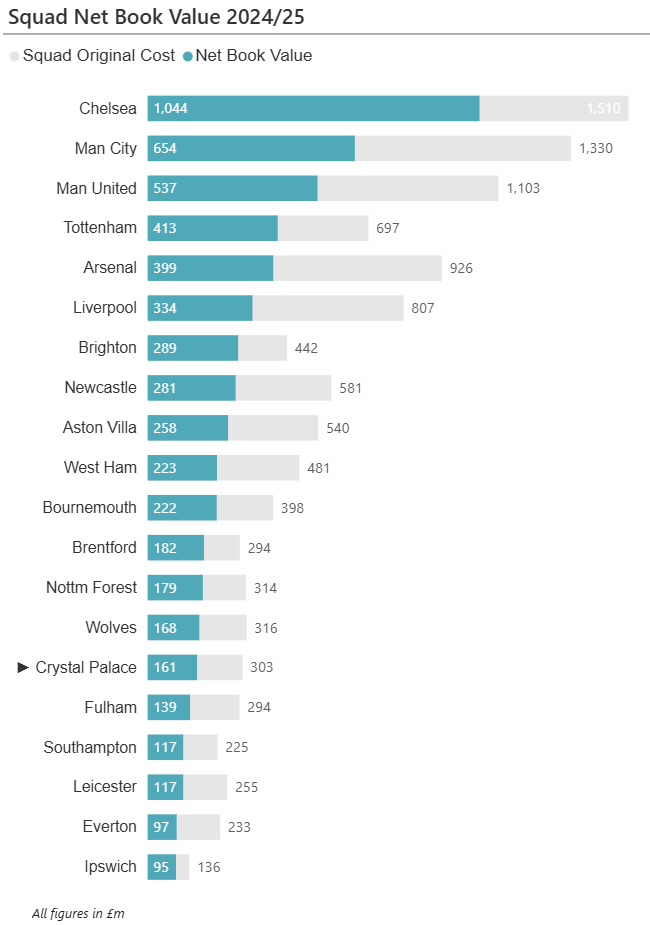
Squad costs represent the total acquisition cost of all squad members, including transfer fees and associated costs such as agent fees. A squad’s Net Book Value (NBV) represents this acquisition cost less accumulated amortisation, with transfer fees expensed over the length of each player’s contract. For example, a player purchased for £50 million on a five-year contract would have an NBV that decreases by £10 million each year.
Crystal Palace’s net book value of player registrations has grown steadily over the past four years. With approximately £80 million invested in players annually and amortisation charges of £40–50 million, combined with relatively limited player sales during this period, the squad’s carrying value has continued to increase.
As a result, future amortisation charges are expected to rise further, reflecting the higher book value of the playing squad.

While the net book value has grown, it remains relatively modest at £161 million. Within the current Premier League, only Fulham and Everton have lower squad values.
Squad Market Value
The squad's net book value (NBV) is part of the club balance sheet, recorded as Intangible Player Assets. The NBV does not however reflect a squad’s current market value.
According to Transfermarkt.com, Crystal Palace’s squad had an estimated market value of around £448 million at the end of the 2024/25 season, ranking tenth in the Premier League. This provides a useful indication of how the club has enhanced squad value despite relatively low levels of player trading compared with most rivals.
The estimated market value is approximately £287 million higher than the club’s net book value. Some uplift is expected, as transfer fees are typically amortised over five years, while a player’s career span is considerably longer. However, the gap also highlights the underlying quality retained within the squad and the potential to generate significant profits from future player sales.
This estimated £287 million uplift is the fifth highest in the league, behind Liverpool, Arsenal, Manchester City and Brighton.

The most valuable players at the end of 2024/25, according to Transfermarkt’s estimates, are:
Player | Age (Jul 24) | Date Joined | Previous Club | Est. Transfer Fee (£) | Est. Market Value £m |
Eberechi Eze | 26 | Aug 2020 | QPR | £17m | £51m |
Marc Guéhi | 23 | Jul 2021 | Chelsea | £18m | £38m |
Adam Wharton | 20 | Jan 2024 | Blackburn Rovers | £18m | £34m |
Ismaïla Sarr | 26 | Aug 2024 | Marseille | £12.5m | £25m |
Jean-Philippe Mateta | 27 | Jan 2021 | Mainz 05 | £14m | £25m |
Maxence Lacroix | 24 | Aug 2024 | Wolfsburg | £18m | £21m |
Daniel Muñoz | 28 | Jan 2024 | Genk | £6.9m | £19m |
Both Eze and Guehi have since been sold.
Football Net Debt
At the football club entity (CPFC 2010 Limited) funding has been primarily through loans, both external and from the parent company. Since the club’s acquisition in 2021, funding has been primarily provided through new share issues, meaning levels of external debt have remained relatively stable in recent years.
At the end of 2024/25, Crystal Palace had £95 million in external loans, including a £30 million bank loan and £64 million advanced against future Premier League distributions. In addition they owed their parent company £26 million, which are interest free. During the year £50 million owed to the parent company was converted to equity. Their debt was partially offset by £14 million in cash reserves.
Following the year-end, the club repaid both of these facilities in full and subsequently entered into a new £150 million loan agreement.

Premier League clubs’ total debt is expected to reach £3.3 billion, a slight decrease from the previous year.
Tottenham Hotspur carry the highest level of debt—primarily driven by stadium financing—followed by Manchester United, reflecting their highly leveraged ownership structure under the Glazer family. Crystal Palace’s net debt (after cash) of £94 million ranks as the thirteenth highest in the league.

Crystal Palace also have outstanding transfer fees payable to other clubs of £79 million, partially offset by £13 million in transfer fees receivable. This relatively modest level of receivables suggests that Bayern structured Michael Olise’s transfer in a way that involved a large upfront payment, with most of the fee recognised early rather than spread over multiple instalments.

Cash Flow
Cash Flows are reported in three categories:
Cash Flows from Operations refer to cash generated from the club’s core activities—revenue minus day-to-day costs such as salaries, rent, and utilities.
Cash Flows from Investments include cash spent on player acquisitions and facility improvements, net of player or asset sales.
Cash Flows from Financing cover new loans or equity raised, less repayments or buybacks. If operational cash flow cannot fund investments, the shortfall is usually met through financing.
The cash flow statement highlights the club’s underlying financial dynamics. Crystal Palace generate relatively healthy operating cash flows, which help to fund a portion of their net player investment. However, there remains a funding gap, which has primarily been covered through loans from the parent company.
Looking at the past three years (to smooth annual volatility), the club has recorded cumulative operating cash inflows of £65 million. Over the same period, it has invested £178 million in players and £32 million in facilities, while generating £71 million from player sales. The resulting funding gap has been financed through £81 million of new borrowing (of which £50 million was converted to equity).

Reporting Entity
This analysis is based on entity CPFC 2010 Limited for the period from 1 July 2024 to 30 June 2025. CPFC 2010 is wholly owned by Palace Midco UK Limited, which in turn is wholly owned by Palace Holdco Limited. At the end of the 2024/25 season, there was no single majority owner of Palace Holdco, with shares held by:
Eagle Football Holdings (44.9% – John Textor)
Palace Holdco LP (37.6% – Harris and Blitzer)
Steve Parish (9.7%)
Stephen Browett (2.7%)
Jeremy Hosking (2.7%)
Kloof Capital (1.7%)
Since the end of the financial year, Eagle Football Holdings has sold its stake to New York Jets owner Woody Johnson for a reported £190 million, implying an overall club valuation in excess of £400 million.


Comments