
Charlton Athletic Financial Results 2024/25.

Promotion at Wembley, a widening loss, and a return to the Championship paid for through debt
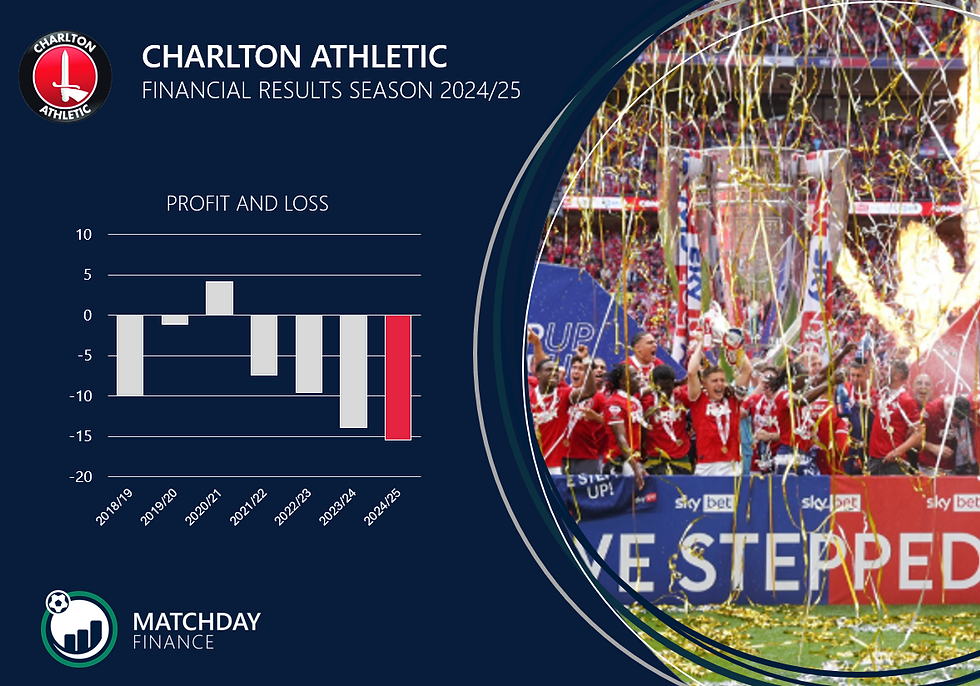
The 2024/25 season ended a five-year exile from the Championship for Charlton Athletic, sealed with a play-off final win over Leyton Orient at Wembley. It was the first full season under head coach Nathan Jones, who arrived in February 2024 with the club sitting in the relegation zone.
Ownership of the club passed to Global Football Partners, via subsidiary SE7 Partners, in July 2023, ending the turbulent Thomas Sandgaard era. The 2024/25 season was the first played entirely under the new ownership structure, and saw a boardroom change of its own: James Rodwell chaired the club until December 2024, when Gavin Carter — a member of the Charlton Athletic Supporters' Trust — took over as non-executive chairman.
Charlton had finished 16th in League One in 2023/24, their lowest league position in almost a century, and posted a club-record loss that year. The turnaround on the pitch in 2024/25 helped lift turnover with higher crowds — though, as it typical at this level, the cost of competing rose even faster.
Financial highlights:
Promotion secured at Wembley. Charlton finished 4th in League One and won the play-offs, beating Leyton Orient in the final to return to the Championship after five seasons away.
Turnover grew by more than a quarter. Turnover rose 27% to £11.2 million, from £8.8 million, driven by promotion-chasing attendances in the second half of the season.
But the loss grew even faster. Pre-tax loss widened to £15.4 million, from £13.9 million the year before — itself a club-record loss at the time — as costs continued to outpace the revenue growth.
Wages rose nearly 30% to fund the promotion push. Salaries and wages increased to £15.7 million, from £12.1 million, taking total staff costs to £16.7 million, or 149% of turnover.
Ownership funded the gap through loans this year. Related-party debt more than doubled, to £25.9 million from £11.7 million, as owners financed the promotion campaign primarily through lending rather than fresh equity.
Net liabilities deepened significantly. Net assets fell to -£38.0 million, from -£22.7 million, tracking the year's heavier loss.
Debt relative to turnover rose sharply. Net debt reached 282% of turnover, up from 183% the year before., as debt grew faster than the year's strong revenue growth.
Player trading stayed modest. Profit on player sales was £1.4 million, roughly double the prior year's contribution, but still a small figure against the scale of the club's overall loss.
Financial Outlook 2025/26
Whilst the club hovered just above the relegation zone for much of their first season back in the Championship, they finished 2025/26 in 19th place, six points clear of relegation.
Financial results for 2025/26 won’t be available until March 2027, but revenues are expected to increase, with higher EFL broadcast distributions and Premier League solidarity payments lifting income by around £9 million. In addition, higher attendances, averaging around 20,000 compared with 15,000 the previous season, should increase matchday revenue by around £2 million to £7 million. Combined with improved commercial opportunities, we expect total revenue to reach around £22 million, up £11 million on the previous season.
Costs are expected to increase as well, however, meaning there is little likelihood of Charlton reporting a profit in 2025/26. We expect a loss of around £10 million, lower than the £15 million reported in 2024/25. These losses will need to be funded and, with no further equity injections, this is likely to have come through increased debt.
Charlton’s short-term ambition is to establish themselves firmly in the Championship. While this suggests a more controlled approach to investment, it still won’t come cheap, with the average Championship club recording a loss of more than £14 million in 2024/25.
Turnover
Revenue is generated from three primary streams: matchday income (ticket sales), broadcast distributions from the EFL and Premier League (in the form of solidarity payments), and commercial activities including sponsorship, merchandising and other business operations.
Charlton's turnover rose to £11.2 million in 2024/25, up 27% from £8.8 million the year before, as promotion-chasing form drove crowds and commercial activity higher across the season.
Charton's revenue ranked sixth highest in League One.
Matchday Revenue
Charlton play at The Valley, a 27,111-capacity stadium in south-east London that the club has occupied since 1919 (with a period away between 1985 and 1992).
Average attendance rose to 15,255, from 13,481 the year before (+13%), lifting stadium occupancy to 56.3% of The Valley's capacity, from 49.7%. The season's highest attendance, 25,722 for the visit of Wycombe Wanderers in the play-offs, reflected the scale of interest generated by the promotion run-in.
Matchday income rose to £5.0 million from £4.5 million, an increase of 11% — a smaller rise than the jump in attendance alone might suggest. Revenue per fan actually fell slightly, to £13.08 from £13.99, indicating that the additional attendance came at a blended ticket price below the club's existing average..
Broadcast Revenue
Broadcast income rose modestly to £2.5 million from £2.3 million, in line with League One's small but relatively evenly distributed central funding pool relative to the Championship above it.
Commercial Revenue
Commercial income rose 34% to £1.9 million, from £1.4 million, the fastest-growing of the club's three main revenue lines, reflecting increased sponsorship and matchday-linked commercial activity around the promotion campaign. "Other" income also rose sharply, to £1.8 million from £0.6 million.
Charlton's principal commercial partnerships during 2024/25 included Castore as kit manufacturer, RSK Group as sponsor of the home and third shirts, and the University of Greenwich as away-shirt sponsor. Separately, engineering and environmental consultancy ITRM has sponsored the Charlton Athletic Community Trust and staff kit for over a decade, a relationship extended to 2030 shortly after this financial year closed.
Stadium and Infrastructure
Charlton play at The Valley, a 27,111-capacity stadium in south-east London that the club has occupied since 1919 (with a period away between 1985 and 1992). Fixed asset spending was modest in 2024/25, at £1.1 million, broadly in line with recent seasons, as the club prioritised squad investment over infrastructure during the promotion push.
Club ownership has since pointed to a "continuation of our planned refurbishment programme at The Valley" as part of preparing for life in the Championship, alongside record season ticket sales and attendances for 2025/26 — investment that sits outside the period covered by these results but signals a step-up in stadium spending to come.
Staff Costs
Staff costs comprise salaries and wages, the amortisation of transfer fees (spreading a player's acquisition cost over the length of their contract), and any impairment charges.
Salaries and wages rose 30% to £15.7 million, from £12.1 million, as the club backed Nathan Jones's promotion push with a significantly larger playing budget. Player amortisation rose to £0.9 million from £0.8 million, a relatively modest increase reflecting a squad built more through wage investment and undisclosed-fee signings than headline transfer spending.
Total staff costs reached £16.7 million, or 149% of turnover, up from 147% the year before — the ratio barely moved despite the near-30% rise in wages, because turnover grew almost as fast.
Charlton's total staff costs ranked fifth highest in League One.
Profit from Player Sales
Profit on player sales rose to £1.4 million in 2024/25, from £0.7 million the year before — near-identical to total sales income of the same amount, implying the departing players carried little to no remaining book value at the time of sale.
Top scorer Alfie May, sold to Birmingham City at the start of the summer, had joined Charlton for an undisclosed fee from Cheltenham Town and would have been substantially amortised after a single season, leaving most of the sale proceeds to flow straight through as profit. Midfielder Conor McGrandles's move to Lincoln City likely followed a similar pattern — a squad built on low-cost transfers tends to generate high-margin profit on sale almost by default, since there is little amortised cost left to offset.
Salary Cost Management Protocol
League One clubs are governed by the Salary Cost Management Protocol (SCMP) rather than the Championship's loss-based Profitability and Sustainability rules, with a standard cap on player wage costs of 60% of turnover. Because Charlton entered the season already playing in League One rather than freshly relegated into it, they did not qualify for the higher allowance available to clubs newly down from the Championship.
On the figures reported here, salaries alone reached 141% of turnover and total staff costs 149% — both far above the standard 60% threshold on a simple accounts basis. SCMP's definition of turnover can include guaranteed funding from ownership, and it is almost certainly this mechanism, backed by Global Football Partners, that kept Charlton's spending within the rules. There is no indication the club breached SCMP or faced any sanction in 2024/25.
Profit and Loss
Charlton reported a pre-tax loss of £15.4 million in 2024/25, up from £13.9 million the year before — a further increase on what was already, at the time, a club-record loss.
Turnover grew by £2.4 million, but staff costs alone grew by £3.7 million, meaning cost growth outpaced revenue growth even in a season of strong commercial and matchday progress. Profit on player sales of £1.4 million provided a partial offset, roughly double the prior year's contribution, but nowhere near enough to close the gap on its own.
The picture is consistent with a club that spent to secure promotion and got the result it was looking for on the pitch.
Net Assets
Net assets represent the difference between total assets and total liabilities, and correspond to a club's net equity position.
Charlton's net liabilities widened to -£38.0 million in 2024/25, from -£22.7 million the year before, tracking the year's heavier loss. This marks a change in funding pattern from the prior year: in 2023/24, a substantial equity injection from ownership (reflected in a roughly £21 million increase to the club's reserves) had helped strengthen the balance sheet alongside a reduction in borrowing. In 2024/25, by contrast, no new share capital was injected, and the funding gap was instead closed through related-party loans, which more than doubled over the year.
Retained earnings — the accumulated total of the club's losses over time — deepened to -£86.9 million from -£71.5 million, moving in step with the year's reported loss.
Player Trading
Charlton spent £1.8 million on player acquisitions in 2024/25, against £1.4 million recovered in sales — a modest net spend of £0.4 million, with the club's recruitment strategy leaning more on free transfers and undisclosed-fee signings than headline transfer spending.
The most significant departure was top scorer Alfie May, who left for League One rival Birmingham City at the start of the summer window after a single, prolific season at The Valley in which he had won the division's Golden Boot despite Charlton's 16th-place finish. His departure prompted the signing of Matty Godden from Coventry City for an undisclosed fee, who went on to fill the goalscoring void as Charlton's fifth summer signing and finished the promotion campaign as top scorer. Midfielder Conor McGrandles also left for Lincoln City during the same window, while experienced midfielder Luke Berry was among the club's incoming signings as Jones rebuilt his squad following his first partial season in charge.
Squad Cost and Net Book Value
A squad's net book value (NBV) represents the acquisition cost of its players, less accumulated amortisation. Charlton's squad NBV rose to £1.8 million from £1.2 million, a modest increase consistent with a rebuild funded more through wages than transfer fees.
As with several other clubs in this division, no individual player in Charlton's 2024/25 squad carried an estimated market value above £3 million. The club's most valuable asset by market-value estimates was academy-developed striker Miles Leaburn, valued in the region of £700,000–800,000 — some way below the threshold, and a reminder that Charlton's promotion was built on coaching and squad cohesion under Nathan Jones rather than on assembling individually high-value talent.
Football Net Debt
Charlton's total loans rose to £31.9 million at the end of 2024/25, up from £17.4 million the year before — an increase of 83%, driven almost entirely by related-party borrowing from ownership, which more than doubled to £25.9 million from £11.7 million. Third-party loans were broadly unchanged, at £6.0 million.
Against modest cash reserves of £0.5 million, net debt reached £30.0 million, up from £16.5 million. Relative to turnover, that equates to 282% of revenue, up sharply from 183% the year before — debt growing considerably faster even than the year's strong 27% turnover increase.
Cash Flow
Cash flows are reported in three categories: cash from operations (revenue less day-to-day running costs), cash from investing activity (player and infrastructure spending, net of sales), and cash from financing (new loans or equity raised, less repayments).
Charlton recorded a £12.6 million operating cash outflow in 2024/25, worse than the £9.3 million outflow the year before, as the promotion push's cost increases fed directly through into cash burn. Investing activity was relatively contained, with £1.8 million spent on player acquisitions and £1.1 million on fixed assets, partly offset by £1.4 million recovered from player sales.
Financing tells the clearest story of how the year was funded: £14.5 million was drawn down in loans, a sharp contrast with the prior year, when £21.3 million in new share capital had been raised and £10.2 million of loans repaid. Cash reserves nonetheless rose modestly, closing the year at £0.5 million, up from a negligible balance of £21,000 the year before.
Reporting Entity
This analysis is based on the entity Charlton Athletic Football Company Limited, for the period 1 July 2024 to 30 June 2025. The accounts cover the men's first-team business only. The company is a subsidiary of SE7 Partners Limited, whose ultimate parent, Global Football Partners Limited, is incorporated in the Cayman Islands.


Comments