
EFL League One Financial Results Season 2023/24

Updated: Sep 23, 2025
The 2023/24 EFL League One marked the 20th season in its current format. It concluded with Portsmouth (as Champions), Derby and Oxford earning promotion to the Championship, while Cheltenham, Fleetwood, Port Vale and Carlisle were relegated to League Two.

League One is the third tier of English football and one of the most competitive divisions, with 10 to 12 clubs realistically capable of promotion in any given season. Unlike the Premier League, where the “big six” dominate financially, or the Championship, where parachute payments distort competition, the financial gaps between League One clubs are smaller.
That said, the division regularly features historically big clubs with large fanbases, giving them a clear financial edge. In 2023/24 this included Derby County, Portsmouth, and Bolton, while in recent years Ipswich Town, Sheffield Wednesday, and Sunderland have also been present. In the 2024/25 season, the impact will be even more pronounced with Birmingham City and Wrexham both bringing significant financial resources.
Financial pressure is a constant across the league. Central distributions from broadcasting and Premier League solidarity payments amount to just £1.5–2 million per club, compared to £9–10 million in the Championship. Most clubs operate at a loss — the average deficit in 2023/24 exceeded £5 million. To cover this, over £120 million of new funding was injected into League One last season. In short, clubs depend heavily on owners with both financial strength and long-term belief in their club.
League One has often served as a landing place for clubs that have fallen on hard times. Sunderland spent four years in the division before climbing back up the pyramid, while Bolton tumbled from the Premier League into financial crisis and administration, and are still rebuilding from the third tier. Derby County endured a similar decline. In 2023/24, two clubs were also hit with points deductions for failing to pay wages on time: Wigan docked eight points for repeated breaches, and Reading six.
The league also plays an important role in player development. Many Premier League clubs send young prospects on loan to League One sides, often subsidising wages to give them valuable first-team experience. While this boosts quality in the short term, it can also cause instability with frequent turnover of loanees.
Crucially, League One clubs remain at the heart of their communities. Though the financial numbers are modest compared to the Championship, these clubs have served their local areas for generations, in some cases for more than a century. Popularity is rising too: median attendances in 2023/24 surpassed 8,000, up 25% compared with pre-COVID levels.
In summary, League One is a fiercely competitive and financially demanding division but a vital part of the English football pyramid both on and off the pitch.
Small Company Exemption
Some smaller clubs file accounts under the “small companies” exemption. This means they are not required to disclose detailed revenue and cost information, with reporting limited to assets, liabilities, and overall profit figures.
For these clubs, listed below, revenue and cost figures have been estimated:
Port Vale
Wycombe Wanderers
Stevenage
Cheltenham Town
Fleetwood Town
Salary Cost Management Protocol
League One is governed by the Salary Cost Management Protocol (SCMP), which differs from the Championship’s Profit & Sustainability (P&S) rules, themselves closely aligned to the Premier League framework.
Under the SCMP, clubs may spend up to 60% of their income on player-related costs, including wages and transfer fees. Income for this calculation covers matchday revenue, broadcast distributions, solidarity payments, commercial income, and profits from player sales.
Clubs may also include approved owner equity funding within their income. Loans are excluded, but guaranteed equity injections can count. In 2023/24, 100% of equity funding could be allocated to wages, though this has since been capped at 60%. Even so, owners are effectively able to underwrite unlimited spending on player costs, as demonstrated last season by Birmingham City and Wrexham.
Penalties for breaching the SCMP include transfer embargoes, restrictions on registering new players, and, in repeat or severe cases, points deductions. The EFL also issues sanctions for failures such as the late payment of wages or taxes.
In recent years, several clubs have been penalised — sometimes for issues carried over from the Championship:
Wigan Athletic (2022/23 and 2023/24): Eight points deducted and embargoes for repeated late payment of wages.
Reading (2023/24): Docked six points for late wage payments and overdue HMRC liabilities.
Derby County (2022/23): Operated under a transfer embargo due to historic P&S breaches in the Championship.
Sheffield Wednesday and Bolton Wanderers: Both received points deductions in earlier seasons, also linked to historic Championship breaches.
Seasons 2023/24 Financial Summary
The financial profile of League One is heavily shaped by the mix of clubs in the division each season. In 2023/24, three “large” clubs — Bolton, Derby, and Portsmouth — boosted overall revenue to £213 million. However, this was lower than the £236 million recorded in 2022/23, when four large clubs were present.
Median revenue, however, provides a clearer picture of underlying growth. The 2023/24 median was £7.6 million, up slightly from £7.4 million in 2022/23. Median is used here rather than average, as it reflects the performance of mid-ranked clubs (12th and 13th in revenue terms) and avoids distortion from the very largest outliers.
Staff costs hit record levels of £218 million in 2023/24, up from £205 million the prior year. This represented 102% of turnover. When combined with other operating expenses, the league recorded a collective loss of £125 million — the highest in its history. The clear trend is that costs, particularly player wages, are rising faster than revenues, leading to widening losses.
As a result, the division is increasingly reliant on external funding. In 2023/24, fresh injections of £120 million were required, with no fewer than 18 clubs seeking new capital. While many clubs speak of sustainability, the financial reality is that very few are close to achieving it.
Turnover
League One clubs generated total revenue of £213 million in 2023/24, down from £236 million the previous season.
Estimated matchday income fell to £69 million (from £78 million), reflecting changes in the mix of clubs and average attendances.
Commercial revenue was also lower, estimated at £91 million, compared with £103 million in 2022/23.
Staff Costs
Total staff expenditure rose 6% to £218 million, the highest figure ever recorded in League One. This represented 102% of total turnover.
Profits from player sales were estimated at £30 million, although not all clubs disclose this information. Barnsley reported the highest individual figure at £7.7 million.
Profitability
Only one club, Carlisle United, reported a profit, aided by a loan write-off.
No club achieved positive EBITDA (Earnings before Interest, Tax, Depreciation, and Amortisation).
Oxford United posted the largest individual loss at £16 million (although that included £5 million 'stadium' related costs), followed by Derby County and Reading.
Overall, League One recorded a combined loss of £125 million, up from £117 million in 2022/23 — the worst in the league’s history — averaging £5.1 million per club.
Player Trading
Clubs spent £13 million on player acquisitions while generating £33 million from player sales.
Football Net Debt
Total loans rose by £103 million to £356 million, with Reading holding the highest debt burden at £80 million.
Approximately 90% of this debt is owed to related parties, mainly owners and associated entities.
Cash Flow
Investment in facilities totalled £24 million.
To cover operating shortfalls, clubs raised £48 million in new equity and an additional £71 million in loans.
Ownership
Two clubs had a change of ownership in 2023/24. Wycombe Wanderers were taken over by Kazakhstan billionaire Mikheil Lomtadze and Charlton were bought by SE7 Partners, a group of investors led by former Sunderland executive Charlie Methven.
Ownership was spread with 11 clubs under UK control, 4 under US ownership, 1 jointly owned by UK and US interests, and the remainder spread across eight other countries. Exeter City were the only fan-owned club in League One.

These figures underline the financial risks within League One. Unlike the Championship, where player trading can help offset operating losses, League One clubs remain heavily reliant on owner funding to sustain operations.

Seasons 2023/24 Revenue
Revenue is generated from several key streams: matchday income, central distributions from the EFL (broadcasting rights), Premier League support (solidarity payments and academy grants), and the club’s own commercial activities, including sponsorship, merchandise, and other income sources.
Overall revenue declined in 2023/24 to £213.1 million, down from £236 million in the prior season. The chart below also highlights the significant effect of the COVID-19 period on League One finances, with revenue falling to just £130 million in 2020/21.

The decline in 2023/24 was primarily due to changes in the club mix. In 2022/23, the division included Ipswich, Sheffield Wednesday, and Plymouth, each generating turnover above £15 million.
By contrast, median revenue — measured as the average of the 12th- and 13th-ranked clubs — rose slightly from £7.4 million to £7.6 million. This is now 20% higher than pre-COVID levels, equivalent to annual growth of 3.7%. While encouraging, this rate of increase continues to lag behind the growth in staff costs.

Bolton Wanderers recorded the highest revenue at £21.3 million, boosted by income from their integrated stadium hotel, which contributes an additional £3–4 million annually and offers guests pitch-view rooms. Derby County and Portsmouth also reported strong revenues, driven largely by the scale of their supporter bases and overall club size.

Matchday Revenue
Matchday revenue is driven by several factors, including the number of home fixtures, average attendance, ticket pricing, and a club’s success in generating income from hospitality and events. The main exception is domestic cup ties, where income is shared between the competing clubs and the FA.
Only 14 of the 24 League One clubs report matchday revenue separately. For the remainder, estimates have been included based on attendance figures and typical revenue per supporter.
The division features a number of impressive grounds, with relatively new stadiums at Bolton, Reading, Wigan, Shrewsbury and Derby, and 10 clubs having capacities of more than 15,000. Average attendances fell from 10,654 in 2022/23 to 9,731 in 2023/24, mainly due to changes in the club mix. On a like-for-like basis (excluding clubs promoted or relegated between seasons), attendances rose slightly from 9,993 to 10,115.
Stadium utilisation remains relatively modest, with League One grounds operating at an average of 65% capacity. Wigan had the greatest availability at just 40% capacity, while Portsmouth led the way at 91%.
On average, clubs generated £11.92 per paying fan (yield), equivalent to £103,000 per home fixture. By comparison, Championship clubs generated an average of £15.48 per fan a £340,000 per home fixture.
Overall, matchday revenue in League One was estimated at £69.1 million in 2023/24, down from £78 million the previous year. Derby County generated the highest figure at £7.6 million, supported by the league’s largest average attendance of 27,278. Portsmouth and Bolton also recorded strong matchday income, reflecting their consistently high crowds.

Broadcast Revenue and other Central Distributions.
Broadcast deals, primarily with Sky Sports, are negotiated centrally by the EFL and then distributed to member clubs after costs. In 2023/24, approximately £160 million was distributed across all EFL clubs, with around £25 million allocated to League One. This meant that each League One club received roughly £1–1.2 million.
League One clubs also benefit from Premier League solidarity payments, which allocate a portion of Premier League broadcast revenue to lower-league clubs to support the football pyramid. In 2023/24, these payments were worth around £0.7–0.8 million per club.
In addition, clubs may receive EPPP (Elite Player Performance Plan) grants to support their academies. Funding levels depend on the academy’s category, graded from 1 to 4. Most League One clubs operate Category 3 academies, while a few of the larger clubs maintain Category 2. Category 3 academies typically receive around £700,000 per season, whereas Category 2 clubs can receive over £1 million.
Commercial Revenue
Commercial revenue, which includes sponsorships, merchandise sales, stadium tours, and other related activities, was estimated at £85 million in 2023/24. This represented a decline from £99 million in the previous season, largely due to the change in club mix. Promoted sides Ipswich, Sheffield Wednesday, and Plymouth each generated relatively high commercial income, so their departure reduced the overall total.
Main sponsors across League One come from a wide range of industries. Unlike in the Premier League and Championship, gambling companies play only a minor role, with Blackpool being the sole club to feature a betting brand as its primary sponsor. Few clubs disclose sponsorship income in detail, but where available, it typically amounts to around £800,000 per year for mid-sized clubs such as Barnsley, rising to more than £1.6 million for larger clubs like Derby.
Only 14 of the 24 clubs report commercial revenue separately, so estimates are used for the remainder. Bolton leads the way in this category, benefiting from the year-round income generated by its integrated hotel, which provides a unique additional revenue stream.

Season 2023/24 Staff Cost
Staff costs consist of club salaries, wages, and player amortisation (spreading transfer fees across the length of a player’s contract).
In 2023/24, staff costs increased by £12 million to £218 million — the highest figure ever recorded in the division. The rise was driven mainly by wage inflation across the league, though the change in club mix also had some impact. Most clubs, however, experienced higher costs.

Excluding clubs that were promoted or relegated, staff costs across the remaining 17 clubs rose by 17%. By comparison, revenue growth among the same group was just 2.3%, highlighting a worrying trend that can only lead to larger losses.
This increase covers total staff costs — including players, management, and administrative staff. Given that non-playing staff are unlikely to have received such substantial pay rises, actual player wage growth is estimated at 20–25%, which is even more concerning.
Derby County recorded the highest staff costs at £22.3 million, up 17% on the prior season and equal to 115% of turnover. Significant increases were also reported at Bolton (34%), Oxford (32%), Portsmouth (30%), and Charlton (18%). As expected, recently relegated clubs saw sharp reductions in costs — Reading fell 52%, Wigan 49%, and Blackpool 27%. In contrast, clubs promoted from League Two posted large percentage increases, though their overall staff costs remained at the lower end of the division.

A common benchmark is whether a club outperforms its staff costs budget. For instance, if a club had the 12th-highest budget in the league but finished 8th, it would be considered to have outperformed expectations by four places.
While there is a widely held view that staff costs and league performance are closely linked — and generally this is true — League One provides numerous examples of both overperformance and underperformance.
In 2023/24, Stevenage ranked top of the overperformance list, finishing 9th despite operating on what we estimate (as detailed figures are not published) to be the lowest staff budget in the league. Exeter, Portsmouth, and Peterborough also strongly outperformed their budgets.
At the other end, Charlton, Fleetwood, and Reading all underperformed relative to their staff costs.

Profit on Player Sales
Player sales provide an important source of additional income for League One clubs. While transfer fees are generally modest compared with higher divisions — with standout deals typically in the £3–4 million range — such sums can have a significant impact for clubs with turnover around £7 million.
The 2023/24 season was particularly strong in this regard, with player sales generating £30 million in profit — the highest level since 2018/19.

Barnsley led the league in profits from player sales, boosted by the departures of Liam Kitching and Mads Andersen, followed by Derby and Peterborough. Peterborough stand out in particular, having generated over £18 million from player sales in the past five years — four of those seasons spent in League One. Their most notable transfers over that time include Ivan Toney and Ephron Mason-Clark, each sold for over £4 million.

Season 2023/24 Profit and Loss
League One faces a major profitability problem. In 2023/24, turnover reached £213 million, while salaries and wages stood at £211 million. On top of that, day-to-day operating expenses added another £134 million. Altogether, these costs amounted to 160% of turnover, resulting in an EBITDA (earnings before interest, tax, depreciation, and amortisation) of -£128 million.
Additional costs, such as player amortisation, depreciation, and interest, were relatively modest. These were largely offset by £30 million of profit from player sales, leaving a consolidated League One loss of £125 million — the highest in the competition’s history, and showing a worrying trend.

On average, each club lost around £5.2 million, which poses a huge challenge. Losses ultimately fall on owners to cover, as they did in 2023/24 by injecting £120 million through a mix of debt and equity. But this reliance on owner funding is not sustainable.
Only a small number of clubs will achieve lasting success, and owner commitment will be tested if results don’t match investment. After all, few will be enthusiastic about putting in £5 million a year only to see their club achieve mid-table League One at best.
The financial data below reflects the consolidated profit and loss statements of all 24 Championship clubs for each respective season.

Only three clubs managed to avoid losses. in 2023/24 Carlisle United recorded a £2.8 million profit, largely due to the write-off of a loan at the time of acquisition. Exeter City posted a modest £0.2 million profit, while Cheltenham Town broke even.
These clubs, along with Stevenage, Burton Albion, and Shrewsbury, generally operate within their means. They are characterised by minimal long-term losses, low debt levels, and limited reliance on external investor funding. However, Carlisle have since dropped into the National League, while Shrewsbury and Cheltenham are now in League Two.
At the other end of the spectrum, Oxford United reported the largest loss at £16 million, though this included £5 million in stadium development costs. Derby County, Bolton Wanderers, and Reading — all clubs with recent histories of severe financial troubles — continue to post heavy losses of £14 million, £12 million, and £11 million respectively. Derby’s spending at least brought promotion, but Reading and Bolton remain in League One.
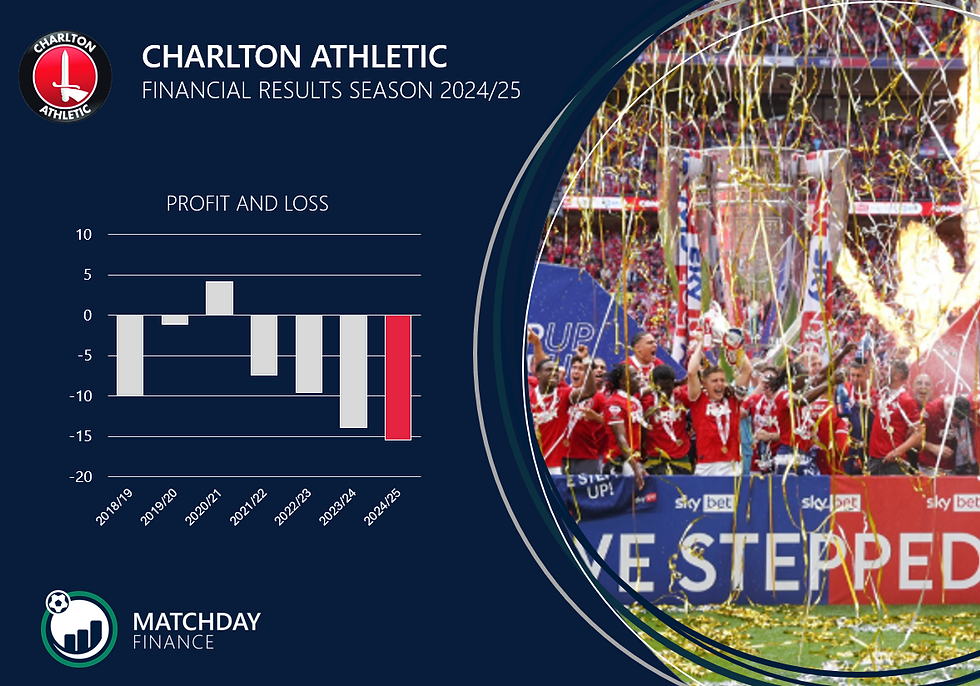
Other notable outcomes include Charlton Athletic’s £14 million loss in their first year under new ownership, and Fleetwood Town’s continued financial struggles. Ownership of Fleetwood has shifted from Andy Pilley (currently serving a prison sentence for fraud) to his son Jamie Pilley. Despite their rise from non-League football, the club carries £43 million in debt and is now competing in League Two.

The figures highlight an ongoing structural challenge. While clubs continue efforts to expand controllable revenues, and the EFL has secured improved broadcast agreements and the prospect of higher solidarity payments, expenditure continues to outpace income by a considerable margin. Given that player wages remain the single largest cost element, a material reduction in this area would be required to move towards sustainability.
Looking ahead, upward pressure on costs from clubs such as Birmingham and Wrexham suggests that little improvement is likely to be reflected in the 2024/25 financial results.
Season 2023/24 Player Trading
League One is typically a net seller of players, though on a far smaller scale than the Championship. In 2023/24, clubs spent just £13 million on signings while generating £33 million from sales. Modest by Championship standards, but still a valuable source of income at this level.

Barnsley led the way in player sales, bringing in £7.9 million from the departures of Mads Andersen and Liam Kitching. Clubs can also boost income through sell-on clauses when former players are transferred again.

Season 2023/24 Football Net Debt
Football net debt includes bank loans (net of cash) as well as funding from owners or related companies.
By the end of 2023/24, total loans stood at £355 million, up from £253 million the year before. Most of this rise came from Reading, relegated from the Championship, who brought significant debt with them.
Of the £355 million total, only £34 million is owed to external lenders, with the remaining £321 million provided by owners or related parties. These loans are usually interest-free, with no set repayment terms, and are often later converted into equity.
As the chart shows, Reading carry the highest debt at £80 million, while Derby, Fleetwood, and Oxford each exceed £40 million.

Season 2023/24 Cash Flow
Cash flow is critical for any business, and especially for League One clubs. Since not all clubs publish cash flow statements, these figures are based on estimates.
Operating cash flow is estimated at negative £123 million, reflecting the gap between day-to-day revenues and costs such as wages, salaries, rent, and utilities. This broadly mirrors the clubs’ underlying profitability.
Around £24 million was invested in facilities, while player trading generated a net £3 million.
The £123 million shortfall was covered by £83 million in loans (mostly from related parties) and £40 million in new equity. Funding requirements have grown steadily in recent years, with the £123 million raised in 2023/24 the highest on record.
The figures below show the financing-related cash flows for League One clubs by season.

Most of the new funding in League One is simply used to cover operating costs. Only £24 million went into facilities, with the rest needed just to keep clubs running under their current revenue and cost structure — a model that looks far from sustainable.
Oxford United raised the most at £13 million, with Derby, Bolton, Wigan, and Charlton each bringing in over £10 million. While part of Oxford’s funds went toward their new stadium, the bulk was used to offset operating losses.

This underlines the heavy financial backing needed to keep League One operating at its current level. Owners continue to inject significant funds, motivated by the pursuit of promotion and the potential rewards of reaching the Championship.
Season 2023/24 Ownership
During the 2023/24 season, two clubs changed ownership. Wycombe Wanderers were acquired by Kazakh billionaire Mikheil Lomtadze, while Charlton Athletic were bought by SE7 Partners, a consortium led by former Sunderland executive Charlie Methven.
Across the league, ownership was spread with 11 clubs under UK control, 4 under US ownership, 1 jointly owned by UK and US interests, and the remainder spread across eight other countries. Exeter City were the only fan-owned club in League One.

At the end of the 2023/24 season, the ownership landscape was as outlined below. Since then, three clubs have changed hands: Cheltenham Town were acquired by UK-based Mike Garlick; Leyton Orient by US-based GSG LOFC Limited, controlled by David Gandler; and Reading, after years of instability, by US-based Redwood Holdings Limited, led by Rob Couhig and Todd Trosclair.



Comments