
Arsenal Financial Results 2024/25

The 2024/25 season was Arsenal’s 99th consecutive year in the top flight and the fifth under manager Mikel Arteta.

Arsenal have long been regarded as one of the leading clubs in England and Europe. However, a lean period between 2017 and 2022 — during which the club failed to qualify for the Champions League for six consecutive seasons — led to growing supporter concerns that the club was under-invested and underperforming relative to its standing.
Over the past four years however, under Arteta, Arsenal have re-established themselves as title contenders and with that, significant commercial growth.
The 2024/25 campaign proved to be another “nearly” season. Arsenal finished runners-up in the Premier League for the third consecutive year, although they trailed Liverpool by a significant margin for much of the season. In Europe, they were the strongest-performing English club in the Champions League, reaching the semi-finals before being eliminated by eventual winners Paris Saint-Germain. Domestically, they exited the FA Cup early to Manchester United but reached the semi-finals of the Carabao Cup.
This season has, to date, been another highly successful campaign. Arsenal currently lead the Premier League, finished top of the Champions League league stage, and face Manchester City in the Carabao Cup final, while remaining active in the FA Cup. There is still a lot of football to be played, including a potentially decisive league fixture away to Manchester City in April.
Arsenal is owned by Kroenke Sports & Entertainment (KSE), controlled by American billionaire Stan Kroenke and his family. Kroenke first acquired a minority stake in 2007, became majority shareholder in 2011, and took full ownership in 2018. In addition to Arsenal, KSE owns several major US sports franchises, including the Los Angeles Rams (NFL), Denver Nuggets (NBA), Colorado Avalanche (NHL), and Colorado Rapids (MLS).
KSE’s level of financial backing was historically criticised by supporters. However, in recent seasons Arsenal have ranked among the Premier League’s highest net spenders on players, behind only Chelsea and Manchester United over the past three years. While KSE has provided financial support — with approximately £340 million currently outstanding in shareholder loans — the club has moved closer to a self-sustaining model as revenues have grown substantially, increasing from approximately £370 million to £690 million over the past three seasons.
Arsenal Women's Football Club
These results are based on Arsenal Holdings Limited, which also includes Arsenal Women’s Football Club, meaning revenues and costs of the women’s team are consolidated in these figures. For Arsenal, the financial contribution of the women’s team is more material than for most women’s clubs.
The club has not yet published separate women’s team accounts, but for reference, in 2023/24 the team recorded turnover of £21.5 million and operating costs, including salaries, of £21.6 million.

Arsenal Financial Results 2024/25
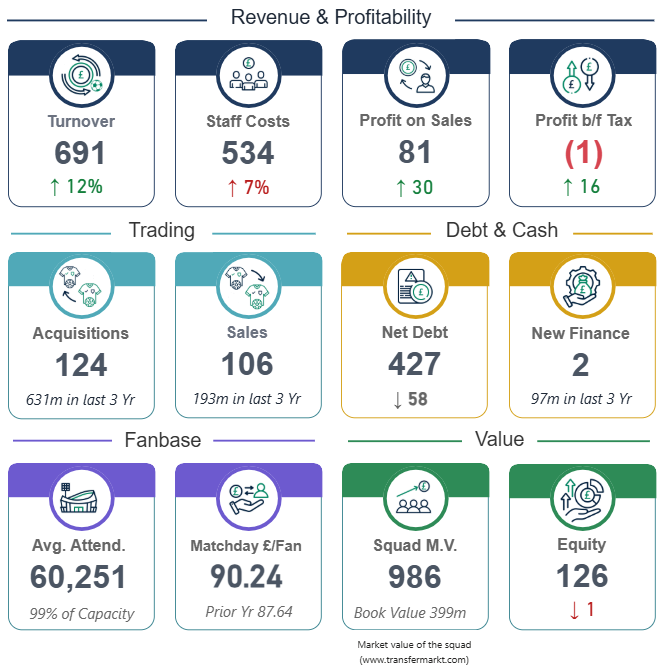
Financial highlights:
Revenue: Total revenue reached a record £691 million, up £74 million year-on-year, with growth across all major revenue streams. Progressing to the Champions League semi-final was a key driver, boosting UEFA distributions, matchday income, and commercial revenue. Arsenal's revenue is the third highest in the league.
Staff costs: Following new player acquisitions and an increased headcount, wages and salaries rose by £19 million to £346 million, while the club also incurred £15 million in player impairment costs. Total staff costs reached £534 million, likely ranking as the fourth-highest in the league.
Player sales: The club generated £81 million from player sales, primarily from Smith Rowe, Nketiah and Ramsdale.
Profit/loss: The club reported a near break-even result, with a £1 million loss, compared with an £18 million loss in the previous season. The improvement was primarily driven by higher revenues and increased profits from player sales.
Net assets: Net assets declined slightly to £126 million, reflecting a decrease in player net book value offset by a reduction in outstanding transfer fees.
Player trading: Arsenal spent a £123 million on new players — likely the 9th highest spend in the league — with Zubimendi, Merino, Calafiori and David Raya joining the club. This was largely offset by £106 million in player-sale income.
Loans and debt: External borrowings totalled £358 million at the end of 2024/25, offset by £56 million in cash reserves. Of this debt, £340 million is owed to the parent company, KSE UK Inc. Meanwhile, net transfer-related debt fell by £85 million to £125 million.
Cash Flow: The club generated £147 million in operating cash flow, likely the highest in the league, while recording a net investment outflow of £161 million. The resulting cash shortfall was primarily funded from existing cash reserves.
Financial Outlook
The club’s financial outlook remains very healthy. So far this season, Arsenal continue to compete strongly across four competitions. Whether it will be a trophy-winning season remains to be seen, but from a financial perspective, any silverware would be an added bonus.
We expect revenues to continue growing, albeit more modestly than last season, with costs likely to increase at a similar rate. With limited income from player sales, the club may record a small net loss this season unless they achieve success in the Champions League.
There is no doubt that Arsenal are now firmly positioned among the top European clubs, both on and off the pitch.
Turnover
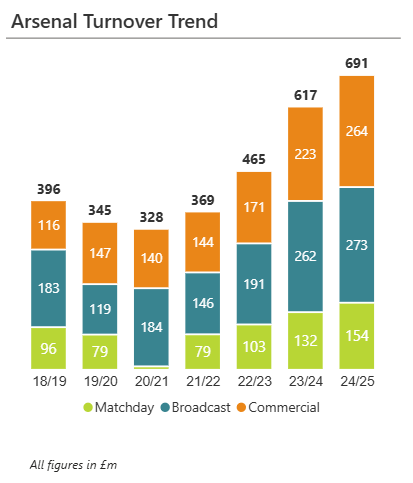
Revenue is generated from three primary streams: matchday income (ticket sales), broadcasting distributions (from the Premier League and, where applicable, UEFA competitions), and commercial activities, including sponsorships, merchandising, and other business operations.
The 2024/25 season marked another record year for Arsenal, with revenue growth across all major streams, driven primarily by the club’s extended Champions League campaign.
To date, seven clubs have published their financial results — Arsenal, Brentford, Brighton, Liverpool, West Ham and the two Manchester clubs. The chart below compares reported figures for these clubs with our revenue estimates for the remaining Premier League teams. Liverpool generated the highest revenue in 2024/25, with Arsenal ranking third overall, narrowly behind Manchester City.

Matchday Revenue
Matchday revenue is driven by several factors, including the number of home fixtures, average attendance, ticket pricing, and a club’s ability to optimise hospitality and premium seating. Domestic cup competitions are an exception, as gate receipts are shared between the participating clubs and the FA.
Arsenal have played at the Emirates Stadium since 2006. With a capacity of 60,704, it is the fifth-largest stadium in the Premier League, now behind Liverpool after their recent expansion. During the 2024/25 season, every league fixture was sold out, with Arsenal averaging 60,251 supporters per match.
The new Champions League format, combined with progression to the semi-final, resulted in two additional high-value home fixtures at the Emirates. The club also hosted three additional domestic cup matches, although revenues from these fixtures are shared.
Arsenal’s London location and sustained on-pitch success support some of the highest ticket prices in the league. The club’s cheapest season ticket, at £1,127, is the highest in the Premier League. As a result, Arsenal generate the highest matchday revenue per attendee (£90.24), ahead of Chelsea (£83.67).
The combination of additional fixtures and league-leading revenue per fan lifted Arsenal’s matchday income to a club-record £154 million.


While the table below includes revenue estimates for clubs that have yet to publish their accounts, Arsenal’s matchday income is the second highest in the league, behind only Manchester United. The club will overtake United this year, due to the Manchester club's lack of European matches.

There are currently no plans to expand the Emirates.
Broadcast Revenue
Broadcast revenue is generated primarily through central Premier League distributions, UEFA payments from European competitions and the club’s own media activities.
The 2024/25 season marked the third and final year of the Premier League’s current broadcast cycle, with total distributions broadly consistent with 2023/24 levels. Approximately 67% of broadcast income is shared equally among clubs, with the remainder allocated through merit payments based on league position and facility fees linked to the number of live televised matches.
Arsenal’s second-place finish earned them £172 million.

The chart below shows the club by club distributions published by the Premier League.

The new formats for UEFA’s three club competitions increased overall distributions by approximately 20%. Revenues are allocated across three components: an equal participation share, performance-based prize money, and a market value component, which is determined by the size of the TV market (with the UK being the largest) and a club coefficient based on results over the past five seasons. Roughly 75% of total revenues are distributed to Champions League participants, 15% to Europa League clubs, and 10% to Europa Conference League teams.
Arsenal’s semi-final finish in the Champions League, combined with an improving club coefficient (12th in 2024/25 and since risen to 8th), lifted their UEFA revenues to £100 million. This demonstrates the significant financial impact of a successful European campaign, further amplified by the additional high-value home matches, and greater commercial opportunities.

The club was the highest-earning of the seven English teams competing in European competitions in 2024/25.

The chart below shows combined broadcast revenue, including Premier League distributions, UEFA payments, and income from the recently expanded FIFA Club World Cup, which was contested only by Chelsea and Manchester City.

Commercial Revenue
Arsenal’s commercial revenue has historically been the lowest among the so-called Big Six. However, since their return to the Champions League, commercial income has grown significantly, reaching £264 million, now surpassing Chelsea and approaching the levels of Tottenham and Manchester United.

In addition to Emirates Airlines, which sponsors both the front of the shirt and stadium naming rights, other major commercial partners in 2024/25 included Visit Rwanda as sleeve sponsor and Adidas as kit supplier. Estimated annual values for these partnerships are approximately £50 million for Emirates, £10 million for Visit Rwanda, and £75 million for Adidas.
The club also reported a full year of revenue from Sobha Realty, alongside an increased number of secondary commercial deals at higher valuations. Retail operations achieved another record year, rising 27% from the previous peak.
As the chart below illustrates, the “Big Six” remain on a distinctly higher scale for commercial revenue, although Newcastle United and Aston Villa have experienced significant growth following recent Champions League participation. Arsenal’s commercial revenue is expected to rank fifth in the league.

Staff Costs
Staff costs comprise salaries and wages for all employees, the amortisation of transfer fees (the allocation of a player’s acquisition cost over the length of their contract), and impairment charges. Impairments arise when a player’s estimated recoverable value falls below their carrying value on the balance sheet.
Salaries and wages increased by 6%, from £328 million to £347 million. While this represents a material rise, it was less than the prior year’s increase. The growth likely reflects a combination of higher headcount and new player signings.
Amortisation remained broadly flat year-on-year. However, the club recognised £15 million of impairment charges. The financial statements do not disclose the specific player(s) involved, though this may relate to Oleksandr Zinchenko, who was recently sold to Ajax for £1 million after being acquired from Manchester City for £30 million in 2022.


Arsenal’s total staff costs are likely to rank fourth in the league, behind champions Liverpool, Chelsea and Manchester City. On this measure, a second-place finish could be viewed as a relative overperformance. However, at this level of spending, the margins between clubs are relatively narrow, and small differences in cost are unlikely to be decisive.

Profit on Player Sales
Through the last five years Arsenal have invested heavily in the playing squad and generally not relied on player sales to balance the books. In 2024/25, however, there was greater outgoing activity. The sales of Emile Smith Rowe, Eddie Nketiah and Aaron Ramsdale generated significant proceeds, contributing to £81 million of profit on player sales for the year.

Among the six clubs that have published full financial results to date, Arsenal reported the second-highest profit from player sales.

Squad Cost Ratio
The Premier League will implement a new set of financial rules from the 2026/27 season, replacing the existing Profitability and Sustainability Rules (PSR). A central metric under the new framework is the Squad Cost Ratio, which caps clubs’ on-pitch spending at 85% of football-related revenue, including net profit or loss from player sales.
This metric is broadly aligned with UEFA’s Squad Cost Ratio, which is set at a stricter 70%. As a result, clubs not competing in European competitions can invest at relatively higher levels than those, like Arsenal, already active in Europe.
The ratio considers only player and coaching staff costs while incorporating profits from player sales into revenue. Although clubs rarely report “football-only” staff costs, we estimate Arsenal’s Squad Cost Ratio at approximately 58% (assuming 75% of total staff costs relate to football), well within both Premier League and UEFA limits.
Profit and Loss
Arsenal reported an effective break-even result for the 2024/25 season, an improvement on the losses seen in previous years. The club has been in an investment phase aimed at restoring regular Champions League qualification, and it is now beginning to reap the commercial benefits of that strategy.
Arsenal’s revenue and cost profile is increasingly comparable to that of Manchester City and Liverpool. Sustained participation in the Champions League would allow the club to operate close to a self-funding model—a position few clubs can claim.

In 2024/25, total revenue rose to £691 million, an increase of £74 million year-on-year. Wage costs increased by £19 million and other operating expenses by £53 million. As a result, EBITDA (earnings before interest, tax, depreciation and amortisation) grew marginally by £3 million to £142 million, making it one of the highest reported in the league, although Manchester United reported a higher figure of £183 million.
After accounting for £172 million of player amortisation, £15 million in player impairments, and £20 million in depreciation, the club recorded an operating loss of £65 million. While this may appear substantial, operating losses remain common across the Premier League; it is unlikely that any club will report an operating profit in 2024/25.
The operating deficit was largely offset by £81 million of profit on player sales. Interest payments remained flat at £18 million, resulting in an overall net loss of £1 million—significantly lower than the £18 million loss reported in 2023/24.
Six other clubs have published their financial results to date. Of these, only Liverpool reported a profit, albeit a modest one. West Ham recorded the largest deficit at £104 million, followed by Brighton with a £56 million loss, although both clubs had reported substantial profits in the preceding season.

Net Assets
Net assets represent the difference between total assets and total liabilities and correspond to the club’s net equity.
Assets include fixed assets—such as player registrations, facilities, and goodwill—as well as current assets like trade debtors, transfer fees receivable, and cash.
Liabilities comprise loans (from banks, shareholders, or group companies), transfer fees payable, trade creditors, deferred income (for example, advance season ticket sales), and other financial provisions.
The 2024/25 season saw only modest changes in Arsenal’s net asset base. Overall player assets, measured at net book value, declined by £88 million due to lower levels of net trading, while transfer-related liabilities declined.


Arsenal reported net assets of £126 million for 2024/25, slightly down from £128 million in the previous season.
The table below shows the latest available net asset positions of Premier League clubs. It is important to note that a club’s net asset position is heavily influenced by its funding structure, particularly among challenger clubs. For instance, Aston Villa and Newcastle have benefited from significant equity injections, supporting their positive net asset positions, whereas Brighton has been primarily funded through owner debt from Tony Bloom.

There are several balance sheet–related measures within the Premier League’s new financial regulations, which come into effect next year. These fall under the Sustainability and Systemic Resilience (SSR) framework and include:
Working Capital Test
This assesses a club’s immediately available cash headroom over the course of a season. Clubs must maintain at least £12.5 million in short-term liquid assets.
Liquidity Test
This examines medium-term resilience and a club’s ability to withstand financial shocks, such as relegation. A club must demonstrate that its liquid assets, less liquid liabilities, plus 40% of squad market value, exceed £85 million. In practical terms, this reflects whether a club could cover short-term obligations by selling part of its squad if required.
Positive Equity Test
This measures long-term financial health. It includes the full squad market value (or net book value, if higher) as an adjusted asset. Total liabilities must not exceed 90% of adjusted assets, tightening to 80% by 2028/29.
Arsenal appear well positioned across these tests and maintain relatively low levels of debt. For example, their estimated Positive Equity Test ratio is around 56% (see calculation below).
The club reports total assets of £1,030 million. Based on Transfermarkt estimates, the squad’s market value of £986 million is £587 million higher than its book value, resulting in adjusted assets of approximately £1,573 million. With total liabilities of £903 million, this equates to 60% of adjusted assets — comfortably within Premier League limits.
Player Trading
Following three seasons of heavy squad investment, player acquisitions were more moderate in 2024/25. The club spent £124 million on new signings, including Martín Zubimendi and Mikel Merino from Real Sociedad, Riccardo Calafiori from Bologna, and David Raya from Brentford after an extended loan spell.
Player sales generated £106 million, largely driven by the departures of Emile Smith Rowe to Fulham, Eddie Nketiah to Crystal Palace, and Aaron Ramsdale to Southampton.

Over the past three seasons, Arsenal have invested more than £630 million in their squad, which we estimate ranks fourth highest in the Premier League. Unsurprisingly, Chelsea top the list at £1.65 billion—nearly double the second-highest, Manchester United.
In terms of net spend (acquisitions less sales), Arsenal move up one position to third, ahead of Manchester City, who generated significant proceeds from player sales.

Investment has continued in the current season, with the club recording a net spend of £268 million on players, including Zubimendi, Eze, Gyökeres, Madueke, Mosquera, and Nørgaard, while there have been few notable player sales. This activity will be reflected in the 2025/26 financial statements.
Squad Market Value
Clubs report the net book value (NBV) of their squads in published accounts, which represents the original acquisition cost (including associated fees) amortised over the length of a player’s contract. For example, a player purchased for £50 million on a five-year contract would have an NBV that decreases by £10 million each year.
NBV does not reflect a squad’s current market value. According to Transfermarkt.com, Arsenal’s squad had an estimated market value of approximately £986 million. The difference between market value and NBV provides an indication of potential profit from player sales and a rough measure of how well a squad is holding its value relative to its accounting value.
Arsenal is in a particularly strong position on this metric. They have the third-highest squad market value, which is £587 million higher than their NBV, the largest value difference in the league. Chelsea is the only club whose squad market value is lower than their NBV, partly due to the club’s tendency to offer players long contracts, although this does not fully explain the discrepancy.

Football Net Debt
Arsenal’s recent on-field resurgence has been achieved with relatively modest levels of new owner funding. Since 2020, the club’s debt has increased by just over £100 million, with no new equity issued. At the end of 2024/25, total debt stood at £358 million, offset by £56 million in cash reserves. Of the outstanding debt, £340 million is owed to the parent company, KSE UK Inc., and is repayable on two years’ notice—though no notice has been issued.

Premier League clubs’ total debt reached £3.6 billion in 2023/24, comprising £2.4 billion owed to third parties and £1.2 billion to related parties. Everton recorded the highest overall debt, although much of its related-party borrowing has since been converted into equity. Arsenal’s debt ranks as the sixth highest in the league.

Following Arsenal’s reduced spending on players, their transfer-related debt declined sharply. Note it is standard practice for clubs to structure transfer payments over multiple years.
In 2024/25, transfer fees payable fell by £57 million to £211 million, while transfer fees receivable rose to £86 million, up from £57 million in the previous season. As a result, net transfer debt declined to £125 million, a reduction of £85 million compared with the prior year.

Cash Flow
Cash Flows are reported in three categories:
Cash Flows from Operations refer to cash generated from the club’s core activities—revenue minus day-to-day costs such as salaries, rent, and utilities.
Cash Flows from Investments include cash spent on player acquisitions and facility improvements, net of player or asset sales.
Cash Flows from Financing cover new loans or equity raised, less repayments or buybacks. If operational cash flow cannot fund investments, the shortfall is usually met through financing.
Arsenal’s cash flows illustrate the club’s strong financial position. In 2023/24, they generated the highest operating cash flows in the league by a significant margin and are likely to repeat this performance in 2024/25, reflecting high revenues relative to day-to-day operating costs.
Over the three years to 2024/25, Arsenal generated £462 million in operating cash flows—the highest in the division. During this period, the club invested £633 million in the squad and £47 million in other assets, while receiving £147 million from player sales.
To fund the resulting gap, external borrowings increased by £97 million. While not yet fully self-sustaining, Arsenal’s model is approaching financial independence, certainly by Premier League standards.

Reporting Entity
This analysis is based on Arsenal Holdings Limited, wholly owned by KSE UK Inc., itself beneficially owned by Stan Kroenke. Arsenal Holdings Limited controls several subsidiaries, including The Arsenal Football Club Limited and Arsenal Women’s Football Club Limited.


Comments