
Newcastle United Financial Results 2024/25

Updated: Apr 14
The 2024/25 campaign marked Newcastle United’s 132nd season and their eighth consecutive year in the Premier League.

It proved to be a historic year for the club, as they ended a 70-year wait for major silverware by defeating Liverpool 2–1 in the Carabao Cup final. They also secured Champions League qualification in dramatic fashion, edging into fifth place on goal difference on the final day. Overall, it was a highly successful season for the Magpies.
The current campaign has not reached those same heights. Newcastle sit 12th, with inconsistent league form undermining their progress, while defeats in both Tyne–Wear derbies will linger with supporters. In Europe, they reached the Champions League round of 16 but were convincingly beaten 8–3 on aggregate by Barcelona.
The club has been transformed since its October 2021 takeover by a consortium led by Saudi Arabia’s Public Investment Fund (PIF), which purchased Newcastle from Mike Ashley. The deal was controversial due to the PIF’s links to the Saudi state and was only approved after assurances that the state would not exercise direct control. Concerns were also raised about the potential to distort competitive balance, though the Premier League’s Profit and Sustainability Rules (PSR) limit the extent of owner funding. '
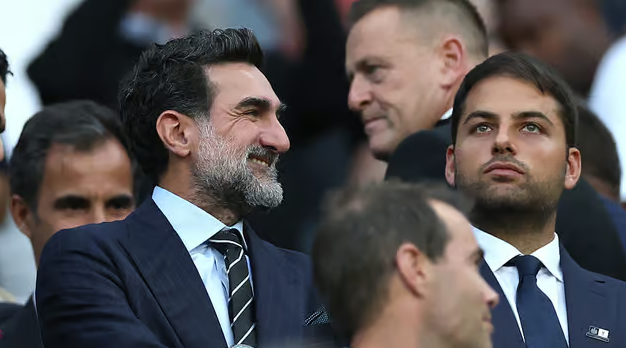
PIF own 84% of the club, with the remaining 16% owned by British businessmen David and Simon Rueben through their investment company RB Sports & Media. PIF governor Yasi Al-Rumayyan is chairman of the club, and Jamie Reuben, son of David represents the Reuben family as a director.
Since the acquisition, more than £440 million has been invested into the club. Around £90 million was used to clear a loan owed to the previous owner, with the remainder largely directed towards strengthening the playing squad. However, spending has not been unconstrained; PSR requirements have necessitated player sales, including Elliot Anderson and Yankuba Minteh in 2023/24.
In 2024/25, Newcastle’s owners undertook a restructuring involving the sale of leasehold improvements at St James’ Park, along with Newcastle Projects Limited, from the football entity to PZ Holdings Limited— another subsidiary of Newcastle’s parent company PZ Newco Limited. While the club does not own the land itself, the transaction included the stadium asset and generated accounting profits for the club of £128 million from the leasehold and £4 million from the projects entity. The club stated this was part of a “reorganisation of its property holdings and group structure to facilitate future infrastructure investment.”
This transaction boosted reported profits for 2024/25 and eased any immediate PSR pressure. By our estimates, the club may otherwise have marginally exceeded the three-year PSR limit. However, it is unlikely this was the primary motivation: the club did not require the profit boost this season—particularly following the sale of Alexander Isak—and the transaction will not benefit the new Squad Cost Ratio or UEFA financial regulations.

Newcastle United Financial Results 2024/25
Although the club did not participate in Europe in 2024/25, they still increased revenue by £15 million to reach a club record £335 million, driven by strong commercial growth. However, with staff costs exceeding revenue and only £20 million generated from player sales, the club would have reported a loss of £98 million if not for the one-off sale of the stadium leasehold improvements and a project investment entity, which generated a £133 million gain and turned the £98 million loss into a £35 million profit. This represents the highest profit recorded in the Premier League this year.

Financial highlights:
Revenue: Total revenue reached a club-record £335 million, up £15 million year-on-year, driven by higher commercial income.
Staff costs: Wages increased by £25 million due to performance-related bonuses and a higher headcount to support expanded commercial activities. Total staff costs were £343 million, equivalent to 102% of revenue, broadly in line with other non–Big Six clubs and the eighth highest in the league.
Player sales: The club generated £20 million from player sales, mainly from the sale of Lloyd Kelly to Juventus.
Profit/loss: Newcastle reported a £15 million profit, supported by a £133 million gain on the sale of the stadium leasehold improvements and a project investment entity. Excluding these disposals, the underlying loss was £98 million.
Net assets: Net assets increased to £333 million, mainly due to income due from the asset sale.
Player trading: The club spent £40 million on new signings, with William Osula the only acquisition of note. This was partially offset by £29 million in player sales.
Loans and debt: Newcastle’s only debt consists of a £50 million term loan and an £8 million credit facility.
Cash Flow: The club recorded operating cash inflows of £5 million and net investment outflows of £60 million, funded by a £50 million share issue.
Financial Outlook
Newcastle have clearly grown substantially as a club since the PIF-led takeover, both on and off the pitch. Two Champions League qualifications and their first major trophy in over 70 years represent a strong return over the first four years of ownership. However, expectations have also risen, with European qualification now seen as a prerequisite to maintain the club’s upward trajectory. Newcastle, along with Aston Villa, are now in a group of their own— not yet at the scale and global appeal of the Big Six, but clearly ahead of the remaining clubs.
The owners have recently invested a further £106 million (after these accounts were closed), taking their total investment to close to £550 million. The club arguably has one of the wealthiest ownership groups in football, and they have made clear their willingness to continue investing. The new Premier League Squad Cost Ratio (coming into effect next season) is likely to benefit Newcastle, as it allows the club to invest in revenue-generating activities without immediate pressure on the bottom line.
While the club no longer owns the stadium outright, the future of St James’ Park remains a significant long-term decision. It is not yet clear whether the club will expand the existing ground or pursue a new stadium as part of a broader redevelopment project. Either option will require substantial funding, which the owners have indicated they are prepared to provide.
This season, revenues could reach £400 million, supported by European participation. Combined with the sale of Alexander Isak to Liverpool, the club could move close to break-even in 2025/26. However, the team is currently in 12th place, and failure to qualify for Europe would now be considered below expectations.
Turnover
Revenue is generated from three primary streams: matchday income (ticket sales), broadcasting distributions (from the Premier League and, where applicable, UEFA competitions), and commercial activities, including sponsorships, merchandising, and other business operations.
Since the takeover, the club has seen strong revenue growth across all streams. In 2024/25, a decline in broadcast income due to the absence of European football was more than offset by exceptional growth in commercial revenue. As a result, total revenue reached a record £335 million, an increase of £15 million on the previous year.

Newcastle’s revenue ranks eighth in the league, behind the Big Six and Aston Villa, who benefited from Champions League participation. While both Villa and Newcastle have begun to close the gap on the traditional elite, Newcastle’s revenue still remains less than half of Liverpool’s.

Matchday Revenue
Matchday revenue is driven by several factors, including the number of home fixtures, average attendance, ticket pricing, hospitality and premium seating. Domestic cup competitions are an exception, as gate receipts are shared between the participating clubs and the FA.
Newcastle play at St James’ Park, one of the most iconic grounds in English football, which has been their home since 1892. It has a capacity of 52,264 following major upgrades in the early 2000s, making it the seventh-largest stadium in England. The club has been exploring the possibility of either expanding the existing ground or building a new stadium. Expansion is challenging due to adjacent heritage buildings and the constrained city-centre site, so the club has also considered a potential new stadium on a site in nearby Leazes Park as part of a wider redevelopment of the area.
The end-of-season sale of the stadium leasehold improvements has been positioned as a reorganisation of its property holdings to facilitate future infrastructure investment.

During 2024/25, the club averaged 52,187 fans per league match, of which around 35,000 were season ticket holders. The remaining seats were made available to members through a ballot system, along with an allocation for visiting supporters. Although the club played three additional domestic cup fixtures, where revenue is shared, the absence of European matches led to a 7% decline in total paying attendees to 1,181,000.
The club continued to increase its yield through a 5% price rise and growth in hospitality, lifting revenue per fan to £43.64. This is now the highest yield outside the traditional Big Six and helped push overall matchday revenue up slightly from £50.1 million to £51.6 million.


Newcastle’s matchday revenue ranks seventh in the league, behind only the Big Six and well ahead of the next highest, West Ham.

Matchday revenue is expected to grow again this season, following the hosting of six Champions League matches at St James’ Park, which is projected to increase matchday income by £12–16 million.
Broadcast Revenue
Broadcast revenue is generated primarily through central Premier League distributions, UEFA payments from European competitions and the club’s own media activities.
The 2024/25 season marked the third and final year of the Premier League’s current broadcast cycle, with total distributions broadly consistent with 2023/24 levels. Approximately 67% of broadcast income is shared equally among clubs, with the remainder allocated through merit payments based on league position and facility fees linked to the number of live televised matches.
Newcastle’s 5th-place finish earned them £160 million in central distributions, up £15 million from the previous season, driven by the higher league position (and associated merit payments) as well as one additional televised match (25 compared to 24).

The chart below shows club-by-club distributions published by the Premier League, with each league position worth close to £3 million in merit payments.

Newcastle participated in the Champions League in 2023/24 but failed to qualify for the 2024/25 competition. They earned £29 million from their 2023/24 campaign, which was under the previous group-stage format, after finishing bottom of their group.
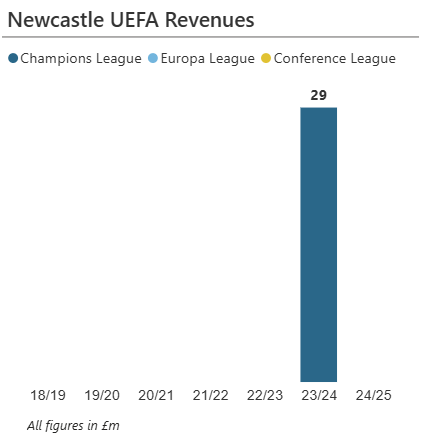
This season, they reached the round of 16 in the Champions League, where they lost to Barcelona, which is expected to generate around £55 million in revenue.
For reference, the chart below shows combined broadcast revenue for 2024/25, including Premier League distributions, UEFA payments, and income from the recently expanded FIFA Club World Cup, which was contested only by Chelsea and Manchester City.

Commercial Revenue
Commercial revenue is where the impact of the takeover is most evident. In the year of the takeover, the club generated £28 million in commercial revenue, which has now grown more than fourfold to reach £123 million in 2024/25.
Initially, this growth was driven by sponsorship income, as the club leveraged its Champions League presence and relationships with PIF-linked organisations. This included deals with Saudi events company Sela for the front-of-shirt sponsorship, and e-commerce platform Noon for the sleeve sponsorship.
The 2024/25 season also marked the first year of a multi-year kit supply agreement with Adidas, reportedly worth around £34 million per year. In addition, the club has recently agreed a new partnership with South African drinks company KNOX Hydration for training ground and kit-related work worth approximately £6 million, although this will come into effect from next season.
The club is also now benefiting from the launch of a flagship retail store and the STACK Fanzone, which opened at the start of the campaign. Furthermore, it has brought its retail operations in-house, which will increase reported revenue, although it will also raise operating costs.
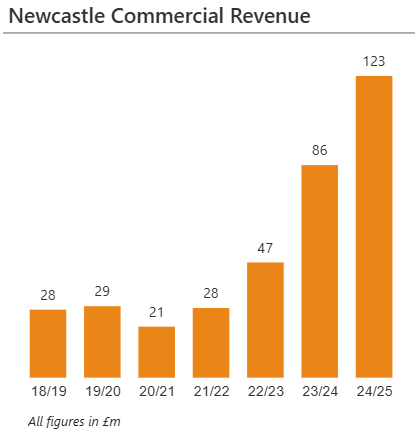
As the chart below illustrates, the “Big Six” remain on a distinctly higher scale in terms of commercial revenue, although Newcastle and Aston Villa have closed the gap in recent years.

Staff Costs
Staff costs comprise salaries and wages for all employees, the amortisation of transfer fees (the allocation of a player’s acquisition cost over the length of their contract), and impairment charges. Impairments arise when a player’s estimated recoverable value falls below their carrying value on the balance sheet.
Salaries and wages have increased in each of the past five years and are now 43% higher than pre-PIF ownership levels. In 2024/25, they rose by 11%, driven by performance-related bonuses (including the Carabao Cup win and Champions League qualification) as well as a 17% increase in headcount, likely reflecting the club’s expanded commercial operations.


Newcastle’s total staff costs are likely to rank eighth highest in the league, but still around 40% lower than the biggest spenders. With a fifth-place finish, the club therefore outperformed relative to its staff cost base.

Newcastle’s total staff costs of £343 million equate to 102% of revenue, which is below the Premier League average outside the “Big Six.” At this level, the club would clearly incur significant losses without income from player sales (excluding the impact of recent asset sales).
Profit on Player Sales
Following the takeover, the club entered a squad-building phase and therefore generated very little income from player sales. However, at the end of 2023/24 they hit a PSR limit and made last-minute sales of Elliot Anderson and Yankuba Minteh to avoid a breach.
In 2024/25, the most significant departure was Lloyd Kelly, who joined Juventus after a loan spell for around £20 million, again at the end of the season. This represented a profitable sale, as Kelly had originally been signed on a free transfer.

Among the clubs that have published full financial results to date, Newcastle's profit from player sales ranks 11th highest.

The record sale of Alexander Isak to Liverpool is expected to generate a profit of over £80 million in the 2025/26 season.
Squad Cost Ratio
The Premier League will implement a new set of financial rules from the 2026/27 season, replacing the existing Profitability and Sustainability Rules (PSR). A central metric under the new framework is the Squad Cost Ratio, which caps clubs’ on-pitch spending at 85% of football-related revenue, including net profit or loss from player sales (based on the average over the last three seasons).
This metric is broadly aligned with UEFA’s Squad Cost Ratio, which is set at a stricter 70%. As a result, clubs not competing in European competitions can invest at relatively higher levels than those, like Liverpool, already active in Europe.
Based on our estimates, Newcastle’s squad cost ratio is around 77%, assuming that “football-only” wages account for 75% of total salaries and wages. This is within the Premier League’s future limits but above UEFA’s threshold. However, higher revenues this year, along with a portion of the Isak sale, will help reduce the ratio.
Profit and Loss
In the first two full seasons following the 2021 takeover, Newcastle recorded significant losses. Substantial increases in wages, alongside around £300 million in player acquisitions, contributed to losses of £72 million and £73 million respectively. In 2023/24, the club needed to reduce losses to avoid a PSR breach, which led to late-season player sales and reduced the loss to £11 million.
In 2024/25, losses would have reached £98 million if not for the gain on the sale of leasehold improvements and the project entity. The total gain recorded was £133 million, which converted the £98 million loss into a £35 million profit—the largest reported across the league.
Assuming the stadium and asset sale are deemed permissible under Premier League regulations, the club would be well within PSR limits for both 2024/25 and the current season. However, with the club returning to European competition, they will also be assessed under UEFA’s financial regulations, including profitability and squad cost rules. The club is likely to breach the profitability limits (which permit an adjusted €60 million loss over three years, subject to conditions). UEFA’s squad cost rules are more difficult to assess, as they are evaluated over a calendar year.


Breaking down the 2024/25 profit and loss, Newcastle’s total revenue reached £335 million, an increase of £15 million year-on-year. Wage costs rose by £24 million, while other operating expenses increased by £24 million in part due to bringing its retail operations back in-house. As a result, EBITDA (earnings before interest, tax, depreciation, and amortisation) fell by £31 million to negative £2 million.
After accounting for £99 million in player amortisation and £8 million in depreciation, the club recorded an operating loss of £109 million. While very few Premier League clubs report an operating profit, Newcastle’s £109 million loss was among the largest in the league.
The operating deficit was offset by £20 million in profit from player sales, £129 million from the sale of St James’ Park leasehold improvements, and £4 million from the sale of the project entity. The club also incurred £9 million in interest expenses, resulting in a net profit of £35 million. Excluding the asset sales, the loss would have been £98 million.
All clubs except Southampton have now reported their profit figures. Chelsea recorded the largest loss at £262 million, the biggest ever reported in the Premier League. Six clubs reported a profit, with the total losses across the league amounting to £796 million.
Two other clubs generated profits from one-off asset sales in 2024/25. Alongside Newcastle, Aston Villa sold their women’s team to a group entity, with the final figure yet to be disclosed but potentially as high as £100 million. Everton also recorded a £49 million gain from the sale of their women’s team and Goodison Park Limited to a group entity.
If these asset sales are excluded, total losses across the league would exceed £1 billion for the year, the highest on record. These losses must be funded, and an additional £1.3 billion of new finance was raised by clubs, primarily to cover operating shortfalls as well as investment in assets.

Net Assets
Net assets represent the difference between total assets and total liabilities and correspond to the club’s net equity.
Assets include fixed assets—such as player registrations, facilities, and goodwill—as well as current assets like trade debtors, transfer fees receivable, and cash.
Liabilities comprise loans (from banks, shareholders, or group companies), transfer fees payable, trade creditors, deferred income (for example, advance season ticket sales), and other financial provisions.
Newcastle have a relatively strong net asset position, as most of their recent funding has been through equity rather than debt. In 2024/25, total assets declined as limited player acquisitions led to the squad’s net book value falling to £281 million (from £350 million), while the sale of the leasehold improvements and project entity reduced fixed assets by £60 million. However, those sales generated £191 million that is recorded as a current asset, as it is yet to be received. This lifted total assets to £607 million at the end of 2024/25.
These assets were offset by total liabilities of £291 million, comprising £58 million in short-term debt, £88 million in transfer fees payable, and the remainder in other liabilities and provisions.


The table below shows the latest available net asset positions of Premier League clubs, with Newcastle’s net assets of £333 million among the higher net assets in the division.

There are several balance sheet–related measures within the Premier League’s new financial regulations, which come into effect next year. These fall under the Sustainability and Systemic Resilience (SSR) framework and include:
Working Capital Test
This assesses a club’s immediately available cash headroom over the course of a season. Clubs must maintain at least £12.5 million in short-term liquid assets.
Liquidity Test
This examines medium-term resilience and a club’s ability to withstand financial shocks, such as relegation. A club must demonstrate that its liquid assets, less liquid liabilities, plus 40% of squad market value, exceed £85 million. In practical terms, this reflects whether a club could cover short-term obligations by selling part of its squad if required.
Positive Equity Test
This measures long-term financial health. It includes the full squad market value (or net book value, if higher) as an adjusted asset. Total liabilities must not exceed 90% of adjusted assets, tightening to 80% by 2028/29.
Newcastle are well positioned under these tests as they have minimal debt. For example, their estimated positive equity test ratio stands at around 32% (see calculation below).
The club reports total assets of £624 million. Based on Transfermarkt estimates, the squad’s market value of £575 million is £294 million higher than its book value, resulting in adjusted assets of approximately £918 million. With total liabilities of only £291 million, this equates to 32% of adjusted assets — comfortably within Premier League limits.
Player Trading
In the first three years under the new owners, the club invested heavily, with over £500 million spent on squad building. This came to an abrupt halt at the end of 2023/24, when PSR concerns led to the late-season sales of Elliot Anderson and Yankuba Minteh. This restraint continued into 2024/25, with only £40 million spent— the lowest investment of any club in the league. The transfer of William Osula from Sheffield United was the only acquisition of note, as other signings such as Lewis Hall and Odysseas Vlachodimos were accounted for in 2023/24.
The club generated £29 million from player sales, with the main departure being Lloyd Kelly, who was sold to Juventus.

As mentioned, Newcastle's player spending was the lowest in the league for 2024/25.

This season, the club has returned to its previous spending patterns, with over £250 million invested in the squad, as Woltemade, Elanga, Wissa, Ramsey and Thiaw all arrived for significant fees. This was, however, partially offset by Alexander Isak’s record sale to Liverpool for £125 million.
Squad Cost and Net Book Value
Squad costs represent the total acquisition cost of all squad members, including transfer fees and associated costs such as agent fees. A squad’s Net Book Value (NBV) represents this acquisition cost less accumulated amortisation, with transfer fees expensed over the length of each player’s contract. For example, a player purchased for £50 million on a five-year contract would have an NBV that decreases by £10 million each year.
After three years of heavy investment, the squad’s net book value rose to £350 million. However, this declined in 2024/25 as new player acquisitions were lower than the amortisation charge, falling to £281 million.

Newcastle's net book value of £281 million is estimated to be the eighth highest in the league.

Squad Market Value
The squad's net book value (NBV) is part of the club balance sheet, recorded as Intangible Player Assets. The NBV does not however reflect a squad’s current market value.
According to transfermarkt.com Newcastle’s squad had an estimated market value of around £575 million at the end of the 2024/25 season, placing it around eighth in the division. This figure is roughly double the club’s net book value, indicating that players have retained or increased their value and highlighting the potential to generate profits through future sales. This £295 million “uplift” ranks as the fifth highest in the league, although at the time it included Isak.
Outside of Isak, among the most valuable players were Guimarães at £68 million, Gordon at £55 million, and Tonali at £50 million.

Football Net Debt
Owner funding since the PIF-led takeover has been predominantly through equity. The only debt consists of a £50 million term loan and an £8 million revolving credit facility. Both were repaid subsequent to these accounts and replaced with a new £50 million loan from HSBC.

Premier League clubs’ total debt is expected to reach £3.3 billion, representing a slight decrease from the previous year.
Tottenham have the highest debt (driven by stadium financing) followed by Manchester United (following their highly leveraged Glazer-era ownership structure).

Following Newcastle's reduced transfer activity, transfer fees payable dropped to £89 million and transfer fees receivable fell to £37 million.

Cash Flow
Cash Flows are reported in three categories:
Cash Flows from Operations refer to cash generated from the club’s core activities—revenue minus day-to-day costs such as salaries, rent, and utilities.
Cash Flows from Investments include cash spent on player acquisitions and facility improvements, net of player or asset sales.
Cash Flows from Financing cover new loans or equity raised, less repayments or buybacks. If operational cash flow cannot fund investments, the shortfall is usually met through financing.
With high operating costs relative to revenue, Newcastle do not generate significant operating cash flows, meaning that most investment must be funded externally.
Since the PIF-led takeover, the club has generated £29 million in operating cash flows. They have invested £455 million in players and £58 million in facilities, while recovering £105 million from player sales. The resulting funding gap has been covered through the issuance of £442 million in equity. Debt has been reduced by £68 million, reflecting repayment of £106 million owed to the previous owner as part of the acquisition and £58 million of new borrowing.
Subsequent to these accounts, a further £106 million has been injected in equity, taking total owner funding to £548 million to date.

Reporting Entity
This analysis is based on the entity Newcastle United Limited for the period 1st July 2024 to 30th June 2025. The company is owned 100% by PZ Newco Limited, which is owned 84% by NCUK Investment Limited and 16% by RB Sports & Media Limited. NCUK Limited is controlled by the Saudi Public Investment Fund and RB Sport & Media Limited by David and Simon Reuben.


Comments