
Leeds United Financial Update Season 2025/26

Updated: Jul 5
This report examines Leeds United's 2025/26 season from a financial perspective. While the club's official financial results will not be published until March 2027, the key drivers of revenue, costs and funding are already visible, allowing us to build a reasonable estimate of the club's financial position at the end of the season.
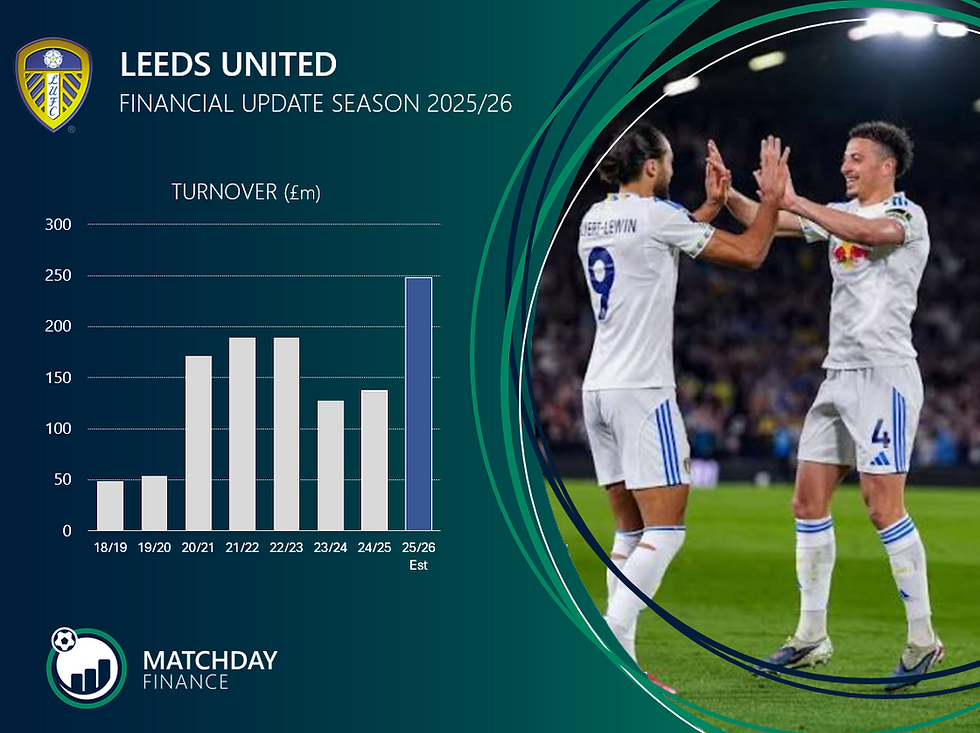
The analysis is based on publicly available information and our own estimates. As such, it should be viewed as an informed assessment rather than a definitive set of financial results. The report is published before Leeds financial year end of 30th June 2026. The report will be updated with any events prior to year end, such as if a player is sold.
The report is structured around nine sections:
Background and Financial Context - brief history and latest financial results.
Sporting performance – the primary driver of revenue and financial outcomes.
Fan base and demand – the foundations of matchday and commercial income.
Commercial partnerships – sponsorship, retail and other commercial revenue streams.
Squad composition and value – squad investment, market values and the cost of promotion
Player trading – £100m summer spend, loan activity and transfer cash flows.
Stadium and Infrastructure - Elland Road redevelopment and the long-term revenue opportunity.
Regulatory and Compliance - PSR position and the transition to Squad Cost Ratios.
Financial Forecast - estimated revenues, costs and pre-tax loss for 2025/26.
Together, these factors provide a framework for estimating Leeds United's financial performance during the 2025/26 season.

Background and Financial Context
Leeds United are one of English football's most recognisable clubs. They play in England's third-largest metropolitan area, hold a season ticket waiting list of over 30,000, and own one of the most storied grounds in the country.
In the late 1990s and early 2000s, Leeds United were a major force in English and European football, reaching the Champions League semi-final in 2001. A rapid financial decline followed — the result of debt accumulated during that period — which led to relegation from the Premier League in 2004, administration in 2007, a 10 point deduction, and a further drop to League One. Recovery was slow: the club did not return to the top flight until 2020/21, under Marcelo Bielsa, finishing a creditable ninth in their first season back.
A further two Premier League seasons followed before relegation in 2022/23 despite investing £170 million in the squad. The appointment of Daniel Farke ahead of 2023/24 brought greater stability. Leeds came close to immediate promotion, finishing third and reaching the play-off final before losing to Southampton at Wembley. They went one better in 2024/25, winning the Championship with 100 points and scoring 95 goals to secure promotion as champions.
Back in the Premier League, Leeds enjoyed a successful return to the top flight, finishing 14th and comfortably avoiding relegation.
Ownership
Leeds United is owned by 49ers Enterprises, the investment arm of the San Francisco 49ers NFL franchise. The group first invested in the club in May 2018, acquiring a 15% minority stake, and gradually increased its holding to 44% by 2021. In 2023, it completed a full takeover by purchasing the remaining 56% from Andrea Radrizzani in a deal reportedly worth around £170 million. Red Bull also holds a minority stake in the club and serves as its principal shirt sponsor.
49ers Enterprises comprises more than 60 investors, with the most prominent being Paraag Marathe and Australian billionaire Peter Lowy, whose family founded the Westfield shopping centre empire. Marathe serves as Leeds United's Chairman, while Lowy sits on the club's board.
Since taking control, 49ers Enterprises has invested approximately £280 million into the club, funding operating losses and supporting the drive for promotion to the Premier League. The ownership group has consistently stated its intention to operate ambitiously within financial regulations, investing up to the limits permitted while maintaining compliance.
The owners are also financing the redevelopment of Elland Road, which will increase stadium capacity to around 53,000. Together with continued investment in the playing squad and club infrastructure, this demonstrates a long-term commitment to establishing Leeds as a sustainable Premier League club.
Note, in May 2025, a US-based consortium including 49ers Enterprises purchased a 51% majority stake in Scottish Premiership club Rangers FC. This deal raises potential questions around UEFA multi-club ownership regulations should they both qualify for the same UEFA tournament; however, it is reported that the deal is structured such that any conflict is avoided.
Financial Base 2024/25
Leeds United's latest financial results cover the 2024/25 season, when they secured the Championship title and promotion back to the Premier League.
From a revenue perspective, Leeds were comfortably the largest club in the Championship, generating £137 million of revenue — around £50 million more than Sheffield United, the division's next highest earner. Their matchday income ranked 10th highest in English football, while commercial revenue was the ninth highest, trailing only the traditional "Big Six", Newcastle United and Aston Villa.
However, Leeds also carried the highest cost base in the Championship. Staff costs reached £103 million, while player amortisation totalled £46 million. Including minor player impairment charges, total squad-related costs amounted to £151 million, £32 million higher than second-placed Burnley.
With operating costs significantly exceeding revenue, Leeds recorded an operating loss of £68 million. Although profits from player sales of £24 million (primarily from Georginio Rutter and Crysencio Summerville) provided some relief, the club still posted a pre-tax loss of £49 million, following a £61 million loss in the previous year.
Leeds stated that they remained compliant with financial regulations, although the club appears likely to have been operating close to the relevant limits. Even after taking into account permitted PSR adjustments, compliance would appear to have required most available deductions. As a result, Leeds entered the 2025/26 season with limited headroom under the Premier League's Profitability and Sustainability Rules (PSR).
On the balance sheet, player registrations were valued at £88 million, a sharp decline from the £200 million reported during the club's previous spell in the Premier League. This reduction reflects Leeds being a net seller of players over the last two seasons, while also reducing transfer spending following relegation.
Debt levels have remained broadly stable in recent years, as ownership has primarily funded the club through equity injections rather than loans. Across their two Championship seasons, the owners contributed a combined £283 million of new capital, providing crucial support while the club pursued an immediate return to the Premier League.
Sporting Performance
Leeds entered the 2025/26 Premier League season as one of three promoted clubs, alongside Burnley and Sunderland. The early weeks were mixed: a run of inconsistent results through September and October left the club in the lower half of the table.
A 3-1 home victory over Chelsea in December and a 3-3 draw with Liverpool the following week demonstrated that the squad is capable of competing with established top-flight sides. By the end of the calendar year, Leeds had moved clear of the relegation zone and the second half of the season was notably more settled. A run of eight matches undefeated, ensured their safety, finishing in 14th place, eight points ahead of relegated West Ham and only six points behind Brighton who secured a Europa Conference League place.
Considering no promoted club has survived in the preceding two seasons, this was a major achievement for the club and manager Daniel Farke.
Financial Impact 2025/26
The financial impact of this result is significant. This season marks the start of a new Premier League broadcast cycle, with total distributions to clubs expected to increase by around £320 million, driven largely by growth in international media rights revenues.
As a result, a 14th-place finish is expected to earn Leeds approximately £145 million in central Premier League distributions. While around 63% of these revenues are distributed equally among clubs (approximately £100 million each), most of the additional income from the new cycle has been allocated through merit payments. Consequently, league position has become even more valuable, with every place in the table carrying a greater financial reward than in previous seasons.
Beyond the immediate commercial benefits, this result also strengthens Leeds financial position in the event of future relegation. Had the club been relegated in 2025/26, it would have received two years of parachute payments. By securing another season in the Premier League, any future relegation will instead trigger a three-year parachute payment cycle, providing a more substantial financial safety net.
Fan Base and Demand
Leeds (population c.850,000) is England's largest city without another top-flight football club competing for support. As a result, Leeds United enjoys a uniquely dominant position within its local market, with the vast majority of football fans in the city supporting the club.
Elland Road, the club's home since 1919, has a capacity of 37,645, making it the 12th largest football stadium in the Premier League. Demand for tickets significantly exceeds supply, with around 27,000 season-ticket holders and a waiting list of more than 30,000. The clubs had an average attendance of 36,695 during the 2025/26 season, also the 12th highest in the division. The capacity constraint, combined with strong demand, has led to plans for a major redevelopment of Elland Road that would increase capacity to approximately 53,000 (see later section).
The club also generates exceptional matchday revenue from its fanbase. During their Championship-winning 2024/25 campaign, Leeds earned an average of £36.02 per attendee, around £15 higher than the next-best Championship club, Luton Town. Comparing Leeds 2024/25 Championship figures with Premier League clubs, their matchday yield and total matchday revenue would have both ranked 10th highest. These figures underline the strength of the club's support and the significant revenue potential that could be unlocked through stadium expansion.
Promotion to the Premier League, came with a further 14% price increase. As there are four fewer matches, that equates to 37% increase in price per match. meaning their yield will likely rank in the top half of clubs in the Premier League in 2025/26. This strong yield is also driven by premium seating and hospitality which will also get a significant boost in the Premier League.
The club also has global appeal, with 142 supporters' clubs and are particularly popular in Scandinavia and Ireland.
Financial Impact 2025/26
Sell-out crowds are expected in the Premier League, but Leeds ability to generate a high yield per supporter should place their matchday revenue comfortably in the top half of the division. An FA Cup quarter-final run also increased the number of paying spectators where revenue is shared between the clubs and the FA. Combined, these factors are expected to drive matchday revenue to around £35-40 million in 2025/26.
Commercial
Leeds are a commercial powerhouse. In their Championship-winning 2024/25 season, the club generated £58 million of commercial revenue, the ninth-highest figure in English football and more than three times greater than that of Bristol City, the next highest club in the Championship.
A breakdown of the revenue highlights strong growth in Sponsorship, Advertising and Other commercial income, which increased to £25.9 million — exceeding the level achieved during Leeds' previous spell in the Premier League. The main driver was the club's new front-of-shirt sponsorship agreement with minority shareholder Red Bull, reportedly worth around £12 million per year.
Leeds merchandise revenue of £24.6 million highlights the strength of demand for the club's products and kits although growth over the past four years has been limited. This strong retail performance also enhances the value of the club's commercial partnerships, particularly its shirt sponsorship and kit supply agreements.
Following promotion to the Premier League, further growth is expected across several commercial revenue streams. The club's kit supply agreement with Adidas could be worth around £10 million per year, while the Red Bull front-of-shirt sponsorship is also likely to benefit from Premier League exposure. Merchandise sales should receive an additional boost from increased global visibility and renewed supporter enthusiasm following promotion.
Leeds have also sought to maximise their retail potential by entering into a partnership with Fanatics, which took over the operation of the club's online and physical retail stores from summer 2025. The agreement should help expand product distribution and support further growth in merchandise revenue.
Leeds major sponsorship deals in 2025/26. All figures are estimates.
Financial Impact 2025/26
Commercial revenue is expected to increase following the club's return to the Premier League. The extent of that growth will depend on the promotion-related uplifts built into existing sponsorship and commercial agreements. Merchandise sales should also rise, driven by greater exposure and demand.
However, the club's new retail partnership with Fanatics may affect how this revenue is reported. Under such arrangements, clubs typically recognise the margin or royalty received from sales rather than the full value of merchandise sold to consumers.
Taking these factors into account, we estimate Leeds will generate £60-65 million of commercial revenue in 2025/26.
Squad Composition and Value
Following promotion, Leeds invested around £100 million in the squad, signing Jaka Bijol, Sebastiaan Bornauw, Gabriel Gudmundsson, James Justin, Sean Longstaff, Noah Okafor, Lucas Perri and Anton Stach, alongside free-transfer arrivals Dominic Calvert-Lewin and Lukas Nmecha.
Such spending offered no guarantee of success, with several recently promoted clubs having matched or exceeded this level of investment only to suffer immediate relegation. This spending followed two seasons of being net sellers following their 2022/23 relegation from the Premier League.
A 14th-place finish suggests the recruitment was largely successful. New signings accounted for almost half of all Premier League minutes played, with each making a meaningful contribution. Calvert-Lewin proved the standout addition, finishing as the club's leading scorer with 14 league goals after arriving on a free transfer from Everton. Stach, Gudmundsson, Justin and Okafor also enjoyed impressive debut campaigns.
Equally important was the ability of several existing players to make the step up from the Championship, with captain Ethan Ampadu, Joe Rodon, Pascal Struijk, Jayden Bogle and Brenden Aaronson all becoming established Premier League performers.
From a financial perspective, we estimate that Leeds United's current squad had a total acquisition cost of approximately £260 million as of June 2026 and carries a net book value of around £122 million.
Transfermarkt currently values the squad at approximately £315 million, up from £210 million a year earlier. This implies a market value premium of around £193 million above the squad's accounting net book value.
While both market valuations and net book values are imperfect measures of a squad's true worth, this estimated £193 million surplus provides an indication of the club's potential to generate significant profits from future player sales.
Ampadu is listed as the club's most valuable player at £24 million, narrowly ahead of Stach. Struijk and Calvert-Lewin generate the largest uplifts relative to book value, each contributing an estimated £17 million surplus after their arrival on free transfers. Most of the squad is also protected by contracts running until at least 2027, reducing short-term transfer risk.
Leeds Academy
Players developed through a club's academy are a key asset, both on and off the pitch. Leeds United has operated as a Category One academy—the highest classification in English football—since 2020 and have produced players such as Archie Gray and Kalvin Phillips, who both sold for significant amounts. They compete in Premier League 2, a competition for the U21 sides of clubs with Category One status. In 2025/26, Leeds' U21 side finished 25th out of 29 with 18 points.
With the exception of Pascal Struijk, who joined Leeds U21 side from Ajax's academy, no academy-developed players played a significant role in the first team's 2025/26 campaign.
Financial Impact 2024/25
Leeds reported wages of more than £100 million in 2024/25, although this figure was boosted by promotion-related bonuses. A significant increase is expected in 2025/26, reflecting both new signings and salary uplifts triggered by promotion. With players such as Calvert-Lewin and Longstaff reportedly among the higher earners, total wages could rise into the £140-160 million range. While this is a substantial increase, this would still place Leeds in the lower half of the Premier League wage rankings.
The summer recruitment also increases amortisation costs, which are estimated to rise from around £46 million to approximately £60-65 million per year. Even at that level, Leeds would remain towards the lower half of the league by this measure. Relative to projected revenue of £240-250 million, football staff costs and amortisation appear manageable, producing a cost base that compares favourably with most Premier League clubs.
This modest cost-to-revenue ratio (of around 70% by our estimates) should reduce the pressure to generate player sales for regulatory compliance and position the club well for next seasons Squad Cost Ratio which becomes the primary financial control.
Player Trading
Whilst Leeds investment of around £100 million on new signings ahead of the 2025/26 season was significant, it was not unprecedented for the club; transfer investment exceeded £170 million in 2022/23, the season they were relegated from the Premier League.
Leeds have been net sellers in the transfer market during their two-year spell in the Championship. Major departures included Georginio Rutter, Archie Gray, Crysencio Summerville and Luis Sinisterra, generating substantial transfer profits. While player sales are common following relegation, they were particularly important for Leeds given the club's financial position and the need to remain compliant with Profitability and Sustainability Rules (PSR).
As mentioned, Leeds' 2025/26 recruitment has largely been a success, with all of the new signings contributing to the club's 14th-place finish.
Player sales have been limited, with Rasmus Kristensen and Sam Greenwood the most significant departures, generating a combined £8-9 million in transfer fees. Several players also spent the season on loan, including Joe Gelhardt, whose strong contribution to Hull City's promotion-winning campaign will likely lead to a permanent move.
Financial Impact 2025/26
The £100 million investment will increase amortisation costs and impact cash flows. As most of the new signings have joined on four or five-year contracts, the transfer fees will be amortised through the profit and loss account at approximately £20–25 million per season. With minimal player sales, the club is likely to report only £7 to £10 million in player sales profits.
The cash flow impact is different, as transfer fees are typically paid in instalments over several years. At the end of 2024/25, Leeds United owed £93 million on previous transfer commitments, of which around £66 million is expected to have been paid during 2025/26. While payment structures vary by deal, if we assume that 50% of the club's £100 million 2025/26 transfer spend is payable in the first year, total transfer-related cash outflows would be approximately £110 million.
This will be partly offset by instalment receipts from previous player sales, estimated at around £40 million. As a result, Leeds net cash outflow from transfer trading during 2025/26 is likely to be in the region of £70 million.
Stadium and Infrastructure
Elland Road is one of English football's most historic stadiums and has been Leeds United's home since 1919. Located around two miles south-west of Leeds city centre, it currently has a capacity of 37,645, making it the 12th-largest stadium in the Premier League.
When the club encountered financial difficulties in 2004, Elland Road was sold to Teak Trading Corporation for approximately £8 million and leased back by the club. In October 2017, shortly after Andrea Radrizzani acquired a controlling stake in Leeds United, the stadium was repurchased and brought back under club ownership.
As previously discussed, demand for Leeds tickets far exceeds supply, with the club reporting that 32,000 supporters are on the season ticket waiting list. Recognising this constraint, the club is expanding Elland Road to around 53,000 seats. The redevelopment will significantly increase matchday, hospitality and commercial revenues, strengthening Leeds' long-term financial position in the Premier League. It will also upgrade the stadium to UEFA Category 4 status, the highest classification for club football venues.

The redevelopment is expected to cost between £150 million and £200 million. Construction on the new West Stand starts this summer and will be built largely over the existing structure. The project will be delivered in phases, allowing the stadium to remain operational throughout construction. The expansion is focused primarily on the West and North Stands and is expected to take around four years to complete.
The stadium project is likely to form part of a wider regeneration of the surrounding area. However, infrastructure challenges remain, most notably the lack of a direct rail or tram connection to the ground, something the club is lobbying for.
Financial Impact 2025/26
The project will have little impact in 2025/26 results. In the short/medium term, the financial impact is likely to be a modest reduction in revenue from lower capacity and hospitality availability during parts of the construction period, although the phased approach should minimise disruption. The more significant impact will be the substantial cash outflows associated with the stadium redevelopment, with spending recorded as work-in-progress on the balance sheet. The project is being funded by the ownership group, likely through equity injections.
Over the longer term, the redevelopment should have a transformative effect on Leeds United's revenue generation. Increased capacity, combined with a greater proportion of premium seating and hospitality offerings, could lift matchday revenue to £50–55 million per season before any contribution from European fixtures. Commercial income should also benefit from expanded hospitality facilities, enhanced event-hosting capabilities, and additional retail and sponsorship opportunities created by the larger stadium.
Regulatory and Compliance
In Leeds United's latest financial statements, the club states that it is compliant with the EFL and Premier League Profitability and Sustainability Regulations (PSR). For Leeds, this meant keeping adjusted losses below £61 million over the three-year assessment period, reflecting one season in the Premier League (maximum allowable loss of £35 million) and two seasons in the Championship (maximum allowable loss of £13 million per season).
For PSR purposes, a number of costs can be excluded from the calculation, including expenditure on youth development, community programmes, women's football, infrastructure and asset depreciation. Leeds would also have been able to adjust for promotion-related bonuses incurred during the 2024/25 season. Given that the club remained compliant despite reporting cumulative losses of £144 million, these allowable adjustments must have exceeded £80 million across the period. This appears relatively high and suggests that promotion-related bonuses may have been particularly significant.
Entering 2025/26, the final season under the current Profitability and Sustainability Rules (PSR) framework, Leeds remain subject to a three-year adjusted loss limit of £61 million, reflecting two Championship seasons and one Premier League season within the assessment period.
Based on our estimates, the club carried forward approximately £45 million of adjusted losses from the previous two seasons. This is derived from cumulative pre-tax losses of around £110 million, less an estimated £25 million promotion bonus and approximately £40 million of other allowable PSR adjustments. As a result, Leeds would need to limit their 2025/26 adjusted loss to no more than £16 million to remain compliant.
We forecast a pre-tax loss of between £20 million and £40 million for 2025/26. After applying the relevant PSR adjustments, the club should remain within the permitted loss threshold.
Squad Cost Ratio
From 2026/27, the Premier League introduce the Squad Cost Ratio (SCR) as its primary financial control mechanism, broadly aligned with UEFA's squad cost rules. However, the Premier League threshold will be more generous, allowing clubs to spend up to 85% of adjusted revenue on squad costs, compared with UEFA's 70% limit.
The SCR is calculated as squad costs divided by adjusted revenue. Squad costs include player and head coach wages, transfer fee amortisation and agents' fees. Adjusted revenue comprises football-related income plus a rolling three-year average of player trading profits and losses.
Based on our 2025/26 estimates, Leeds' SCR is approximately 65%, comfortably below the proposed 85% threshold.
Financial Impact in 2025/26
In recent seasons, PSR compliance has influenced Leeds transfer strategy, contributing to the sale of key players such as Archie Gray to Tottenham Hotspur.
While the club appeared to have limited PSR headroom entering 2025/26, strong revenues combined with relatively modest staff costs mean Leeds should be within current financial regulations and well positioned for the future SCR. As a result, the club is unlikely to require significant player sales for compliance purposes and should have greater flexibility in its squad-building strategy going forward.
Financial Forecast 2025/26
To summarise the analysis above, we estimate that Leeds United's revenue will increase to between £240 million and £250 million, driven primarily by Premier League central distributions of approximately £144 million.
Staff costs are expected to rise to £150-160 million, while player amortisation is projected to increase to £60-65 million following approximately £100 million of investment in new signings. However, player trading profits are expected to be relatively modest, with the club likely to generate only £7-10 million from player sales.
Higher operating costs associated with Premier League participation will also contribute to increased expenditure, resulting in an estimated pre-tax loss of between £20 million and £40 million. Despite this, the club should remain comfortably within the PSR threshold, with allowable adjusted losses limited to £35 million for the season.
Based on these projections, Leeds would rank ninth in the Premier League by revenue, behind the traditional "Big Six" as well as Aston Villa and Newcastle United, both of whom benefited from European competition. Revenue would still be less than half that of sixth-placed Tottenham Hotspur, highlighting the growing financial gap created by participation in European tournaments. The combination of increased prize money, additional broadcast income and high-value matchday fixtures means that European qualification is becoming an increasingly important driver of revenue growth.
In conclusion, the importance of surviving the club's first season back in the Premier League cannot be overstated. The financial rewards of remaining in the division are transformative, providing the platform for further investment in the squad, infrastructure and long-term growth of the club.
With ambitious owners willing to invest, a strong financial foundation and the redevelopment of Elland Road underway, Leeds is well positioned to build on the momentum generated by promotion. The next challenge is to establish itself as a consistent mid-table Premier League club and, over time, close the gap to those competing regularly for European places.


Comments