
Ipswich Town Financial Results 2024/25

Updated: May 29
Ipswich Town’s latest financial results cover the period from 1 July 2024 to 30 June 2025, the club’s 147th season and its first in the top flight since 2001/02.

Ipswich’s recent history has been turbulent. After spending 17 years in the Championship, the club dropped into League One for the first time in 62 years and remained there for four seasons. In 2021, then-owner Marcus Evans sold the club to Gamechanger 20 Ltd, a vehicle controlled by the American investment manager ORG on behalf of the Arizona Public Safety Personnel Retirement System. As part of the transaction, around £100 million of debt owed to Evans was written off. The new ownership group installed Mark Ashton as chief executive and, in December 2021, appointed Kieran McKenna as head coach.
The impact was immediate. Ipswich secured promotion from League One as runners-up in 2022/23 and followed it with another runners-up finish in the Championship in 2023/24, sealing a return to the Premier League after a 22-year absence.t.
The return to the Premier League in 2024/25 ultimately proved a step too far. Ipswich approached the season with ambition, investing more than £100 million in the playing squad following promotion. However, they spent the entire campaign in the relegation zone and finished 19th with just 22 points.
Performance
24/25 | 23/24 | 22/23 | 21/22 | 20/21 | 19/20 | 18/19 | |
League | EPL | Cham | L1 | L1 | L1 | L1 | Cham |
Position | 19th | 2nd | 2nd | 11th | 9th | 11th | 24th |
FA Cup | Rd 5 | Rd 4 | Rd 4 | Rd 2 | Rd 1 | Rd 2 | Rd 3 |
League Cup | Rd 2 | Rd 4 | Rd 1 | Rd 1 | Rd 2 | Rd 1 | Rd 1 |
Back in the Championship, the inevitable sales of key players followed, with Liam Delap and Omari Hutchinson departing for significant fees. However, much of the squad remained intact and McKenna stayed on as head coach. After a slow start to the campaign, Ipswich spent most of the second half of the season in the top four and ultimately secured an immediate return to the Premier League on the final day, finishing second and just one point ahead of third-placed Millwall.
Ownership
At the end of season 2024/25, Ipswich Town was owned by Gamechanger 20 Ltd, a holding company backed by American investors led by ORG Portfolio Management, which manages funds on behalf of the Arizona Public Safety Personnel Retirement System (PSPRS).
The acquisition in 2021 from previous owner Marcus Evans, who had controlled the club for more than 13 years, was completed for a reported £30 million. As part of the deal, Evans also wrote off around £100 million of debt accumulated during his tenure.
Since the takeover, the new owners have invested a further £130 million into the club, the majority of which has funded player recruitment, alongside approximately £40 million spent on infrastructure and facility improvements.
In December 2025, after these accounts were completed, majority ownership of the club transferred to Portman Holdings Limited, with ORG retaining a significant minority stake. Portman Holdings is backed by the Three Lions Fund — comprising Turkish businessman Berke Bakay and US investment banker Brett Johnson — together with Clara Vista Partners, headed by Bob Gold, both of whom were already investors in the club. This newly formed group now controls a majority stake in Gamechanger 20 Ltd. Pop star Ed Sheeran retains his 1.4% minority shareholding.
Analysis of Financial Results 2024/25
This analysis presents the club’s financial results across eight sections:
Financial Summary
Turnover
Staff Costs
Profit and Loss
Net Assets
Player Trading
Football Net Debt
Cash Flow
Financial Summary
Ipswich’s return to the Premier League significantly increased revenue, primarily through higher central broadcasting distributions, with total revenue rising to £155 million — a long way from the £14 million reported just three seasons earlier.
Player wages increased as expected but remained low by Premier League standards, with Ipswich recording the lowest wage bill in the division by a considerable margin. Total staff costs represented 72% of revenue, the second-lowest ratio in the league.
The end-of-season sale of Liam Delap to Chelsea generated a £15 million profit on player sales, helping the club report a profit before tax of £4 million. Ipswich were one of only four Premier League clubs to generate a genuine underlying profit during the season.
The club invested £113 million in player acquisitions during 2024/25, including Liam Delap, Jaden Philogene, Jack Clarke, Jacob Greaves and Dara O’Shea. This followed the £25 million signing of Omari Hutchinson at the end of the 2023/24 season.
Ipswich also generated one of the strongest operating cash flows in the division at £75 million, ranking behind only a handful of the league’s biggest clubs. However, the club still required a further £45 million of owner funding to support investment in the squad and upgrades to facilities needed to meet Premier League standards.

Turnover
Revenue derived from the club’s main operations, excluding player transfer income. The key sources include:
Matchday income from ticket sales,
Broadcasting income from central distributions from the Premier League, UEFA payments for participation in European tournaments, FIFA payments for participations in the Club World Cup and income generated through the club’s media platform.
Commercial income from sponsorships, merchandising, non-football events, tours and other commercial activities.
Other Revenue from football related activities not covered by the above categories, including player loan fees received.
Promotion to the Premier League dramatically increased revenue, driven primarily by central distributions exceeding £100 million, compared with around £10 million in the Championship, alongside a significant uplift in commercial income. Overall revenue rose to £155 million, up from £37 million in the club’s previous Championship season.


Ipswich recorded the lowest revenue in the league, reflecting their 19th-place finish and comparatively low matchday income.

Matchday Revenue
Matchday revenue is influenced by several factors, including the number of home fixtures, average attendance, ticket pricing, hospitality income and premium seating. Domestic cup competitions are treated differently, as gate receipts are shared between the participating clubs and the FA.
Ipswich have played at Portman Road since 1884, making it one of the oldest grounds in English football. Significant investment was made in the stadium following promotion in 2023/24 to bring it up to Premier League standards. The stadium is owned by the club and has a current capacity of 30,056, making it the 16th-largest ground in the Premier League during the 2024/25 season.

During 2024/25, Ipswich averaged 29,792 supporters per league match, slightly higher than in their previous Championship season. Although the club hosted four fewer home matches than in the Championship, average revenue per supporter increased significantly from £14.70 to £18.40. Despite this improvement, Ipswich still recorded the lowest matchday yield in the league by a considerable margin, with Everton the next lowest at £25.03 per supporter. As a result, overall matchday revenue increased modestly from £10.4 million to £11.2 million.


Ipswich recorded the second-lowest matchday revenue in the league, reflecting their low revenue yield per supporter. Only Bournemouth generated less matchday revenue, largely due to the constraints of their 11,000-capacity stadium.

Broadcast Revenue
Broadcast revenue is generated primarily through central Premier League distributions, UEFA payments from European competitions and the club’s own media activities.
The 2024/25 season marked the third and final year of the Premier League’s current broadcast cycle, with total distributions broadly consistent with 2023/24 levels. Ipswich’s 19th-place finish earned the club approximately £111 million in central distributions.

Commercial Revenue
Considering 2024/25 was the club’s first season back in the Premier League for more than 20 years, Ipswich generated surprisingly strong commercial income. Commercial revenue increased by £20 million to reach £36.6 million which, while still among the lower totals in the league, was ahead of clubs including Fulham, Bournemouth and Wolves. This was particularly impressive given that the club’s front-of-shirt sponsor was minority owner Ed Sheeran’s Mathematics Tour, which provided significant global exposure but was not understood to involve a major sponsorship payment.

Staff Costs
Total staff costs include:
Salaries and wages paid to all employees,
Amortisation of transfer fees (spreading the cost of a player’s acquisition costs over the length of their contract),
Impairments incurred when a player’s estimated current market value falls below their book value.
Total staff costs are offset by profits from player sales when the net proceeds (transfer fee received minus any related costs) exceed the player’s net book value.
Ipswich invested heavily in the squad following promotion, spending more than £120 million on new players. As expected, this significantly increased both wages and player amortisation. Salaries and wages rose by £33 million to £77 million, although the 2023/24 figure included approximately £15 million of promotion bonuses. Player amortisation increased by £25 million to £30 million. The club also recorded a £4 million player impairment charge, although the accounts did not specify which player or players were affected.


Ipswich’s staff costs of £111 million were the lowest in the league by a considerable margin, with the next lowest, Southampton, reporting costs around £58 million higher. In recent seasons, only Luton Town and Sheffield United have recorded lower staff costs in the Premier League.
While the club showed clear ambition through more than £120 million of investment in player acquisitions, its wage bill remained well below Premier League norms, making it a significant challenge to compete at this level.

Profit and Loss
The key measures of profitability are:
EBITDA (Earnings Before Interest, Tax, Depreciation and Amortisation) measures the club’s profitability before non-cash charges and financing costs.
Operating Profit represents EBITDA less non-cash expenses, including depreciation of fixed assets and amortisation of player transfer fees.
Profit Before Tax is the club’s overall financial result before corporation tax, after accounting for all costs,
Since the acquisition by Gamechanger, the club has accumulated losses of more than £70 million, including a £39 million loss in their Championship promotion season. However, that figure was inflated by approximately £16 million of promotion-related player bonuses. While these losses are significant, achieving promotion in 2023/24 on a comparatively low budget, while competing against clubs benefiting from parachute payments, was still a major achievement.
Back in the Premier League, revenue increased sharply due to higher central broadcasting distributions, rising by £118 million to £155 million. Despite this uplift, the club maintained a relatively low wage budget by Premier League standards, with salaries and wages increasing by £33 million to £77 million. Other operating costs almost doubled to £51 million. Even so, Ipswich generated a positive EBITDA of £32 million, the highest outside the traditional “Big Six” clubs.
After accounting for £38 million of amortisation, impairment and depreciation charges, the club reported an operating loss of £6 million. No Premier League club recorded an operating profit in 2024/25, meaning Ipswich’s £6 million deficit was the smallest operating loss in the division.
Following the season, but before the financial year-end, Ipswich sold Liam Delap to Chelsea after just one successful season at the club, generating a reported profit on player sales of £15 million. After £5 million of interest costs, the club recorded a profit before tax of £4 million.


Ipswich were one of only four clubs to report a genuine profit. While Aston Villa and Newcastle United also reported profits, these were largely driven by one-off asset sales within their respective ownership groups. Newcastle recognised a £133 million gain, while Aston Villa reported £113 million. Everton also benefited from a £49 million gain relating to the sale of their women’s team.
Combined losses across the division totalled £795 million. However, excluding these one-off asset sale profits, aggregate Premier League losses would have exceeded £1 billion for the season, the highest combined loss on record.

Net Assets
Net assets represent the difference between total assets and total liabilities and correspond to the club’s net equity.
Assets include fixed assets—such as player registrations, facilities, and goodwill—as well as current assets like trade debtors, transfer fees receivable, and cash.
Liabilities comprise loans (from banks, shareholders, or group companies), transfer fees payable, trade creditors, deferred income (for example, advance season ticket sales), and other financial provisions.
Since the takeover in 2020/21, owner funding has primarily been provided through equity injections, meaning the club carries very little debt and maintains a positive equity position.
Following promotion, Ipswich invested around £120 million in players and a further £20 million in infrastructure, including upgrades to Portman Road to meet Premier League standards and improvements to the Playford Road training ground. As a result, total assets increased to £181 million by the end of 2024/25.
These assets were offset by total liabilities of £113 million, comprising mainly £66 million owed to other clubs for outstanding transfer fees — equivalent to around 50% of recent player acquisition costs — together with £39 million of other liabilities and provisions.
During the year, the club also received £45 million as a cash advance relating to a future share issue.


Player Trading
Buying and selling players impacts several financial measures:
Net player trading is the difference between player acquisition costs and income from player sales.
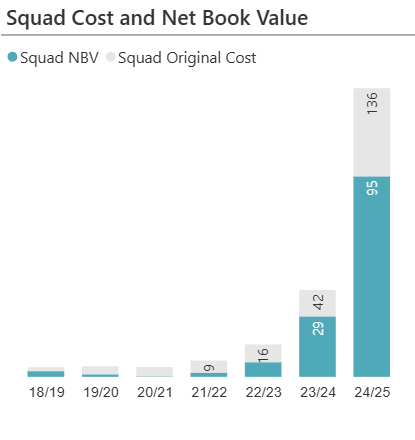
Net Book Value is the total acquisition cost less accumulated amortisation (the write down of the player’s acquisition costs over the length of their contract) and reflects the remaining book value of the squad.
Total Squad Cost is the total acquisition cost of the current squad.
Market Value is the aggregate market value of the squad as estimated by transfermarkt.com.
Value add is the difference between market value and net book value.
The club achieved promotion in 2023/24 despite spending very little on the squad, with no player signed for more than £2 million prior to that success. This again highlights the outstanding job done by the team in securing promotion that season.
Since then, Ipswich have invested more than £130 million in the playing squad. Omari Hutchinson was the first major arrival, joining from Chelsea for around £20 million in a deal recorded in the 2023/24 accounts.
During 2024/25, the club spent a further £113 million on player acquisitions, with Liam Delap, Jaden Philogene, Jack Clarke, Jacob Greaves and Dara O’Shea among the principal signings.
The only significant departure was leading goal scorer Liam Delap, who joined Chelsea at the end of the season for around £28 million.

Ipswich main player acquisition 2024/25.
Dir | Player | Club From | Age | Window | Fee |
IN | Liam Delap | Manchester City | 21 | Summer | £15m |
IN | Jaden Philogene | Aston Villa | 22 | Winter | £20m |
IN | Jack Clarke | Sunderland | 23 | Summer | £15m |
IN | Jacob Greaves | Hull City | 23 | Summer | £15m |
IN | Dara O'Shea | Burnley | 25 | Summer | £12m |
IN | Arijanet Murić | Burnley | 25 | Summer | £8m |
IN | Sammie Szmodics | Blackburn Rovers | 28 | Summer | £9m |
IN | Chiedozie Ogbene | Luton Town | 27 | Summer | £8m |
IN | Conor Townsend | West Brom | 31 | Summer | £500k |
IN | Alex Palmer | West Brom | 28 | Winter | £2m |

Following relegation, the club lost only Liam Delap and Jaden Philogene from their main group of signings, with both players roughly doubling in value within a single season. This enabled Ipswich to reinvest around £50 million following their return to the Championship, with Walle Egeli, Kasey McAteer, Azor Matusiwa, Marcelino Núñez and Darnell Furlong among the arrivals. Matusiwa would later be named the club’s 2025/26 Player of the Season.
The club’s player retention and recruitment strategy was undoubtedly a major factor in securing an immediate return to the Premier League.
Football Net Debt
Football net debt represents the total amount owed by a club. It includes:
Third party loans, such as bank borrowings or other financial institutions.
Related part loans from owners or other related entities (for example, a parent company or directly from the owner). These 'shareholder' loans are often converted to equity at a later date.
Transfer fees owed to other clubs, net of transfer fees receivable as transfer fees are often settled over several years.
Since the takeover in 2020/21, owner funding has primarily been provided through equity injections, meaning the club carries very little debt. The only notable borrowing outstanding was £8.1 million owed to a related party in respect of preference shares.
Following the club’s £130 million investment in players, around £66 million remained payable at the year-end, equivalent to roughly 50% of the original transfer fees.


Cash Flow
Cash Flows are reported in three categories:
Cash Flows from Operations refer to cash generated from the club’s core activities—revenue less day-to-day operating costs.
Cash Flows from Investments includes cash spent on player acquisitions and facility improvements, net of player or asset sales.
Cash Flows from Financing covers new loans or equity raised, less repayments or buybacks. If operational cash flow cannot fund investments, the shortfall is usually met through financing.
The cash flow statement highlights the club’s underlying financial dynamics. Prior to promotion, Ipswich generated moderate operating cash outflows, meaning ongoing losses and investment spending had to be funded through fresh owner injections.
Before 2024/25, this amounted to around £87 million of owner funding. This level of support is significant and ranked third-highest in the Championship at the time of promotion, behind Leeds United and Leicester City.
In 2024/25, however, the club’s relatively low operating cost base enabled it to generate very healthy operating cash inflows of £74 million — the fourth highest in the Premier League, behind only Arsenal, Liverpool and Manchester City.
Even so, this was insufficient to fully cover the club’s £109 million net investment in players and facilities, resulting in a further £45 million of cash funding being provided by the owners during the year.


Reporting Entity
Year | Reporting Entity (link) | Period | Pd. | Majority Owner |
2019/20 | 1st July 2019 - 30th June 2020 | 12 | Marcus Evens Worldwide Holdings | |
2020/21 | 1st July 2020 - 30th June 2021 | 12 | Gamechanger 20 (Limited) | |
2021/22 | 1st July 2021 - 30th June 2022 | 12 | Gamechanger 20 (Limited) | |
2022/23 | 1st July 2022 - 30th June 2023 | 12 | Gamechanger 20 (Limited) | |
2023/24 | 1st July 2023 - 30th June 2024 | 12 | Gamechanger 20 (Limited) | |
2024/25 | 1st July 2024 - 30th June 2025 | 12 | Gamechanger 20 (Limited) |
This report represents Matchday Finance’s interpretation of the club’s published accounts. While every effort has been made to ensure the accuracy and completeness of the information presented, Matchday Finance makes no representations, warranties or guarantees, whether express or implied, as to the accuracy, reliability or completeness of the data. Users should not rely solely on this information for financial, investment or commercial decision-making and should refer to the club’s published accounts for official figures.


Comments