
Blackburn Rovers Financial Results 2023/24

Updated: Aug 10, 2025
Blackburn Rovers narrowly missed out on a play-off spot in the 2024/25 season, finishing seventh. Their campaign was marked by inconsistency, with promising winning streaks often followed by poor runs of form that ultimately cost them a chance at promotion.

The club boasts a proud history, highlighted by their Premier League title triumph in 1994/95. That success was driven by the substantial backing of lifelong supporter and local steel magnate Jack Walker, whose investment enabled the signings such as star striker Alan Shearer and manager Kenny Dalglish.
In 2010, Indian poultry conglomerate VH Group, through its subsidiary Venkys London Limited, purchased the club from the Walker family while Blackburn were still competing in the Premier League, typically finishing mid-table. However, relegation followed in 2012, and since then Blackburn have spent twelve of the past thirteen seasons in the Championship. Despite their long stay, they have never reached the play-offs during this period, with seventh place their highest finish.
Under current ownership led by the Rao family, nearly £200 million has been invested with little tangible return. In recent years, around £12.5 million per season has been injected simply to cover operating losses, with limited spending on player recruitment or infrastructure improvements.
Supporters have grown increasingly frustrated with the lack of progress, though the club has publicly stated that the owners are not considering a sale.
This report reviews Blackburn’s financial results for the 2023/24 season—their most recently published accounts—which marked their sixth consecutive year in the Championship. That campaign ended in a narrow escape from relegation, as they avoided the drop on the final day with a victory away to champions Leicester.

Overview of Blackburn Rovers' Financial Results Season 2023/24
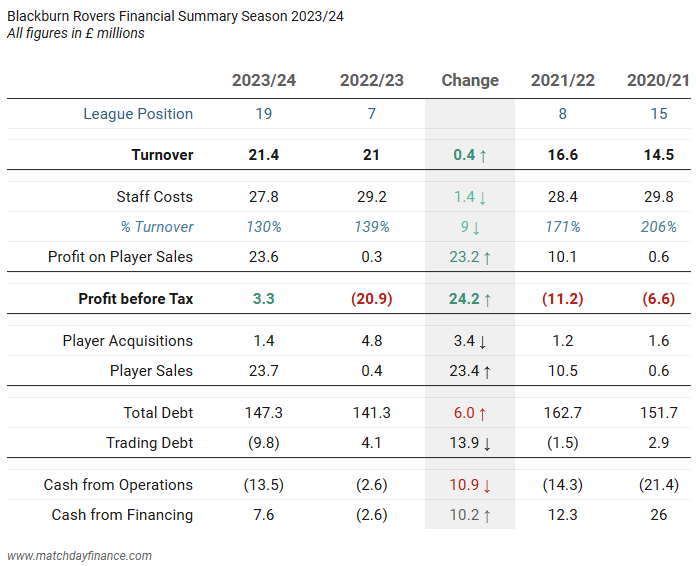
Financially, Blackburn Rovers operate near the lower end of the Championship in both revenue and costs. For the 2023/24 season, the club generated £21 million in revenue—the fifth lowest in the division—with no growth from the prior year. Staff costs stood at £28 million, the seventh lowest in the league and less than a quarter of those of champions Leicester City.
With total operating expenses of £37 million significantly exceeding revenue, Blackburn posted a negative EBITDA (Earnings before Interest, Tax, Depreciation and Amortisation) of £16 million. However, the approximately £20 million profit from the sale of academy graduate Adam Wharton to Crystal Palace allowed the club to record a rare pre-tax profit of £3.3 million—its first since 2011/12 and one of only four Championship clubs to finish in the black.
Financial Highlights for the 2023/24 Season:
Turnover
Revenue increased slightly by 2% to £21.4 million (fifth lowest in the Championship).
Broadcasting income totaled £9.5 million, in line with clubs not receiving Premier League parachute payments.
Matchday revenue fell to £4.9 million, partly due to two fewer cup matches, ranking fifth lowest in the league.
Commercial income rose 13% to £6.9 million.
Staff Costs
Their wage bill held steady at £25 million (eighth lowest in the division).
Amortisation charges declined to £2.2 million (from £3.4 million) due to limited player recruitment.
Combined staff costs, including amortisation, reached £28 million—less than a quarter of Leicester, Southampton, and Leeds, all benefiting from maximum parachute payments.
The club generated £23.6 million in player trading profit, primarily from the sale of academy graduate Adam Wharton to Crystal Palace.
Profitability
Pre-tax profit of £3.3 million, making Blackburn one of only four Championship clubs to report a profit.
Player Trading
The club spent £1.4 million on new signings, including Leo Wahlstedt and Connor O’Riordan.
Player sales generated £23.7 million, primarily from Wharton’s £22 million move to Crystal Palace.
Football Debt
Blackburn carried the second-highest debt in the Championship, with £134 million owed interest-free to parent company Venkys London Limited.
Additional liabilities included a £13 million bank overdraft and £2.3 million owed to other clubs for past signings.
The club was also due £13 million in receivables from transfer instalments (likely relating to Wharton’s sale).
Cash Flow
Operating cash outflow before investment and financing was £13.4 million,.
£2.4 million was spent on player acquisitions and the club received £10.9 million from player sales.
To cover the funding gap, the club increased loans by £7.5 million.
Financial Outlook
While Blackburn’s seventh-place finish in 2024/25 marked an improvement on the pitch, the club’s financial performance is expected to remain largely unchanged. Revenues and operating costs are projected to be similar to the previous season, with player sales once again helping to offset losses. The most notable transaction was the £9 million transfer of 2023/24 top scorer Sammie Szmodics to Ipswich Town. Overall, the club is likely to report a modest pre-tax loss in the region of £5–10 million.
Next Read
For a full breakdown of the EFL Championship’s 2023/24 financial results, check out our recent blog: EFL Championship Financial Results Season 2023/24
Turnover
Commercial revenue grew 13% in season 2023/24 while broadcast and matchday revenue remained flat.

Their total revenue of £21.4 million was the fifth lowest in the Championship,

Matchday Revenue
Matchday revenue is influenced by factors such as the number of home games, average attendance, ticket prices, and the club's ability to generate income from hospitality events and corporate boxes. The only exception to this is domestic cup matches, where revenue is shared between the clubs and the FA.
Blackburn’s home ground, Ewood Park, has a capacity of 31,367. In the 2023/24 season, the club averaged 15,579 fans per league match—just 50% of capacity. While this marked a slight improvement on the previous year, it was still the second-lowest attendance in the Championship, ahead of only Rotherham, and represented the lowest stadium utilization percentage in the division by a significant margin.
Revenue per spectator remained steady at £12.20, consistent with other smaller northern clubs. With two fewer cup matches compared to the prior season, total matchday revenue dipped slightly from £5.1 million to £4.9 million, ranking fifth lowest in the league.

Unsurprisingly, given the stadium is operating at just 50% capacity, there are currently no plans to expand Ewood Park.
.
Broadcast Revenue
For clubs not receiving Premier League parachute payments, broadcast revenue is made up of several components: a share of the Championship’s domestic TV deal (typically worth £3–4 million annually), appearance-based fees that can add £500,000 to £1.5 million depending on how often the club is televised, and a share of international broadcasting rights, which usually contributes an additional £1–2 million.
On top of this, each club receives approximately £5 million in solidarity payments from the Premier League, designed to support clubs in the Championship and lower leagues.
Altogether, these sources typically generate around 9 to £10 million annually for non-parachute clubs—consistent with Blackburn's £9.5 million in broadcast income for the 2023/24 season.
Commercial Revenue
Blackburn’s commercial revenue—which includes income from sponsorships, merchandise sales, hospitality, stadium tours, and other non-matchday activities—increased by 13% in 2023/24, reaching £6.9 million.
In that season, the club’s front-of-shirt sponsor was local vaping company Totally Wicked, which was replaced by regional law firm Watson Ramsbottom for the 2024/25 campaign.
Despite the year-on-year growth, Blackburn’s total commercial revenue of £6.9 million ranked as the seventh lowest in the Championship.

Staff Costs
Blackburn’s player wage bill has remained steady in recent seasons at around £25 million annually. With limited player signings, amortisation—the allocation of transfer fees across player contract terms—has gradually fallen, reaching £2.3 million in 2023/24.

Blackburn’s total staff costs of £28 million ranked seventh lowest in the league. Given their 19th-place finish, this level of spending could be seen as broadly in line with on-pitch performance.
As shown in the chart below, Blackburn’s staff costs were less than a quarter of those of the relegated clubs—Leeds, Leicester, and Southampton—underscoring the significant financial advantage Premier League parachute payments provide.

Profit on Player Sales
Blackburn recorded a £23.6 million profit from player trading, driven mainly by the sale of academy graduate Adam Wharton to Crystal Palace.
The club has a good track record of profitable player sales, with Adam Armstrong in 2021/22 and Sammie Szmodics last season also delivering strong returns.
Profit and Loss
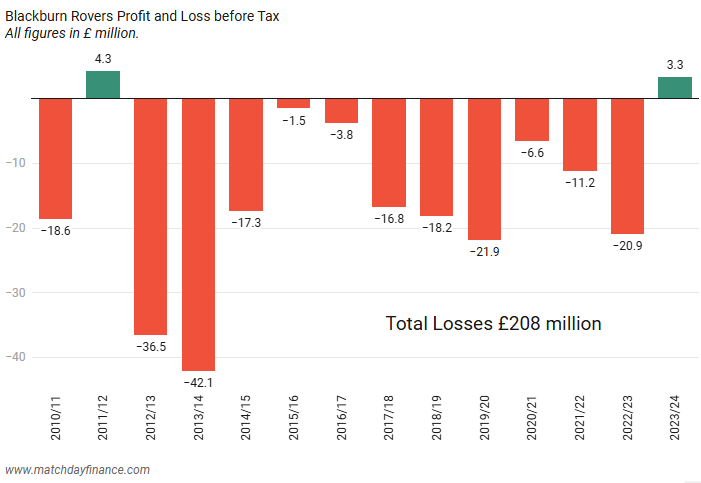
Historically Blackburn generally operates at a loss. Since VH Group’s takeover, the club has accumulated losses of just over £200 million, covered by the parent company through a mix of share issues and loans. The only periods of reduced losses have come in seasons where significant profits were generated from player or asset sales.
Most Championship sides, even those receiving Premier League parachute payments, operate at an operating loss. With average wage bills sitting around £30 million—higher than the revenue many clubs, including Blackburn, generate—achieving profitability is nearly impossible without relying on player sales.
The chart below shows 12 clubs reported salaries in excess of turnover in 2023/24.

For Blackburn, wages of £25.4 million were below the league average but still equated to 119% of turnover. When other operating costs are factored in, the club’s EBITDA (Earnings Before Interest, Tax, Depreciation, and Amortisation) came in at a negative £16.2 million, broadly in line with previous seasons.
Depreciation and amortisation have only a minor impact on Blackburn’s accounts, meaning that profits largely depend on selling players at a gain. This was evident in 2023/24, when Adam Wharton’s move to Crystal Palace contributed most of the £23.6 million in player sales profit, allowing the club to post a £3.3 million pre-tax profit—their first in 12 years.

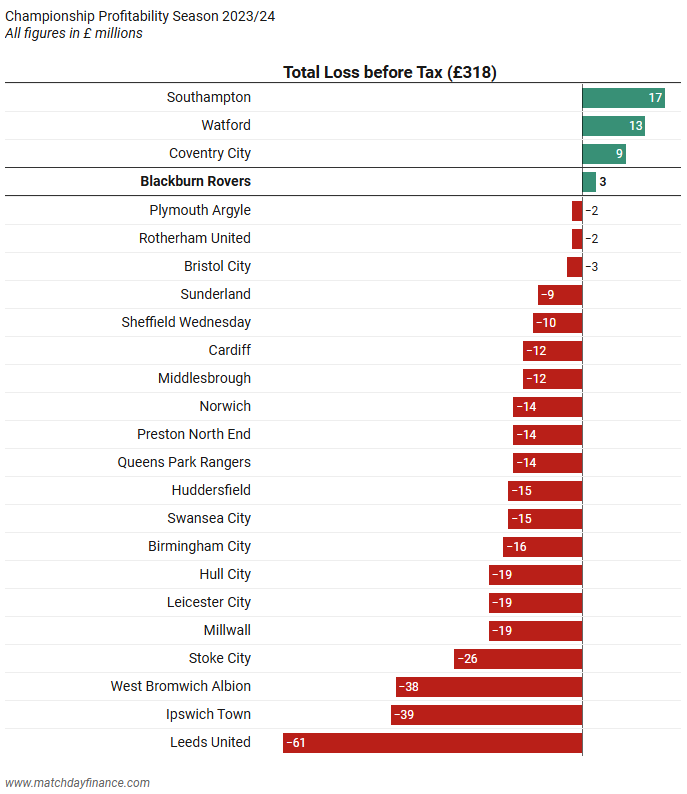
Blackburn were one of just four Championship clubs to report a profit in 2023/24, with all of them relying on player sales to achieve it.
Player Trading
It’s fair to say Blackburn have been relatively quiet in the transfer market in recent years. Over the past five seasons, they’ve spent just £14 million on player acquisitions—one of the lowest totals in the Championship.
During that same period, player sales have generated £38 million, making Blackburn a net seller, which is typical for many clubs at this level.
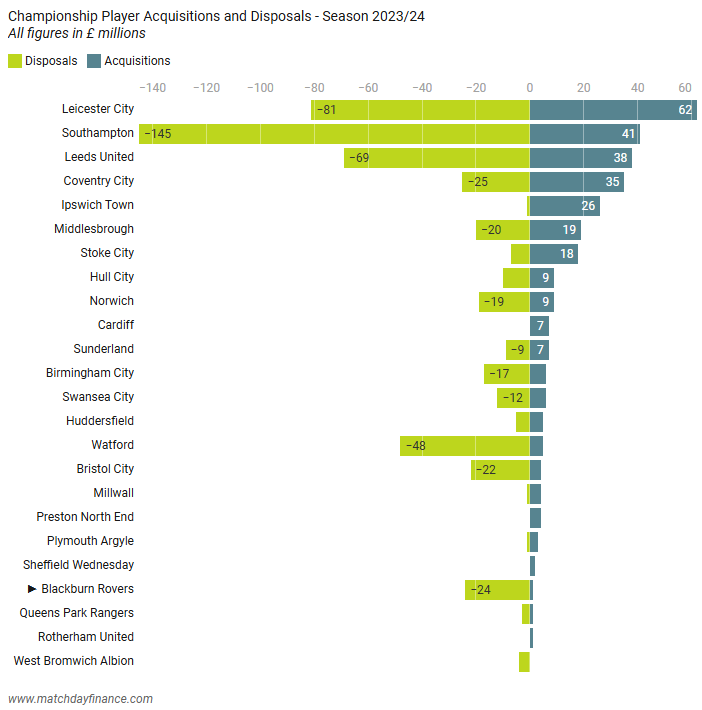
In 2023/24 specifically, the club spent £1.4 million on new signings while bringing in £23.7 million from player sales, the majority of which came from Adam Wharton’s transfer to Crystal Palace.

Blackburn’s £1.4 million spend ranked as the fourth lowest in the Championship.
Player trading remains a crucial element of the financial model at this level, enabling clubs to comply with profitability regulations and highlighting the league’s role as a talent developer. Consequently, the Championship consistently operates as a net seller—Blackburn included.
In 2023/24, Championship clubs collectively posted a net transfer outflow of £209 million, with all three relegated sides making major sales. Southampton alone generated an impressive £145 million from player departures.
After securing their Championship status at the end of the 2023/24 season, Blackburn sold their top scorer, Sammie Szmodics, to Ipswich for £9 million.
Football Net Debt
Debt remains a key source of funding for Championship clubs. By the end of the 2023/24 season, total debt across the league had reached £1.56 billion—equivalent to 163% of total turnover. This marked an increase of £250 million over the year, largely driven by changes in club makeup, with Leicester, Southampton, and Leeds contributing significantly due to their sizeable existing loans. Notably, around 75% of this debt consists of loans from related parties.
By the end of the season, Blackburn’s total debt had reached £147 million, comprising £134 million owed to the parent company and £13 million in bank loans—the second highest debt level in the Championship.
The debt to parent company Venkys London Limited carries no interest and has no fixed repayment date.

Largely due to Adam Wharton’s sale, the club has £12.2 million in outstanding transfer instalments owed, while owing £2.8 million for previous player signings.
Cash Flow
The club has long depended heavily on financial backing from its owners. Since acquiring Blackburn in 2010, they’ve invested around £200 million directly into the club, in addition to the initial purchase price. Of that amount, £20 million was used to clear existing debt at acquisition, with the remainder provided as loans—£54 million of which has since been converted into equity.
Unfortunately for Blackburn, much of this investment has simply covered ongoing operating losses. Since 2010, the club has spent £75 million on player acquisitions but generated £88 million from player sales, resulting in a positive net cash flow of £13 million from trading players. Meanwhile, just £6 million has been invested into facilities.
Given that the club was a mid-table Premier League side when purchased and has made little progress since, it’s understandable why supporters feel frustrated.
In 2023/24, Blackburn posted negative operating cash flow of £13.5 million. They spent £2.4 million on new players and £0.3 million on facility improvements while earning £10.9 million from player sales, producing a net investment cash inflow of £8.2 million.
To bridge the remaining funding gap, the club raised an additional £7.5 million in borrowings, with the balance covered by existing cash reserves.
More broadly, Blackburn are not alone in their financial challenges. In 2023/24, no Championship club reported positive operating cash flow. Across the division, total operating outflows reached £422 million, with a further £36 million in investment outflows. These were largely financed through £417 million in new funding and £41 million drawn from cash reserves.


Comments